

Luxury Rehab Center: What the Price Actually Buys
In brief: “Luxury rehab” is doing two jobs at once, and only one of them is honest. This page separates them. I will tell you what the price actually buys, what the four things are that change outcomes, what a week here looks like, what the research says about every therapy in the program, what it costs and why, and what I will not promise. I built this facility after living the alternative, and I would rather you leave this page knowing exactly how to compare us against anyone else than leave it sold.
Why I Built a Luxury Rehab Center
I did not build Holistic Sanctuary because I saw a market. I built it because I had been the product. Seventeen programs, over roughly twenty years, most of them expensive, several of them beautiful — and every one of them handed me back to my life medicated, managed and no closer to well. Somewhere in that stretch the question that runs this facility took shape: why does the system meant to help people so often send them home worse than it found them?
Luxury was part of the problem. I watched money buy a better room and the same twenty-eight-day program, the same group circle, the same discharge. The suite was real. The care underneath it was interchangeable. So when I finally had the means to build something, the question was never how to make it more comfortable. It was how to make the comfort sit on top of care that was actually different: one-to-one, physician-led, long enough to finish, and built around one person at a time.
We opened in 2011, four and a half years after I started raising the money. More than 1,000 clients have come through since, and I say that carefully: it is a count, not a success rate, and I will never dress it up as one. I have personally overseen more than 5,000 medically supervised ceremonies in that time. None of it is a guarantee about you. It is fifteen years of staying in the building while this work happened, which is the only reason I can tell you in detail what the price actually buys here.
What “Luxury” Actually Buys, and What It Does Not
The word is doing two jobs at once, and only one of them is honest.
The first job is describing the room. Private suite instead of a shared ward, a chef instead of a canteen, linen that does not announce that you are in an institution. That is real, it is worth paying for, and nobody should apologize for wanting it. Recovery is hard enough without fluorescent lighting and a roommate you did not choose.
The second job is implying that comfort is clinical. It is not. A better mattress does not repair a receptor. An oceanfront view does not shorten a benzodiazepine taper. When a luxury rehab center’s marketing spends more words on the infinity pool than on who is awake at three in the morning, that is a decision about priorities, and it tells you what you are actually buying.
The distinction matters because the two things are priced together and disclosed separately. A facility can charge premium rates for the accommodation while running the same group-based, one-size curriculum as a facility charging a fifth as much. The room is different. The treatment is identical. That is the most common thing wrong with this category, and it is almost never visible from the website.
Here is the test we would apply to anyone, including ourselves: ask what changes clinically because of the price. If the honest answer is “nothing, the room is nicer,” that is a legitimate product — it is a hotel with clinical supervision, and for some people that is exactly right. If the answer includes staffing ratio, physician availability, length of stay set by assessment rather than by package, and individualized protocols, then the premium is buying something that could plausibly affect the outcome.
The Four Things That Actually Change Outcomes
Strip away the photography and four variables account for most of the difference between one residential program and another. None of them are aesthetic.
Staffing ratio
This single number explains more of the price difference between centers than anything else, and it is the number most often withheld. A program running one clinician to twelve guests has a fundamentally different economic model from one running one to one, and no amount of interior design closes that gap. Here the ratio is three to five guests in residence, with three to five nurses on every shift and a physician directing care. A facility that will not put a number to this has answered the question.
Medical depth
“Physician-supervised” is not a regulated phrase. It can mean a doctor who signs off on admissions remotely and visits weekly, or it can mean bloodwork, cardiac review, medication reconciliation, and a supervised taper whose rate is adjusted against repeat labs. Ask which. Ask whether clinical staff are physically present overnight or on call from elsewhere, because withdrawal does not keep office hours.
Whether the plan is built or applied
Most residential programs have one method and fit every guest to it. The alternative is to assess first and build from what the assessment found. The difference shows up in a specific way: in a fitted program, the length of stay is known before you arrive. In a built one, it cannot be, because the taper and the labs set it. If a luxury treatment center quotes you a fixed number of days before it has seen your bloodwork, it is selling a package.
What happens after
The period after discharge carries the highest risk in almost every condition treated in residential care. Ask what the aftercare schedule is, who delivers it, and on what cadence — and whether it is included or sold separately. A program whose answer is “we will check in” has not planned for the part that decides the outcome.
Luxury Recovery Center, Luxury Treatment Center, Luxury Rehab Center: The Words, Decoded
People search all three, and the industry uses them interchangeably, but they carry different connotations and it is worth knowing which one you actually want.
| Term | What it usually signals | What to verify |
|---|---|---|
| Luxury rehab center | Residential addiction treatment with premium accommodation. The most common term, and the broadest. | Whether there is real medical capability behind the word, or hospitality with a clinical veneer. |
| Luxury recovery center | Often used by programs emphasising the phase after acute treatment — integration, sober living, aftercare. | Whether detox and withdrawal management happen on site, or are referred out before you arrive. |
| Luxury treatment center | Broader than addiction. Frequently used by facilities also treating depression, anxiety, trauma and eating disorders. | Whether the psychiatric capability is real, or the addiction program with different labeling. |
| Luxury rehabilitation center | The most formal register. Sometimes used by medical rehabilitation facilities that have nothing to do with addiction. | That you are looking at behavioral health and not physical rehabilitation. |
The practical advice: the label tells you very little. Two facilities using identical language can differ by a factor of ten in staffing. Read past the noun to the four variables above.
“The Most Luxurious Rehab in the World” — An Honest Answer
It is a real search, and it deserves a real answer rather than a claim.
No credible facility can hold that title, because there is no body that awards it and no metric that would settle it. What people are usually asking is narrower and more answerable: where is the ceiling, and what does the ceiling actually consist of?
At the top of this category you are looking at a small number of facilities, worldwide, that combine four things: single-digit guest numbers, medical staff physically present around the clock, therapy delivered one-to-one rather than in groups, and accommodation of a standard you would otherwise find in a private resort. There are perhaps a few dozen such places globally. Prices run from roughly forty thousand to well over a hundred thousand dollars per month, and the spread within that range is explained more by staffing and length than by thread count.
What the ceiling does not include, anywhere, at any price: a guaranteed outcome. Any facility presenting itself as the most luxurious in the world while also promising you a cure has told you which of the two claims to distrust.

The Staffing Ratio Question, In Detail
If you ask only one question, ask this one.
Group treatment is the economic engine of the residential industry, and it is not illegitimate — one clinician working with twelve people costs a twelfth as much per guest as one working with one, and for a great many people the group is genuinely where the work happens. Shared experience does something that a one-to-one room cannot.
It fails a specific population, though, and predictably. It fails anyone whose condition is organized around comparison, because a room full of other people’s stories becomes raw material for measuring yourself. It fails anyone whose professional life makes disclosure to a room of strangers a genuine risk rather than an emotional hurdle. And it fails anyone whose presentation is unusual enough that a curriculum built for the median does not reach them.
If you are in one of those groups, the ratio is not a comfort question. It is the treatment.
What “Physician-Supervised” Should Mean
Ask for specifics, and notice whether they are given freely.
Before admission: a medical history, a full medication reconciliation, laboratory work, and cardiac screening where the presentation or the medication list calls for it. A psychological assessment that is conducted rather than mailed.
During withdrawal: vital signs on a schedule appropriate to the substance, not to the calendar. Nursing cover physically present overnight. A physician who can be at the bedside, not just on the phone. Repeat bloodwork, because the point of measuring is to see whether something is changing.
Throughout the stay: a taper rate that is adjusted against those labs rather than against a discharge date. This is the point at which a good program will disappoint you: if the taper needs longer, the stay needs longer, and a facility that lets a guest’s impatience set the rate is not supervising anything.
At discharge: a written plan, a named person responsible for it, and a schedule that starts before you leave rather than after you relapse.
What a Luxury Detox Actually Involves
People search for a luxury detox near them, and the honest response is that geography should be about the fourth consideration, not the first.
Detox — withdrawal management, properly — is a medical process with a narrow set of genuine dangers. Alcohol and benzodiazepine withdrawal can be fatal without supervision. Opioid withdrawal is rarely fatal but is severe enough that people leave against advice and return to a tolerance that has dropped, which is where overdose happens. These are the facts that should drive where you go, and they favor capability over proximity every time.
What the “luxury” part legitimately changes: privacy during a period most people would rather nobody witnessed, a private room instead of a shared detox ward, food you can actually keep down, and a ratio that means someone notices when you are struggling at four in the morning rather than at the next scheduled round.
What it does not change: the pharmacology. The timeline is set by the substance, the dose, the duration of use and your own physiology. Anyone offering to compress that with a proprietary method is describing rapid detox, which carries its own well-documented risks and which we do not offer.
And the part that matters most: detox is not treatment. It is the medical process that makes treatment possible. A program that presents withdrawal management as the destination has sold you the first week of a much longer piece of work.

One-to-One and Group: Why the Model Outranks the Marble
The program here is one guest at a time. Every therapy hour is private. There is no circle, no shared identity built around a substance, and no requirement to introduce yourself by your diagnosis for the rest of your life.
That is a real choice with real trade-offs, and the trade-off is worth naming. Group work offers something individual work cannot: the specific relief of discovering that your experience is not unique, delivered by someone who has lived it rather than studied it. Twelve-step fellowship has kept more people well than any residential program in history, and we say so plainly.
What one-to-one offers instead is precision and privacy. The hour is about you. Nothing is generalised to fit a room. Nobody who could recognize you professionally is sitting three chairs away. For a particular kind of guest — the surgeon, the founder, the person whose name is searchable — that is not a preference. It is the condition under which treatment can happen at all.
What a Week Actually Looks Like
Descriptions of luxury rehab centers tend to list amenities without ever saying what a day contains. The list is the least useful part. What determines whether a program works is how the hours are arranged, who is in the room, and what happens on the days a guest does not want to participate.
Mornings are the clinical part of the day. Vital signs, any scheduled intravenous protocol, and the sessions that need a guest rested rather than reflective. Where a supervised taper is running, the morning review is when its rate is set. Pressure from a guest who wants to move faster is precisely what the schedule exists to absorb.
Middays are physical. Movement, bodywork, daylight, and food built around the deficiencies the labs actually found rather than around a philosophy of eating. This is the least photogenic part of a program and one of the more reliable.
Afternoons hold the psychological work, one-to-one, with the same practitioner across the stay. Continuity is not a hospitality detail. A guest who re-explains their history to a rotating roster never gets past the summary of it.
Evenings are deliberately unstructured, and that is a clinical decision rather than an absence of programming. Recovery of sleep architecture is among the clearer signals that the rest of the work is landing, and it does not happen on a schedule that runs until nine at night.
No two weeks are identical, because no two intake assessments are. What is described here is the shape of a week, not a timetable anyone is handed on arrival.
What Each Therapy Actually Does — and What the Research Actually Shows
I built this section because I’m tired of watching this industry either oversell every therapy as a miracle or say nothing real about any of them. Below is what the published research says about each modality in this program — general findings from clinical and scientific literature, not claims about outcomes at this facility or for any individual guest. Where the evidence is strong, I say so. Where it’s early or mixed, I say that too.
Hyperbaric Oxygen Therapy (HBOT)
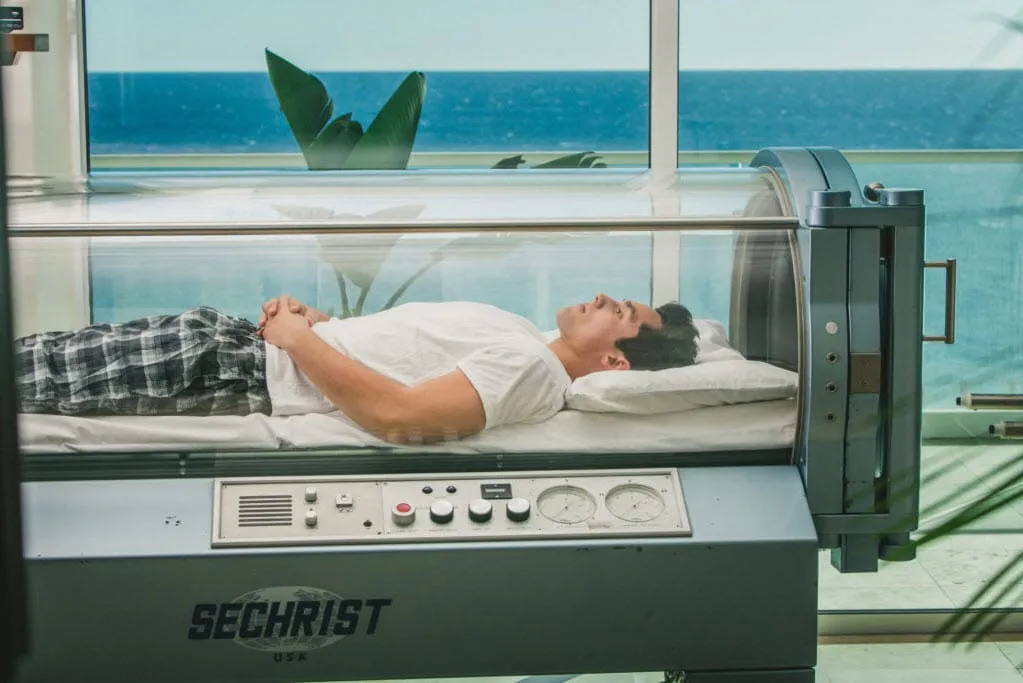
HBOT increases the amount of oxygen dissolved in blood plasma by having a person breathe oxygen at elevated atmospheric pressure. A 2024 review in Frontiers in Neurology describes how this process can promote mitochondrial function, new blood vessel growth, and reduced inflammatory signaling (lower TNF-α and IL-6) in nervous system tissue, with researchers reporting associated improvements in cognitive function, recovery from traumatic brain injury and post-concussion syndrome, and symptom reduction in PTSD and fibromyalgia in the populations studied. A separate 2024 meta-analysis of randomized controlled trials found measurable cognitive improvements in people with Alzheimer’s disease. HBOT is FDA-cleared for a specific list of conditions — wound healing, decompression sickness and carbon monoxide poisoning among them — and its use for neurological and psychiatric conditions remains an active area of research rather than an approved indication. At Holistic Sanctuary, it is offered as a supportive therapy within a broader protocol, not as a treatment for any diagnosis on its own.
Red Light Therapy and Infrared Sauna
Red and near-infrared light in the 600–1,100 nanometer range is absorbed by an enzyme called cytochrome c oxidase inside mitochondria, increasing cellular ATP production — a mechanism reviewed extensively by Harvard-affiliated researcher Michael Hamblin. This is the basis for red light therapy’s documented effects on collagen production, wound healing and inflammation at the cellular level. Infrared sauna use operates differently, through heat: a study published in JAMA Internal Medicine associated frequent sauna use with reduced cardiovascular risk, and infrared heat exposure has been shown to activate heat shock proteins involved in cellular repair and to promote sweat-based excretion of certain heavy metals and organic compounds. Both are offered here as restorative, supportive therapies — not as treatments for any specific disease. As with HBOT, I would rather tell you plainly that they are supportive than let a device carry a claim it cannot support.
Therapeutic Massage
A widely cited review by Tiffany Field and colleagues, published in the International Journal of Neuroscience, found that massage therapy was associated with an average 31% decrease in cortisol and increases of 28% in serotonin and 31% in dopamine across a range of populations and conditions, including stress, pain and mood-related studies. Massage is included in this program as bodywork that supports the nervous system during an intensive period of change — not as a treatment for any underlying condition.
Yoga and Meditation
A systematic review in Health Psychology Review examined the mechanisms by which yoga reduces stress and found consistent evidence for effects on cortisol, inflammatory markers (IL-6, C-reactive protein) and psychological measures including self-compassion and positive affect. A separate controlled study of medical students found a statistically significant reduction in perceived stress after six weeks of yoga and meditation practice. These practices are part of daily life here because the evidence for their effect on stress physiology is genuinely strong — not because we present them as a cure for anything.
NAD+ IV Therapy and Amino Acid Support
NAD+ (nicotinamide adenine dinucleotide) is a coenzyme every cell in the body requires for energy metabolism, and levels are known to decline with age and with chronic substance use. Intravenous NAD+ and amino acid infusions are used here to support the body’s own restorative processes during a period of significant physical demand. This is an area where clinical research is still developing, and we do not claim these infusions treat any specific condition — they are offered as nutritional and metabolic support alongside the rest of your protocol.
The Brain Repair IV Protocol
The Brain Repair IV Drip is a proprietary formulation I developed myself, incorporating amino acids, peptides and a nature-derived alkaloid. It is one component of a comprehensive, individualized protocol, intended to support the body and brain during the recovery process rather than presented as a guaranteed cure or a replacement for individualized medical care. The formulation, administration sequence and available evidence are documented separately on our Brain Repair IV Protocol page.
Medically Supervised Plant Medicine
Where clinically appropriate and medically cleared through cardiac and blood screening, your protocol may include ceremonial work with ibogaine, ayahuasca or other plant medicines — always screened, always supervised by our medical team, and always followed by structured integration time. These are compounds with centuries of traditional use and a growing body of modern clinical research; they are also serious medical undertakings, which is exactly why the screening described below exists.
Organic Nutrition and Cleansing Protocols
The nutritional program is built around what your body specifically needs to rebuild during detoxification and restoration — not a generic cleanse. Real, whole-food nutrition supporting liver function and cellular repair is foundational to every other therapy in this program; a depleted body cannot make full use of any of the modalities above it.
The Screening Behind All of It
None of the above happens without real medical screening, continued throughout your stay: blood pressure, bloodwork, EKG, stress test, echocardiogram, and 24-hour nursing. This is the credible substitute for any absolute promise of safety, and it’s why the pace of a Platinum program is set by what your body can safely do — not by a calendar.
The Accommodation Question
Worth being direct about, because most of this category is not.
A private oceanfront suite costs more to build, staff and maintain than a shared room. That difference buys privacy, quiet, dignity and sleep. Those things are not nothing — sleep in particular is measurably load-bearing in recovery, and a guest who is not sleeping is a guest whose treatment is being undermined nightly.
What it does not buy is a clinical outcome, and we are not going to imply otherwise in order to justify a price. When a facility’s photography is doing the persuading, look at what the photography is standing in for.
The right way to think about it: accommodation is the floor, not the ceiling. It should be good enough that it is not a source of stress. Beyond that point, additional luxury is a preference you are entitled to have and should not be sold as medicine.

Cost, and What Actually Drives the Number
Prices across luxury rehab facilities run from roughly twenty thousand to well over a hundred thousand dollars per month, and four factors explain most of the variation. Quality of care is not directly one of them, which is why the number alone tells you very little.
Staffing ratio. The dominant factor. One clinician per guest costs several times more per day to deliver than one clinician per twelve.
Medical cover. Whether clinical staff are physically present overnight or reachable by phone. This is a payroll line, and it is a large one.
Length of stay. Set by the taper and the labs rather than by a package. Someone coming off a long-term benzodiazepine prescription cannot be compressed into the same calendar as someone who is not, and any quote that ignores this is a quote that will change.
Accommodation. Real, legitimate, and the one component that should never be presented as a clinical claim.
What should be true regardless of the figure: it is itemised before arrival, the things that could extend a stay are named in advance, and nobody is quoted a number that depends on how the first week goes.
Insurance, Honestly
Most luxury rehab centers are out-of-network, and many are not covered at all. Some guests recover a portion through out-of-network benefits or a superbill submitted after the fact; many recover nothing. Coverage depends on the policy, the diagnosis, the documented medical necessity and the jurisdiction, and none of those can be assessed from a website.
Our position is simply stated: we will tell you what we can document and what we cannot, and we will not imply coverage that we cannot substantiate in order to keep an inquiry alive. A facility that answers “we work with all major insurers” without looking at your policy has told you something about how it operates.
Who This Program Is Built For
Admission is a medical decision before it is anything else. For some people the honest answer is not yet — and we will say so. That is not a filter for difficulty. It is a judgment about whether this is the right setting.
We are not the right fit where a presentation needs a hospital rather than a residential setting: acute medical instability, an active psychiatric emergency, or a withdrawal risk profile that belongs under inpatient monitoring. We are not the right fit where a condition would be better served by a level of care we do not provide, and we say which one. We are not the right fit where someone is being sent by a family rather than arriving by their own decision, because a residential program cannot manufacture consent and the outcomes when it tries are poor.
For a proportion of inquiries the assessment concludes that this is the wrong setting entirely, and that conversation happens on day one rather than in week three.
What Brought Me to This Work
I am not a physician, and I have never presented myself as one. I don’t diagnose and I don’t prescribe. What I do is design the protocol, lead the healing side of this work, and stay personally involved in every case at this facility. In fifteen years of operation there has been no guest death at this facility. I state that once, plainly, because it’s true and because it is the direct result of the screening and staffing decisions on this page — never as a guarantee about your own outcome, which no honest program can offer anyone.
Why We Don’t Have Outside Trial Data — and Why That’s a Real Trade-Off
We are independently funded. We take no government, institutional or pharmaceutical money, and I have made a deliberate choice not to license this protocol to outside researchers. I make that choice with full awareness of what it costs: the kind of third-party clinical trial data that larger, funded programs can point to. I’d rather be honest about that trade-off than pretend it doesn’t exist. What I can offer instead is fifteen years of doing this work openly, under our own name, and a founder who is still in the building.
What We Will Not Promise
We will not promise a cure, a guaranteed outcome, or a fixed number of days.
We do not publish success statistics, because we cannot substantiate them and neither can anyone else in this industry. The figures you see quoted on competitor sites are, without exception, either unaudited internal numbers or marketing artefacts. When a facility advertises a percentage, ask who measured it, over what window, with what definition of success, and what happened to the people who did not respond.
We will not tell you that plant medicine is appropriate for every presentation, because it is not, and for some it is contraindicated.
And we will say plainly that for many people a different level of care is the better clinical choice, including levels we do not offer.
How to Compare Any Two Luxury Rehab Centers
Take this to every one of the luxury rehab facilities you speak with, including this one, and compare the answers rather than the brochures.
- How many guests are in residence, and how many clinical staff per shift? Ask for numbers. Reluctance to state them is itself the answer.
- Is therapy delivered individually or in groups, and how many hours of each per week? “Individual therapy available” and “every therapy hour is individual” are different products at similar prices.
- Who supervises withdrawal, what is their credential, and are they on site overnight?
- Who sets the length of stay, and what would extend it?
- What is measured during the stay, how often, and what does a non-response trigger?
- What does the fee include, itemised, and what is billed separately?
- What happens in week six, after discharge? Who delivers it and is it included?
- What will you not treat, and who do you refer out? A facility that claims to treat everything treats nothing especially well.
The answers matter. Whether the questions are welcome matters more.
Traveling for Treatment: What Guests From the United States Should Know
Most of the people who come here travel to do it, and the majority arrive from the United States — California, New York, Texas and Florida account for the bulk. Traveling for treatment is a real decision with real logistics, and it is worth setting them out plainly rather than pretending distance is not a factor.
Why people travel. Two reasons dominate, and neither is price. The first is privacy: leaving the state, or the country, removes the possibility of being recognized in a waiting room by someone from your industry. The second is that the specific model people are looking for — one guest at a time, medically supervised, without a group curriculum — exists in very few places, so the search naturally becomes a search across geography rather than within a city.
What to sort before you fly. Bring a current medication list and recent bloodwork if you have it; it shortens the assessment. Do not stop or taper anything on your own before traveling — that is the single most common avoidable problem, and the taper is a supervised process that begins after assessment, not before departure. Understand that a supervised withdrawal cannot be started and abandoned mid-course, so the return date should have slack in it.
What to tell work. Most guests take medical leave without specifying the condition, which is generally sufficient and generally private. If your role has disclosure obligations — clinical licensure, aviation, some financial roles — that is a conversation to have with your own counsel before you travel, not after you arrive.
Family. Visits are possible and are planned into the stay rather than improvised. Where family dynamics are part of what is being treated, that involvement is structured deliberately.
We will not pretend that travel suits everyone. If you need to remain within driving distance of your children, your job or an outpatient team you already trust, that is a legitimate constraint and it points to a different answer. We would rather say so than sell you a flight.
What a Luxury Treatment Center Should Be Able to Treat
The breadth a facility claims is worth examining, because in this category it is often aspirational.
The work here is built around substance dependence — alcohol, opioids including OxyContin and heroin, benzodiazepines, stimulants — and around the conditions that so often sit underneath it: trauma, post-traumatic stress, depression, anxiety, and the behavioral patterns that develop alongside them. Care is individualized, which is a phrase used loosely across this industry and which we mean literally: no two plans here are the same, because no two intake assessments are.
What that does not mean is that every guest receives every therapy on the list. A modality is offered where the assessment indicates it and withheld where it does not, and a program that gives everyone the same protocol regardless of findings is not individualising anything.
Where a presentation needs a level of care we do not provide — acute psychiatric inpatient care, medically complex hospitalization, or specialist eating disorder refeeding under continuous monitoring — we say so and refer. The list of what a facility declines is a more useful document than the list of what it advertises.

The First Forty-Eight Hours
The part almost nobody describes, and the part most guests are anxious about.
Arrival is deliberately unhurried. Nothing clinical of consequence happens in the first hours beyond vitals, hydration, food and sleep, because a guest who has just traveled is not in a state to make decisions or absorb a plan.
The assessment runs across the first day: medical history, medication reconciliation, laboratory work, cardiac screening where indicated, and a psychological assessment conducted in person. Where withdrawal management is needed it begins under supervision once that picture is complete — not before, and not on a schedule set by anything other than the findings.
The plan is presented on day two, in person, with the reasoning shown. Guests are told what is proposed, why, what the alternatives were, and what would change it. For a proportion of people the assessment concludes that this is the wrong setting, and that conversation happens then rather than in week three.
Withdrawal, where it applies, is the hardest stretch and it is not glamorous. Sleep is disrupted, appetite is unreliable, and mood is poor. Anyone describing this phase as comfortable is describing a brochure.
Why Aftercare Decides the Outcome
If residential treatment is the part people ask about, aftercare is the part that determines whether anything holds.
The risk profile is counterintuitive. The dangerous period is not the stay; it is the weeks after it, when structure disappears, tolerance has dropped, and the environment that produced the problem is waiting unchanged. In opioid dependence specifically, reduced tolerance after a period of abstinence is a well-documented overdose risk, which is why discharge planning here begins in week one rather than week four.
What a real aftercare plan contains: a schedule with dates rather than an open invitation, a named person responsible for delivering it, a defined cadence of contact that does not depend on the guest reaching out during a bad week, and an explicit plan for the environment — the household, the workload, the relationships — that a guest is returning to.
National guidance is unambiguous that duration matters. The National Institute on Drug Abuse’s research-based guide states that remaining in treatment for an adequate period of time is critical, and that most people need at least three months to significantly reduce or stop substance use.1 Most of that window falls after residential discharge, which is precisely why the plan for it cannot be an afterthought.
Why Affluent Guests Often End Up in the Wrong Program
A pattern worth naming, because it is expensive in both senses.
Money removes the constraint that normally forces a careful choice. Someone without resources compares two options within driving distance and reads both closely. Someone with resources is presented with twenty beautiful websites, chooses on photography and reputation, and arrives at a facility whose clinical model is identical to the one down the road at a fifth of the price.
The second pattern is repetition. A guest completes a premium program, relapses within months, and concludes that they need a more expensive version of the same thing. Frequently the problem was never the standard of the accommodation — it was that a group-based curriculum was the wrong instrument, or that the taper was compressed to fit a package, or that there was no aftercare at all.
The third is deference. Facilities serving high-net-worth guests are commercially reluctant to say no, to extend a stay against a guest’s wishes, or to enforce a taper rate that a paying guest finds frustrating. A program that will not disappoint you is not treating you.
Frequently Asked Questions
What actually makes a rehab “luxury”?
Officially nothing — the term is unregulated and any facility may use it. In practice it signals private accommodation, higher staffing, chef-prepared food and a resort-standard setting. The distinction that matters is whether the premium buys anything clinical: staffing ratio, medical cover overnight, individualized protocols, and a length of stay set by assessment rather than by package.
How much does a luxury rehab center cost?
Across the category, roughly twenty thousand to well over a hundred thousand dollars per month. Four things explain most of the variation: staffing ratio, whether clinical staff are physically present overnight, length of stay as set by the taper and the laboratory findings, and accommodation. Ask for the figure itemised before arrival, and ask what could extend the stay.
What is the difference between a luxury rehab center, a luxury recovery center and a luxury treatment center?
Mostly marketing register rather than substance. “Rehab center” is the broadest and most common. “Recovery center” often signals emphasis on the phase after acute treatment. “Treatment center” is frequently used by facilities also treating depression, anxiety and trauma rather than addiction alone. Two facilities using identical language can differ by a factor of ten in staffing, so read past the label.
Does luxury rehab work better than standard rehab?
Not because of the accommodation. Comfort, privacy and protected sleep genuinely help and should not be dismissed, but they are not the mechanism. What plausibly changes outcomes is staffing ratio, medical depth, whether the plan is built from an assessment, and what aftercare exists. A premium facility scoring poorly on those four is a nicer room around the same treatment.
What is the most luxurious rehab in the world?
No credible facility can claim the title, because no body awards it and no metric would settle it. At the top of the category sit a small number of programs worldwide combining single-digit guest numbers, medical staff present around the clock, one-to-one therapy rather than groups, and resort-standard accommodation. Be wary of any facility claiming the superlative while also promising an outcome.
How do I find a luxury detox center near me?
Proximity should be roughly the fourth consideration rather than the first. Alcohol and benzodiazepine withdrawal can be fatal without supervision, and opioid withdrawal carries a post-abstinence overdose risk, so capability matters more than distance. Ask who supervises withdrawal, what their credential is, whether they are on site overnight, and what happens after detox ends — because detox is not treatment, it is what makes treatment possible.
Do you accept insurance?
We are out-of-network. Some guests recover a portion through out-of-network benefits or a superbill submitted afterwards; many recover nothing. Coverage depends on your policy, diagnosis, documented medical necessity and jurisdiction. We will tell you what we can document and what we cannot, and we will not imply coverage we cannot substantiate.
How long will I stay?
Long enough that the taper and the laboratory findings decide it rather than a package. National guidance is that most people need at least three months of treatment overall to significantly reduce or stop substance use, though much of that window is aftercare rather than residential. A facility quoting a fixed number of days before seeing your bloodwork is quoting a product, not a plan.
Is there group therapy?
Not here. Every therapy hour is one-to-one, with the same practitioner across the stay. That is a deliberate choice with a real trade-off: group work offers the specific relief of shared experience, and for many people it is where recovery happens. One-to-one offers precision and privacy instead, which matters most for guests whose professional life makes disclosure a genuine risk.
What conditions do you treat?
Substance dependence — alcohol, opioids, benzodiazepines, stimulants — and the conditions that frequently sit underneath it, including trauma, post-traumatic stress, depression and anxiety. Care is individualized, which means a modality is offered where the assessment indicates it and withheld where it does not. Not every guest receives every therapy.
Who is not accepted?
We are not the right fit where a presentation needs a hospital rather than a residential setting — acute medical instability, an active psychiatric emergency, or a withdrawal risk profile requiring inpatient monitoring. We also say so where someone is being sent by their family rather than arriving by their own decision. The list of what a facility declines is more informative than the list of what it advertises.
Can I keep working during treatment?
Limited, scheduled contact can usually be accommodated once the acute phase has passed, and for some guests that is the difference between coming and not coming. Attempting to run a full workload through residential treatment is not, in our experience, compatible with the work — particularly during withdrawal, when concentration and judgment are measurably affected.
What should I ask before choosing any facility?
How many guests are in residence and how many clinical staff per shift; whether therapy is individual or group and how many hours of each; who supervises withdrawal and whether they are on site overnight; who sets the length of stay and what would extend it; what is measured and how often; what the fee includes, itemised; and what happens after discharge. The answers matter, and whether the questions are welcome matters more.
Where are you located?
On the Pacific oceanfront in Baja California, Mexico — a private facility licensed for the therapies described on this page, which is what allows plant medicine to be administered lawfully under physician supervision. The majority of our guests travel from the United States, and travel logistics are planned with you before arrival.