
Benzodiazepine Detox for Swiss Residents

Last reviewed
3 September 2026
Johnny Tabaie is not a physician and does not practice medicine. He is the founder of Holistic Sanctuary and the creator of the Pouyan Method; every clinical statement on this page is reviewed by Dr. Jimenez before it publishes.
In brief: Swiss law lets you carry thirty days of your own prescription out of the country. A taper worth doing takes longer than that — which is why the prescribing, the dispensing and the supervision have to happen in one place. This page is for the person weighing benzodiazepine detox in Switzerland against a program abroad. I built the program described here after living the alternative, and I will tell you exactly what the thirty-day rule means for you, what your insurance will and will not do, what we actually do across four to twelve weeks, what the research says about each therapy we use, and where the evidence stops. It is not a promise of a cure.
Anyone weighing benzodiazepine detox Switzerland against a program abroad runs into a problem that has nothing to do with medicine and everything to do with customs law: you are not permitted to carry more than thirty days of your own prescription out of the country. That single rule decides the shape of everything that follows.
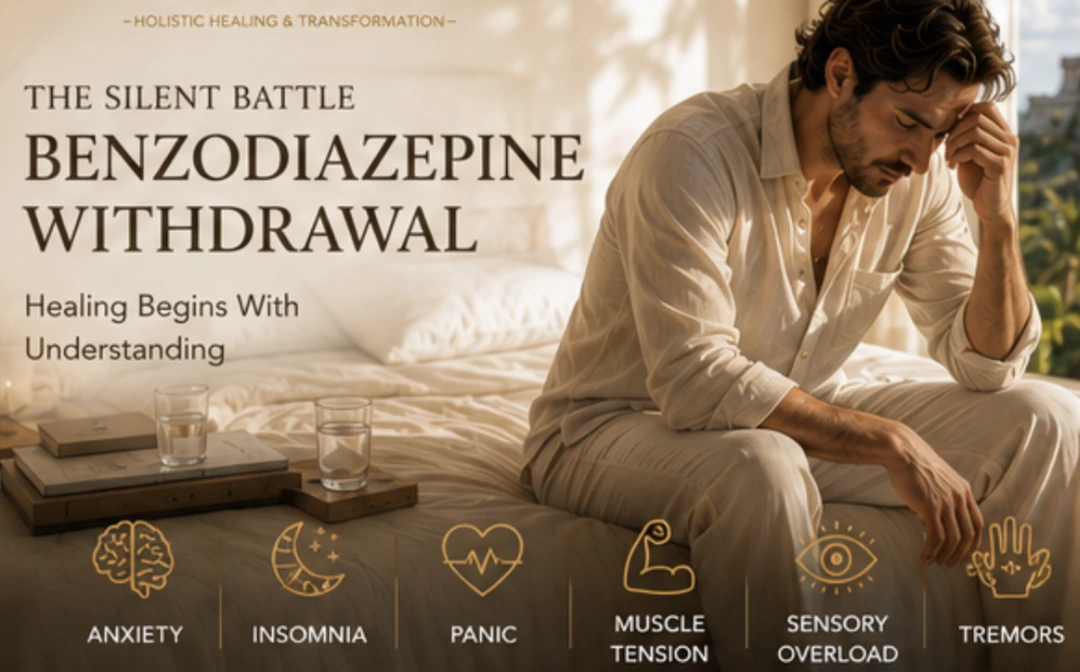
Read this part first. Benzodiazepine withdrawal is one of the few drug withdrawals that can be dangerous without supervision. Do not reduce or stop a prescribed benzodiazepine on your own, and do not stop one abruptly — abrupt cessation can cause seizures and can be life-threatening. Any change to your dose belongs with a physician who knows your history. If you are in crisis in Switzerland, the emergency number is 144 and the Dargebotene Hand / La Main Tendue helpline is 143.
Why I Built a Program for This
Holistic Sanctuary did not begin as a business idea. It began with a patient — me — who had been through the standard of care enough times to stop believing it, and who came out asking a question I have never put down: why does the system meant to help people so often send them home worse than it found them?
Switzerland gives that question a particular edge. Swiss medicine is careful, well-funded and well-regulated, and Swiss patients are rightly used to a high standard. Yet the data on benzodiazepine prescribing in Switzerland — which I lay out below, with the studies — shows that a careful system can still leave a person dependent on a drug for years and then offer them nothing but a printed reduction schedule when they try to stop. The rule that you may carry only thirty days of your own prescription across the border is the practical version of the same problem: the system is built to control the drug, not to get you off it.
We opened in 2011. More than 1,000 clients have come through since, from Zurich, Geneva, Basel and further afield, and I will say what that number is and is not: it is a count, not a success rate, and I will never present it as proof of a cure. What it is, is fifteen years of doing this one person at a time, adjusting it case by case, and staying in the building while it happened. That is why I can tell you, in detail, what a Swiss guest’s taper here actually involves.
The Thirty-Day Problem
Most people arrive at this page having already decided that a taper at home is not working. That decision is usually correct, and it is usually made for the right reasons: the dose has been cut and reinstated more than once, the interdose window has become the worst part of the day, and the prescribing relationship has quietly become an argument.
What almost nobody has been told is that leaving Switzerland with a long taper supply in a suitcase is not an option. Under the Swiss Ordinance on Narcotic Drug Control, a private individual may export their own prescribed narcotic-containing medicine without an export license — but only in a quantity corresponding to a maximum treatment period of thirty days, and only carried on their person. It cannot be posted, couriered, or sent ahead.3
Benzodiazepines fall inside that rule. Swissmedic names diazepam explicitly when it warns Swiss travellers that these medicines are treated as controlled narcotics in most countries and require advance planning.3
A taper worth doing is longer than thirty days. So a Swiss guest has exactly two workable options: taper at home under a Swiss physician, or go somewhere the prescribing, the dispensing and the medical supervision all happen on site. There is no third arrangement where you bring the medication with you and someone abroad manages it for you. Understanding that early saves months.
Benzodiazepine Detox Switzerland: What Swiss Law Lets You Carry
The practical checklist for benzodiazepine detox Switzerland residents plan abroad is short, and it is worth getting right before booking anything.
For destinations outside the Schengen Area — which includes Mexico — Swissmedic publishes a certificate template in German, French, Italian and English that your own physician completes. Swissmedic is candid that this template is not an officially recognized international form, so the destination country’s own rules govern what happens at its border. Before departure, the traveler is expected to contact that country’s consulate and confirm three things: whether a certificate is required at all, whether an import license is needed, and what quantity limits apply.3
The thirty-day ceiling comes from the Narcotics Control Ordinance and aligns with United Nations guidance. The Schengen version of the certificate, for comparison, stays valid for three months and permits repeated crossings; the non-Schengen route has no such standing.3
None of this is a reason not to travel. It is a reason to travel to a facility that prescribes and dispenses on site, with its own physician, its own pharmacy and its own records — rather than one that assumes you will arrive holding your own supply.
Your physician completes the certificate
Swissmedic publishes the non-Schengen template in German, French, Italian and English. The doctor who prescribes for you completes it, and you carry the original.
Confirm the destination rules
Swissmedic is explicit that its template is not an officially recognized form. Contact the destination consulate about certificates, import licenses and quantity limits before booking.
Pack inside the thirty-day ceiling
The legal maximum for a private individual is a thirty-day treatment supply, carried on your person. It cannot be posted, couriered or sent ahead.
Benzodiazepine Detox Switzerland: Why the Numbers Look Better Than the Experience Feels
Switzerland is not a country with a small benzodiazepine problem. In a Helsana claims analysis covering 844,692 people — roughly fourteen per cent of the Swiss population — 8.1 per cent of adults received a benzodiazepine prescription in 2018, and 10.5 per cent received a benzodiazepine, a Z-drug, or both. Just over half of the people receiving benzodiazepine prescriptions were 65 or older. Around a quarter of benzodiazepine recipients met the study’s definition of long-term use, and roughly two thirds were women.1
The more revealing finding is what happened when Swiss hospitals set out to reduce that prescribing. A longitudinal study across four Swiss teaching hospitals, covering 74,659 hospital stays between late 2014 and mid-2023, found exactly the reduction the Choosing Wisely campaign had asked for: new benzodiazepine and Z-drug prescriptions fell by 0.20 per cent a year, and the share of patients admitted already on them fell by 0.32 per cent a year.
Over the same period, new antipsychotic prescriptions rose by 0.20 per cent a year and admissions on existing antipsychotic therapy rose by 0.36 per cent a year. The authors concluded that the increase in antipsychotics quantitatively matched the decrease in benzodiazepines, “suggesting a shift from one to the other sedative therapy.”2
That is worth sitting with, because it describes a great many people’s actual experience. They were told they were coming off. On paper they came off. What they were not told is that a second sedative had taken the first one’s place, and that the underlying problem — a nervous system that no longer regulates itself without pharmacological help — had not been addressed at all. If you have been through a Swiss deprescribing program and still feel unwell, the statistics are not arguing with you.

What Your Insurance Will and Will Not Do
Swiss basic insurance under the KVG/LAMal is precise about care taken outside the country, and the precision does not work in a guest’s favor.
For planned treatment abroad, the Federal Office of Public Health states that costs may be reimbursed only where the treatment is not available in Switzerland or where waiting periods are excessive. Your physician must submit a written application to your insurer’s independent medical adviser, and the insurer decides in consultation with that adviser. Approval is discretionary.4
Benzodiazepine treatment is available in Switzerland. That means the realistic answer for almost every Swiss guest is that basic insurance will not fund a planned stay abroad, and that this is a private arrangement from the outset.
The second half of the rule matters for a different reason. Outside the EU, EFTA and the United Kingdom, basic insurance covers emergency treatment only, reimbursed to a maximum of twice what the same treatment would have cost in Switzerland, with hospital stays capped at 90 per cent of Swiss costs.4 Anyone traveling for medical care outside Europe should read that as a reason to hold appropriate private travel cover, not as a safety net.
We would rather you knew this before an inquiry than after one. A Swiss family that expects partial reimbursement and discovers otherwise mid-program is a family we have failed.
Zurich and Geneva to the Sanctuary
The travel picture matters more for benzodiazepine detox Switzerland than for most treatment decisions, because the thirty-day supply limit makes the arrival date part of the clinical plan.
Edelweiss Air operates the only non-stop service between Zurich and Cancún, flown by an Airbus A350-900 over 8,738 kilometres in a little under twelve hours. It is a weekly departure rather than a daily one, which makes arrival dates a planning constraint rather than an afterthought.
Geneva has no non-stop equivalent. A Romandy guest connects — most commonly through Zurich, Madrid, Paris or Amsterdam — and should plan for a full travel day. From Cancún the transfer to the sanctuary is by private car.
Two consequences follow, and both are practical rather than promotional. First, a guest traveling from Switzerland should hold enough medication, correctly documented, to cover the journey and the first days on site — within the thirty-day limit, with the Swissmedic certificate completed by the prescribing physician. Second, arrival day is not the day to make the first dose reduction. It is a day for assessment, bloodwork, an EKG and sleep.
How a Taper Is Built for a Swiss Guest
Nothing in a benzodiazepine detox Switzerland residents undertake abroad is clinically different from the same taper anywhere else. What differs is the sequencing, and the reason is legal rather than medical.
Nothing about the clinical work is Swiss. What is Swiss is the set of constraints around it, and those constraints change the sequencing.
The first days are assessment rather than reduction: a physician-led intake, medical history, current dose and dosing interval, previous reduction attempts and what happened during them, bloodwork, cardiac screening, and a conversation about what the last attempt actually felt like. Nobody’s schedule is copied from anybody else’s. A person taking 0.5 mg of a short-acting benzodiazepine three times a day is in a different position from someone taking 20 mg of a long-acting one at night, and the plans are not interchangeable.
Reduction is gradual and is adjusted against what the guest reports and what the nursing observations show, not against a calendar fixed in advance. Where a reduction proves too steep, it is held. Holding is a clinical decision, not a failure, and it is one of the reasons a supervised taper takes the time it takes.
Alongside the reduction sit sleep support, nutrition, structured daily activity, breathwork and bodywork, one-to-one psychological support, and — where a physician judges it appropriate — intravenous nutrient support. These run alongside a taper. They are not a substitute for one, and no serious program would present them as such.
Because Swiss guests cannot bring an extended supply, the prescribing physician here takes over dose management on arrival, with the medication dispensed on site and recorded on site. Your Swiss physician remains part of the picture: we ask for a discharge summary to go back to them, because the months after a taper matter more than the weeks during one.
What We Actually Do Here
The taper is inpatient and medically supervised from the first day to the last, with nursing cover running 24 hours a day across a morning shift, an evening shift and two to three night shifts, with at least four nurses on duty across a 24-hour period.
Dr. Jose A. Jimenez, MD, our Medical Director, reviews and clears each client before treatment begins and signs off on the medical picture the taper is built on. I am not a physician and I do not pretend to be one; he is, and every clinical decision on this page runs through him.
It begins with a full workup: bloodwork, EKG, cardiac evaluation, and an honest accounting of everything currently in the system, including alcohol, opioids and other prescriptions. Polypharmacy is the norm rather than the exception among the people who come to us, and it changes the plan.
From there the reduction is stepwise and continuously monitored, slowed whenever the clinical picture calls for it. The schedule is set and adjusted clinically, based on the person in front of us rather than a printed timetable. Sleep, nutrition, hydration and autonomic symptoms are managed around the clock rather than left to the guest to endure between appointments.
What we do not do is substitute. Nobody leaves here on a maintenance prescription for something else, and nobody is moved sideways onto a longer-acting drug they will have to come off in a year’s time somewhere else. I have watched that pattern for fifteen years — a person “successfully” off one benzodiazepine and quietly on another — and I refuse to run it here.
Medication-free is the destination. If that is not what someone wants, we are the wrong facility, and we say so during the inquiry.
The taper also happens here, in-house. It is not outsourced to a detox unit elsewhere and then handed back to us afterwards.
Why Twelve Weeks, Not Less
I hear the objection before it’s finished: twelve weeks is a long time to be away from a life. I understand that completely. What I have also seen, in this field for fifteen years, is what happens when a timeline is compressed to fit a calendar instead of a body.
The standard outpatient answer to a benzodiazepine dependence is a taper measured in many months, sometimes years. That advice exists for good reason, and I am not going to tell you it is wrong. The difficulty is what it looks like for the person living it: a very long stretch of time spent partly symptomatic, alone, still working, still parenting, still driving, and repeatedly deciding whether today is the day to hold the reduction or go back up.
Carrying out a reduction inside a facility, with 24-hour nursing cover, continuous monitoring and full-time support, changes what a person is able to tolerate — and therefore changes what is achievable in a given stretch of time.
Programs here run four to twelve weeks, and longer when a taper needs it. We do not run a five-to-seven-day detox, because a week is long enough to get someone through the sharpest edge of withdrawal and send them home fragile, which is how people end up back on the prescription within the month.
Twelve weeks is the floor, not a target we hit early when things go well. Some tapers here run slower than expected because the clinical picture demands it, and we would rather extend a stay than hit a date. It also does not mean this is easy. It means it is supervised, and that the hardest part happens somewhere with a physician on site rather than in a bedroom at four in the morning.
What Each Therapy Does — and What the Research Actually Shows
I built this section because I’m tired of watching this industry either oversell every therapy as a miracle or say nothing real about any of them. Below is what the published research says about each modality that runs alongside a benzodiazepine taper here — general findings from clinical and scientific literature, not claims about outcomes at this facility or for any individual guest. Where the evidence is strong, I say so. Where it’s early or mixed, I say that too.
One thing first. The reduction schedule is the spine of the program. Everything below exists to make that schedule survivable. None of it replaces it, and no component of this program has been tested in a randomized controlled trial as a treatment for benzodiazepine dependency. I am not going to imply otherwise.
The Brain Repair IV Protocol
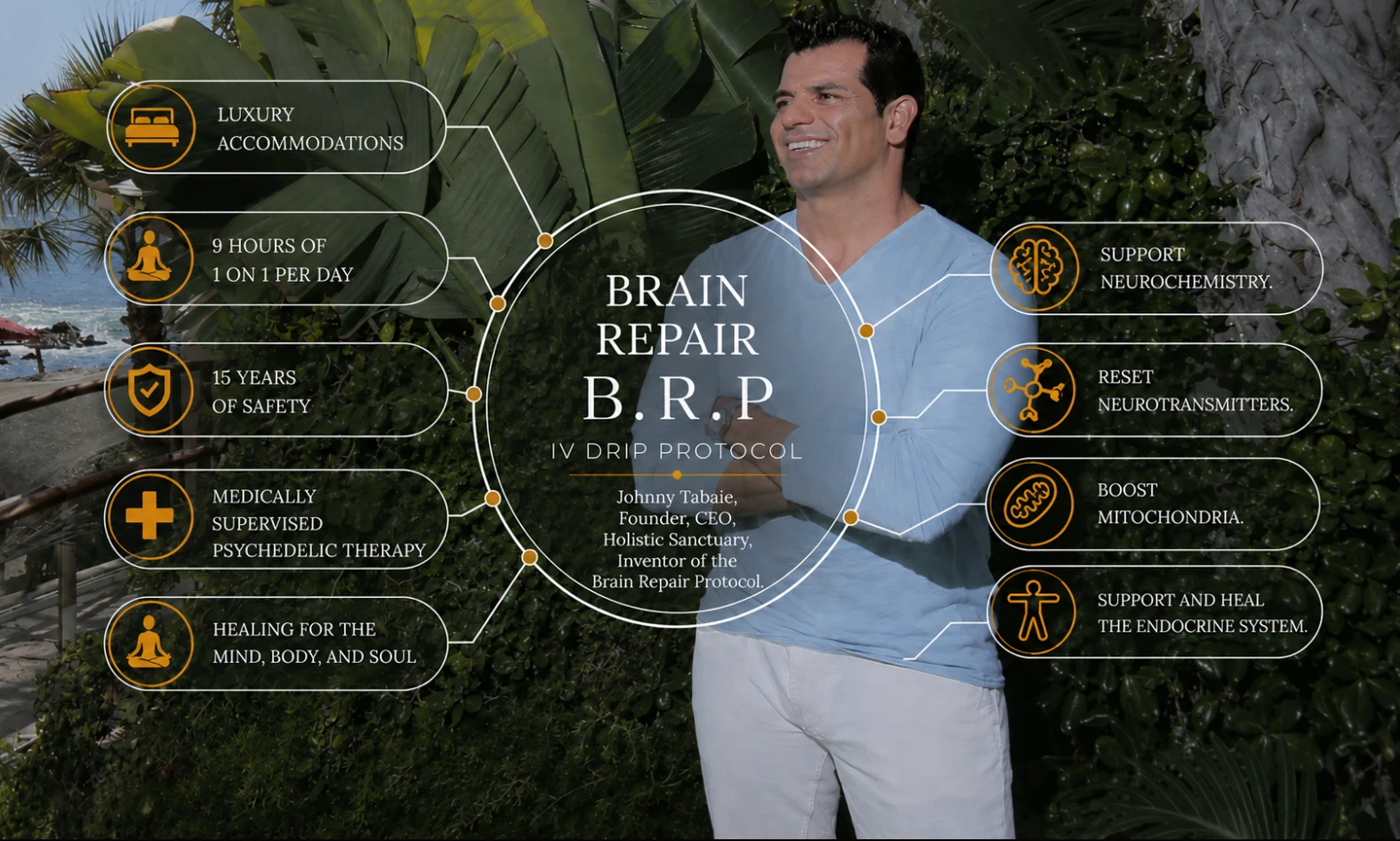
The Brain Repair IV Drip is a proprietary formulation I developed myself, incorporating amino acids, peptides and a nature-derived alkaloid. It is the intravenous component of the Pouyan Method built for benzodiazepine and SSRI recovery, sequenced and dosed to the individual under nursing supervision. It is one component of a comprehensive, individualized protocol, intended to support the body and brain during the recovery process rather than presented as a guaranteed cure or a replacement for individualized medical care. The formulation, administration sequence and available evidence are documented separately on our Brain Repair IV Protocol page.
NAD+ Support and Amino Acids
NAD+ (nicotinamide adenine dinucleotide) is a coenzyme every cell in the body requires for energy metabolism, and levels are known to decline with age and with chronic substance use. NAD+ and amino acid support are used here to assist the body’s own restorative processes during a period of significant physical demand. This is an area where clinical research is still developing, and we do not claim it treats any specific condition. I will also say directly what I make every member of staff say: NAD is a supportive therapy here. It is not the Brain Repair Protocol, and I do not allow it to be described as if it were.
Hyperbaric Oxygen Therapy (HBOT)
HBOT increases the amount of oxygen dissolved in blood plasma by having a person breathe oxygen at elevated atmospheric pressure. A 2024 review in Frontiers in Neurology describes how this process can promote mitochondrial function, new blood vessel growth, and reduced inflammatory signaling (lower TNF-α and IL-6) in nervous system tissue. HBOT is FDA-cleared for a specific list of conditions — wound healing, decompression sickness and carbon monoxide poisoning among them — and the Undersea and Hyperbaric Medical Society’s approved indications do not include benzodiazepine dependency. Its use for neurological and psychiatric conditions remains an active area of research rather than an approved indication. At Holistic Sanctuary, it is offered as a supportive therapy within a broader protocol, not as a treatment for any diagnosis on its own.
Red Light Therapy and Infrared Sauna
Red and near-infrared light in the 600–1,100 nanometer range is absorbed by an enzyme called cytochrome c oxidase inside mitochondria, increasing cellular ATP production — a mechanism reviewed extensively by Harvard-affiliated researcher Michael Hamblin. This is the basis for red light therapy’s documented effects on collagen production, wound healing and inflammation at the cellular level. Infrared sauna use operates differently, through heat: a study published in JAMA Internal Medicine associated frequent sauna use with reduced cardiovascular risk, and infrared heat exposure has been shown to activate heat shock proteins involved in cellular repair and to promote sweat-based excretion of certain heavy metals and organic compounds. Both are offered here as restorative, supportive therapies — not as treatments for any specific disease.
Therapeutic Massage
A widely cited review by Tiffany Field and colleagues, published in the International Journal of Neuroscience, found that massage therapy was associated with an average 31% decrease in cortisol and increases of 28% in serotonin and 31% in dopamine across a range of populations and conditions, including stress, pain and mood-related studies. In a benzodiazepine taper, where the nervous system is being asked to do without a brake it has leaned on for years, that matters. Massage is included as bodywork that supports the nervous system during an intensive period of change — not as a treatment for any underlying condition.
Yoga, Breathwork and Meditation
A systematic review in Health Psychology Review examined the mechanisms by which yoga reduces stress and found consistent evidence for effects on cortisol, inflammatory markers (IL-6, C-reactive protein) and psychological measures including self-compassion and positive affect. A separate controlled study of medical students found a statistically significant reduction in perceived stress after six weeks of yoga and meditation practice. These practices are part of daily life here because the evidence for their effect on stress physiology is genuinely strong — not because we present them as a cure for anything.
Detox Baths, Juice Cleanses, Superfoods and Organic Nutrition
The nutritional program is built around what your body specifically needs to rebuild during a taper — not a generic cleanse. Real, whole-food, organic nutrition supporting liver function and cellular repair is foundational to every other therapy in this program; a depleted body cannot make full use of any of the modalities above it. Detox baths, juice cleanses and superfood nutrition sit in the same category: supportive, restorative, and honestly described as such.
How These Are Scheduled
Nothing here runs on a fixed weekly timetable that every guest moves through together. Sessions are placed around where a person is in their reduction — heavier support in the days after a step down, lighter when a dose is holding steady — and the physician can pause any of it. If a therapy is not appropriate for someone on the day, it does not happen on the day, and nothing about the reduction schedule changes because of it. The taper is the fixed point; everything else moves around it.
What Brought Me to This Work
I am not a physician, and I have never presented myself as one. I don’t diagnose and I don’t prescribe. What I do is design the protocol, lead the healing side of this work, and stay personally involved in every case at this facility. In fifteen years of operation there has been no guest death at this facility. I state that once, plainly, because it’s true and because it is the direct result of the screening and staffing decisions on this page — never as a guarantee about your own outcome, which no honest program can offer anyone.
Why We Don’t Have Outside Trial Data — and Why That’s a Real Trade-Off
We are independently funded. We take no government, institutional or pharmaceutical money, and I have made a deliberate choice not to license this protocol to outside researchers. I make that choice with full awareness of what it costs: the kind of third-party clinical trial data that larger, funded programs can point to. I’d rather be honest about that trade-off than pretend it doesn’t exist. What I can offer instead is fifteen years of doing this work openly, under our own name, and a founder who is still in the building.
What We Do Not Claim
We do not claim a cure, and we do not publish success rates. Benzodiazepine recovery is not a single event with a clean endpoint, and any facility quoting you a percentage is quoting you a marketing figure.
We do not claim that any modality we offer eliminates withdrawal. Some people experience symptoms that persist well beyond the taper itself. The evidence base for protracted symptoms is thinner than either patients or clinicians would like, and we will not pretend otherwise to make a stay sound more certain than it is.
What runs alongside a taper here is the Brain Repair Protocol — an intravenous formulation of amino acids, peptides and neurotransmitter compounds, given not as a single treatment but as a sequence: once, twice or three times over a set number of days, across one to four weeks, dosed to the individual and administered under nursing supervision. Johnny Tabaie developed it over two decades and it is the component of the Pouyan Method built for benzodiazepine and SSRI recovery. The formulation itself is proprietary and unpublished, and the reason is stated plainly elsewhere on this site: the facility is independently funded, runs no externally sponsored trials, and does not license the protocol out. It supports what chronic benzodiazepine exposure depletes. It does not replace the taper, and we do not claim it removes withdrawal.
What we will say is what is verifiable: benzodiazepines carry a boxed warning from the FDA covering the risks of abuse, dependence and withdrawal reactions, added in September 2020;5 a supervised, individualized reduction is safer than an unsupervised one; and doing it somewhere the medication is legally prescribed and dispensed on site removes a constraint that Swiss law otherwise imposes on you.
Admission is by medical clearance. Speak to us before you change anything about your current dose.
Call or WhatsApp +1-323-612-9904
Read Next
- Luxury benzodiazepine detox and rehab — the pillar behind this benzodiazepine detox Switzerland guide — the full program, what runs alongside a taper, and what we do not promise.
- Alprazolam dependence — why short-acting benzodiazepines are the hardest to reduce.
- Diazepam dependence — the long-acting picture, and the medicine Swissmedic names in its travel guidance.
- Clonazepam dependence — interdose withdrawal and why the schedule matters more than the dose.
References
- Landolt S, Rosemann T, Blozik E, Brüngger B, Huber CA. Benzodiazepine and Z-Drug Use in Switzerland: Prevalence, Prescription Patterns and Association with Adverse Healthcare Outcomes. Neuropsychiatric Disease and Treatment. 2021;17:1021–1034. doi:10.2147/NDT.S290104
- Gabutti L, et al. Antipsychotic, benzodiazepine and Z-drug prescriptions in a Swiss hospital network in the Choosing Wisely and COVID-19 eras: a longitudinal study. Swiss Medical Weekly. 2024. doi:10.57187/s.3409
- Swissmedic. Traveling with narcotic-containing medicines — countries outside the Schengen Area. swissmedic.ch
- Swiss Federal Office of Public Health (FOPH). Treatment abroad for policyholders resident in Switzerland. bag.admin.ch
- US Food and Drug Administration. FDA requiring Boxed Warning updated to improve safe use of benzodiazepine drug class. September 2020. fda.gov
- Systematic review and dosage analysis: hyperbaric oxygen therapy efficacy in the treatment of posttraumatic stress disorder. Frontiers in Neurology 2024;15:1360311.
- Field T, et al. Cortisol decreases and serotonin and dopamine increase following massage therapy. International Journal of Neuroscience 2005;115(10):1397–1413.
- Laukkanen T, et al. Association between sauna bathing and fatal cardiovascular and all-cause mortality events. JAMA Internal Medicine 2015;175(4):542–548.
- Riley KE, Park CL. How does yoga reduce stress? A systematic review of mechanisms of change. Health Psychology Review 2015;9(3):379–396.
- Undersea and Hyperbaric Medical Society. Approved indications for hyperbaric oxygen therapy.
Frequently Asked Questions
Can I bring my benzodiazepine prescription from Switzerland to Mexico?
Yes, within limits. Swiss law permits a private individual to export their own prescribed narcotic-containing medicine without an export license, but only up to a maximum thirty-day treatment supply, carried in person, with a physician-completed certificate. It cannot be mailed. Because Mexico is outside the Schengen Area, Swissmedic advises confirming the destination country’s own requirements with its consulate before traveling.
Will Swiss basic insurance pay for treatment abroad?
For planned treatment, almost certainly not. The Federal Office of Public Health permits reimbursement only where the treatment is unavailable in Switzerland or waiting periods are excessive, and only after a written application from your physician to the insurer’s medical adviser. Benzodiazepine treatment is available in Switzerland, so a planned stay abroad should be budgeted as a private arrangement.
How long does a benzodiazepine taper take?
Longer than thirty days, which is precisely why the Swiss export limit shapes the decision. The honest answer is that it depends on the drug, the dose, the dosing interval, how long it has been taken and what previous reduction attempts did. Anyone offering a fixed number before assessing you is guessing.
Where do people go for benzodiazepine detox Switzerland cannot provide privately?
Most people weighing benzodiazepine detox Switzerland side by side with a stay abroad are choosing between a Swiss private clinic and a facility that can prescribe and dispense the whole taper on site. Both are private-pay. The difference is whether the thirty-day export limit governs your schedule.
Is there a direct flight from Switzerland?
From Zurich, yes. Edelweiss Air flies non-stop to Cancún, roughly twelve hours, weekly rather than daily. From Geneva you connect, most often via Zurich, Madrid, Paris or Amsterdam.
I came off benzodiazepines in Switzerland and still feel unwell. Why?
One documented possibility is that a second sedative replaced the first. A study across four Swiss teaching hospitals found that the fall in benzodiazepine and Z-drug prescribing between 2014 and 2023 was quantitatively matched by a rise in antipsychotic prescribing, which the authors read as a shift from one sedative therapy to another rather than a resolution. That is a conversation to have with a physician who will look at the whole medication history.
Medical disclaimer: this page describes how supervised benzodiazepine reduction is approached and summarizes published Swiss regulatory, insurance and prescribing information. It is not medical advice and does not establish a physician–patient relationship. Do not start, change or stop any prescribed medication on the basis of this page. Benzodiazepine withdrawal can be dangerous and abrupt cessation can be life-threatening; any dose change belongs with a physician who knows your history. In an emergency in Switzerland call 144; the Dargebotene Hand / La Main Tendue helpline is 143. In the United States, the Suicide and Crisis Lifeline is 988.