
Benzodiazepine Treatment: Four Facts Before You Choose


Last reviewed
4 September 2026
Johnny Tabaie is not a physician and does not practice medicine. He is the founder of Holistic Sanctuary and the creator of the Pouyan Method; every clinical statement on this page is reviewed by Dr. Jimenez before it publishes.
In brief: Sixty-three controlled trials have been run on getting people off benzodiazepines. Together they say something useful, something uncomfortable, and something almost nobody selling benzodiazepine treatment will tell you. I am going to tell you all three, and then I am going to tell you what benzodiazepine treatment looks like here across four to twelve weeks, what the research says about each therapy that runs alongside the taper, and where the evidence stops. It is not a promise of a cure — the trials are precisely why no honest program can make one.
Choosing benzodiazepine treatment is not like choosing treatment for alcohol or opioids, and the reason is simple: most people who need it were not misusing anything. They took a prescription as directed and became dependent on it, which is a different problem requiring a different answer.
Read this part first. Do not reduce or stop a prescribed benzodiazepine on your own, and never stop one abruptly. Abrupt cessation can cause seizures and can be life-threatening. Any change to your dose belongs with a physician who knows your history. If you are in crisis, the Suicide and Crisis Lifeline in the United States is 988.
Why I Built a Benzodiazepine Treatment Program
I know the standard of care from the wrong side of the desk. Before Holistic Sanctuary existed, I was the patient — admitted, medicated, discharged, re-admitted — and the thing that stayed with me was not any single failure but the pattern: a system that was very good at managing me and had no real interest in whether I ever got well. That is the question underneath everything I have built since: why does the system meant to help people so often send them home worse than it found them?
Benzodiazepine treatment is where that pattern is most visible, because the evidence is unusually clear. Two Cochrane reviews, sixty-three trials, and a joint guideline from ten medical societies all point the same direction, and most of the industry ignores them in favor of a twenty-eight-day model that was never built for this drug. I did not want to run another version of that. I wanted to build the thing the trials actually tested and then be honest about what they could not prove.
The facility opened in 2011. Since then, more than 1,000 clients have stayed here, and I say that plainly rather than proudly: it is a number, not an outcome. It proves nothing about any individual and I will not pretend otherwise. What it does mean is that for fifteen years I have watched, up close, what benzodiazepine treatment demands of a person, and I have refined what we do around that — not around a brochure.
Fact One: Benzodiazepine Treatment Is Not the Same Thing as Detox
These two words get used interchangeably by facilities that should know better, and the confusion costs people months.
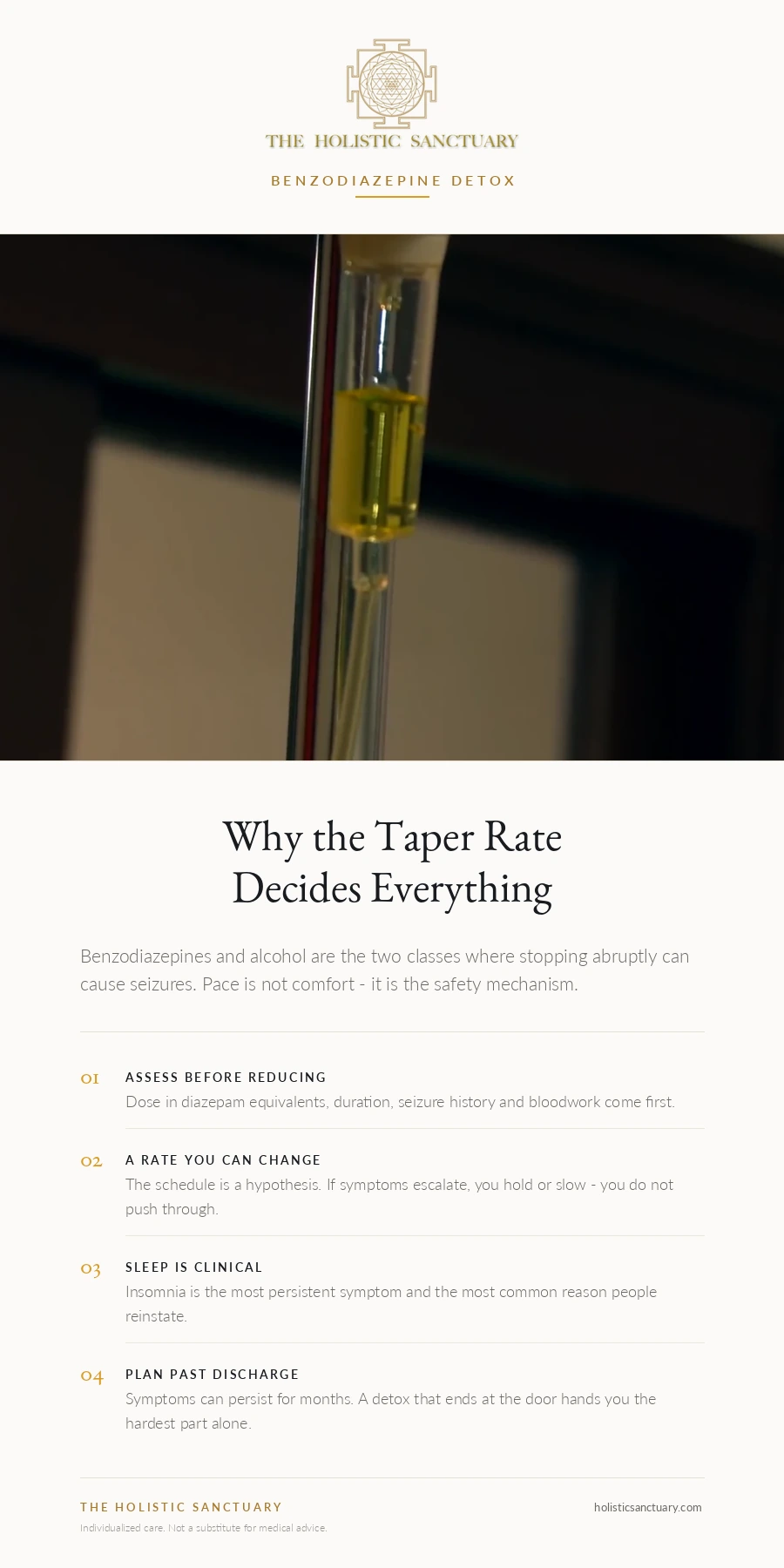
Detox is the medically supervised removal of the drug — the taper itself, and the clinical management of what happens during it. It has a beginning and an end. We describe that work in detail on the benzodiazepine detox page.
Withdrawal is the physiological event the taper is managing: the symptoms, their timeline, and the small number of them that are genuinely dangerous. That is covered on the benzodiazepine withdrawal page.
Treatment is the whole arc, and it is the only one of the three that does not end when the last dose does. It includes the decision about where and how to taper, what runs alongside it, what happens to the original problem the prescription was written for, and what the following year looks like. A program that solves the taper and ignores everything after it has solved the easier half.
If you remember nothing else from this page: the taper is the part everyone focuses on, and the part after it is the part that decides the outcome.
Fact Two: No Medication Reliably Gets You Off
This is the finding the industry is quietest about, and it comes from the most conservative source available.
In 2018 a Cochrane systematic review examined pharmacological interventions for benzodiazepine discontinuation in chronic users. It pooled 38 randomized controlled trials covering 2,543 participants who had either taken benzodiazepines for at least two months or met criteria for dependence. The medications tested included valproate, tricyclic antidepressants, pregabalin, paroxetine, carbamazepine, flumazenil and several others.3
The authors’ conclusion, in their own words, was that it is not possible to draw firm conclusions regarding pharmacological interventions to facilitate benzodiazepine discontinuation in chronic benzodiazepine users. Certainty of evidence was rated low or very low for every outcome. They also noted that adverse events could not be reliably assessed across the trials because reporting was poor, and that pharmaceutical industry involvement in funding was a factor in the body of research.3
Read that carefully, because it cuts both ways. It means nobody can hand you a drug that makes this easy. It also means that any facility offering you a proprietary compound, an infusion or a supplement protocol as the thing that gets you off benzodiazepines is making a claim that 38 trials and 2,543 people could not support for anything.
Fact Three: Therapy Plus a Taper Works — and the Benefit Fades
The companion Cochrane review looked at psychosocial rather than pharmacological approaches. It pooled 25 randomized controlled trials covering 1,666 participants, testing cognitive behavioral therapy, motivational interviewing, tailored letters from general practitioners, standardized interviews and relaxation techniques.4
The clearest finding was that CBT combined with a taper is effective in the short term. At three months, CBT plus taper produced a risk ratio of 1.51 for successful discontinuation, with a 95 per cent confidence interval of 1.15 to 1.98 — moderate certainty evidence. Motivational interviewing had insufficient evidence behind it. Letters, structured interviews and relaxation showed modest promise.4
Then the part that matters most, and the part that is almost never quoted: the benefit did not persist beyond six months.4
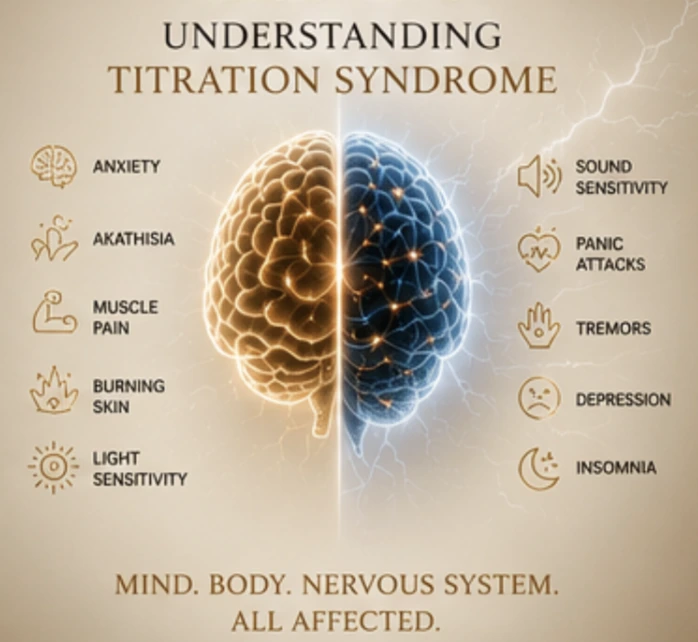
Put the two reviews side by side and the shape of the problem appears. Medication does not reliably get people off. Therapy plus a taper helps them get off, and then stops helping. Which means the field has decent evidence for the first three months and very little for what follows — and the period after month six is exactly when most people either hold their ground or go back.
Any honest program has to be built around that gap rather than around the part that photographs well.
The Five Questions to Ask Any Benzodiazepine Treatment Program
Everything above is easier to use as a buyer than as a reader. These are the five questions that separate a program built for benzodiazepine patients from one that will take the admission and improvise.
One. Who writes and adjusts the taper, and how often do they look at it? The answer should be a named physician and a schedule of review measured in days. If the taper was set at admission and nobody is scheduled to revisit it, it is not an individualized plan, whatever the brochure says.
Two. Is the medication prescribed and dispensed on site? If a program expects you to arrive holding your own supply, ask what happens when that supply runs out, and whether their physicians can legally prescribe for you where the facility sits. For guests traveling from countries with export limits on controlled medicines, this question decides whether the plan is possible at all.
Three. What happens in month seven? This is the question that exposes most programs, because the strongest evidence in the field shows the benefit of the acute phase fading after six months. A program that has no answer beyond a phone number has not read the literature it is competing against.
Four. What do you claim, and what will you not claim? A facility that cannot name a limitation is not being careful with you. Ask directly whether they claim a cure, whether they publish a success rate, and what the source of that number is. Ask what their evidence is for any proprietary infusion or protocol, and whether it is a controlled trial or a testimonial.
Five. Who would you turn away? Every legitimate medical program has exclusion criteria — cardiac, psychiatric, obstetric. If a program cannot describe a person it would decline on medical grounds, it is not screening, and the person it fails to screen might be you.
None of those five questions requires medical training to ask, and the quality of the answers tells you more than any brochure will.

Fact Four: Most Treatment Was Built for a Different Drug
Walk into a conventional addiction program as a benzodiazepine patient and you will usually be placed inside a model developed for alcohol and opioids. That model assumes a person who sought the substance out, escalated it, and needs to accept that they cannot control it.
For a large proportion of benzodiazepine patients, none of that describes what happened. They were prescribed the drug for anxiety, insomnia, panic or grief, took it as directed, and developed physical dependence — which the FDA’s 2020 boxed warning treats as a separate risk from abuse and addiction precisely because they are different things.1
The mismatch is not academic. It produces group sessions where a person is asked to admit to powerlessness over a medication their doctor told them to take. It produces abstinence frameworks that treat a slow medical taper as a form of using. It produces staff who read protracted symptoms as drug-seeking. People leave those programs convinced something is wrong with them, when what was actually wrong was the model.
What a benzodiazepine patient needs instead is closer to deprescribing medicine than to conventional rehab: a physician who can taper, people who understand interdose withdrawal, and a plan for the year after.
What Treatment Looks Like Here
We are a residential setting, so what we can do is concentrate the things that the evidence supports into one place and remove the obstacles that make them fail elsewhere.
The taper is physician-led, prescribed and dispensed on site, and adjusted against what is actually happening rather than against a schedule fixed in advance. That is what the 2025 joint guideline from the American Society of Addiction Medicine and nine partner societies asks for: an individualized plan that is developed, monitored and adjusted.2
Structured psychological work runs alongside it rather than after it, because that is the combination the trials actually tested. Sleep, nutrition, daily structure, breathwork and bodywork are handled by somebody else, at the point when the person cannot reliably handle them.
Admission is by medical clearance. Cardiac screening and bloodwork come before any reduction, and there are people we will tell during the inquiry that a residential taper abroad is not the right setting for.
And because the evidence says the benefit of the acute phase fades, the discharge plan is treated as part of the treatment rather than paperwork at the end of it: a written taper record and summary for the physician at home, and a plan for the months where the research thins out.

What Benzodiazepine Treatment Here Actually Involves, Day to Day
The taper is inpatient and medically supervised from the first day to the last, with nursing cover running 24 hours a day across a morning shift, an evening shift and two to three night shifts, with at least four nurses on duty across a 24-hour period.
Dr. Jose A. Jimenez, MD, our Medical Director, reviews and clears each client before treatment begins and signs off on the medical picture the taper is built on. I am not a physician and I do not pretend to be one; he is, and every clinical decision on this page runs through him.
It begins with a full workup: bloodwork, EKG, cardiac evaluation, and an honest accounting of everything currently in the system, including alcohol, opioids and other prescriptions. Polypharmacy is the norm rather than the exception among the people who come to us, and it changes the plan.
From there the reduction is stepwise and continuously monitored, slowed whenever the clinical picture calls for it. The schedule is set and adjusted clinically, based on the person in front of us rather than a printed timetable. Sleep, nutrition, hydration and autonomic symptoms are managed around the clock rather than left to the guest to endure between appointments.
What we do not do is substitute. Nobody leaves here on a maintenance prescription for something else, and nobody is moved sideways onto a longer-acting drug they will have to come off in a year’s time somewhere else. I have watched that pattern for fifteen years — a person “successfully” off one benzodiazepine and quietly on another — and I refuse to run it here.
Medication-free is the destination. If that is not what someone wants, we are the wrong facility, and we say so during the inquiry.
The taper also happens here, in-house. It is not outsourced to a detox unit elsewhere and then handed back to us afterwards.
Why Benzodiazepine Treatment Takes Twelve Weeks Here, Not Twenty-Eight Days
I hear the objection before it’s finished: twelve weeks is a long time to be away from a life. I understand that completely. What I have also seen, in this field for fifteen years, is what happens when a timeline is compressed to fit a calendar instead of a body.
The standard outpatient answer to a benzodiazepine dependence is a taper measured in many months, sometimes years. That advice exists for good reason, and I am not going to tell you it is wrong. The difficulty is what it looks like for the person living it: a very long stretch of time spent partly symptomatic, alone, still working, still parenting, still driving, and repeatedly deciding whether today is the day to hold the reduction or go back up.
Carrying out a reduction inside a facility, with 24-hour nursing cover, continuous monitoring and full-time support, changes what a person is able to tolerate — and therefore changes what is achievable in a given stretch of time.
Programs here run four to twelve weeks, and longer when a taper needs it. We do not run a five-to-seven-day detox, because a week is long enough to get someone through the sharpest edge of withdrawal and send them home fragile, which is how people end up back on the prescription within the month.
Twelve weeks is the floor, not a target we hit early when things go well. Some tapers here run slower than expected because the clinical picture demands it, and we would rather extend a stay than hit a date. It also does not mean this is easy. It means it is supervised, and that the hardest part happens somewhere with a physician on site rather than in a bedroom at four in the morning.
What Each Therapy Does — and What the Research Actually Shows
I built this section because I’m tired of watching this industry either oversell every therapy as a miracle or say nothing real about any of them. Below is what the published research says about each modality that runs alongside a benzodiazepine taper here — general findings from clinical and scientific literature, not claims about outcomes at this facility or for any individual guest. Where the evidence is strong, I say so. Where it’s early or mixed, I say that too.
One thing first. The reduction schedule is the spine of the program. Everything below exists to make that schedule survivable. None of it replaces it, and no component of this program has been tested in a randomized controlled trial as a treatment for benzodiazepine dependency. I am not going to imply otherwise.
The Brain Repair IV Protocol
The Brain Repair IV Drip is a proprietary formulation I developed myself, incorporating amino acids, peptides and a nature-derived alkaloid. It is the intravenous component of the Pouyan Method built for benzodiazepine and SSRI recovery, sequenced and dosed to the individual under nursing supervision. It is one component of a comprehensive, individualized protocol, intended to support the body and brain during the recovery process rather than presented as a guaranteed cure or a replacement for individualized medical care. The formulation, administration sequence and available evidence are documented separately on our Brain Repair IV Protocol page.
NAD+ Support and Amino Acids
NAD+ (nicotinamide adenine dinucleotide) is a coenzyme every cell in the body requires for energy metabolism, and levels are known to decline with age and with chronic substance use. NAD+ and amino acid support are used here to assist the body’s own restorative processes during a period of significant physical demand. This is an area where clinical research is still developing, and we do not claim it treats any specific condition. I will also say directly what I make every member of staff say: NAD is a supportive therapy here. It is not the Brain Repair Protocol, and I do not allow it to be described as if it were.
Hyperbaric Oxygen Therapy (HBOT)
HBOT increases the amount of oxygen dissolved in blood plasma by having a person breathe oxygen at elevated atmospheric pressure. A 2024 review in Frontiers in Neurology describes how this process can promote mitochondrial function, new blood vessel growth, and reduced inflammatory signaling (lower TNF-α and IL-6) in nervous system tissue. HBOT is FDA-cleared for a specific list of conditions — wound healing, decompression sickness and carbon monoxide poisoning among them — and the Undersea and Hyperbaric Medical Society’s approved indications do not include benzodiazepine dependency. Its use for neurological and psychiatric conditions remains an active area of research rather than an approved indication. At Holistic Sanctuary, it is offered as a supportive therapy within a broader protocol, not as a treatment for any diagnosis on its own.
Red Light Therapy and Infrared Sauna
Red and near-infrared light in the 600–1,100 nanometer range is absorbed by an enzyme called cytochrome c oxidase inside mitochondria, increasing cellular ATP production — a mechanism reviewed extensively by Harvard-affiliated researcher Michael Hamblin. This is the basis for red light therapy’s documented effects on collagen production, wound healing and inflammation at the cellular level. Infrared sauna use operates differently, through heat: a study published in JAMA Internal Medicine associated frequent sauna use with reduced cardiovascular risk, and infrared heat exposure has been shown to activate heat shock proteins involved in cellular repair and to promote sweat-based excretion of certain heavy metals and organic compounds. Both are offered here as restorative, supportive therapies — not as treatments for any specific disease.
Therapeutic Massage
A widely cited review by Tiffany Field and colleagues, published in the International Journal of Neuroscience, found that massage therapy was associated with an average 31% decrease in cortisol and increases of 28% in serotonin and 31% in dopamine across a range of populations and conditions, including stress, pain and mood-related studies. In a benzodiazepine taper, where the nervous system is being asked to do without a brake it has leaned on for years, that matters. Massage is included as bodywork that supports the nervous system during an intensive period of change — not as a treatment for any underlying condition.
Yoga, Breathwork and Meditation
A systematic review in Health Psychology Review examined the mechanisms by which yoga reduces stress and found consistent evidence for effects on cortisol, inflammatory markers (IL-6, C-reactive protein) and psychological measures including self-compassion and positive affect. A separate controlled study of medical students found a statistically significant reduction in perceived stress after six weeks of yoga and meditation practice. These practices are part of daily life here because the evidence for their effect on stress physiology is genuinely strong — not because we present them as a cure for anything.
Detox Baths, Juice Cleanses, Superfoods and Organic Nutrition
The nutritional program is built around what your body specifically needs to rebuild during a taper — not a generic cleanse. Real, whole-food, organic nutrition supporting liver function and cellular repair is foundational to every other therapy in this program; a depleted body cannot make full use of any of the modalities above it. Detox baths, juice cleanses and superfood nutrition sit in the same category: supportive, restorative, and honestly described as such.
How These Are Scheduled Around the Taper
Nothing here runs on a fixed weekly timetable that every guest moves through together. Sessions are placed around where a person is in their reduction — heavier support in the days after a step down, lighter when a dose is holding steady — and the physician can pause any of it. If a therapy is not appropriate for someone on the day, it does not happen on the day, and nothing about the reduction schedule changes because of it. The taper is the fixed point; everything else moves around it.
What Brought Me to This Work
I am not a physician, and I have never presented myself as one. I don’t diagnose and I don’t prescribe. What I do is design the protocol, lead the healing side of this work, and stay personally involved in every case at this facility. In fifteen years of operation there has been no guest death at this facility. I state that once, plainly, because it’s true and because it is the direct result of the screening and staffing decisions on this page — never as a guarantee about your own outcome, which no honest program can offer anyone.
Why We Don’t Have Outside Trial Data — and Why That’s a Real Trade-Off
We are independently funded. We take no government, institutional or pharmaceutical money, and I have made a deliberate choice not to license this protocol to outside researchers. I make that choice with full awareness of what it costs: the kind of third-party clinical trial data that larger, funded programs can point to — the same kind of data I have just spent this page telling you to demand. I’d rather be honest about that trade-off than pretend it doesn’t exist. What I can offer instead is fifteen years of doing this work openly, under our own name, and a founder who is still in the building.
What We Do Not Claim
We do not claim a cure and we publish no success rates. The honest reason is on this page: the strongest evidence in the field found a benefit that did not survive six months, so anyone quoting you a durable percentage is quoting marketing.
We do not claim any modality we offer eliminates withdrawal or replaces a taper. The Cochrane review of 38 medication trials could not support that claim for any compound, and we are not going to make it for ours.
What runs alongside a taper here is the Brain Repair Protocol — an intravenous formulation of amino acids, peptides and neurotransmitter compounds, given not as a single treatment but as a sequence: once, twice or three times over a set number of days, across one to four weeks, dosed to the individual and administered under nursing supervision. Johnny Tabaie developed it over two decades and it is the component of the Pouyan Method built for benzodiazepine and SSRI recovery. The formulation itself is proprietary and unpublished, and the reason is stated plainly elsewhere on this site: the facility is independently funded, runs no externally sponsored trials, and does not license the protocol out. It supports what chronic benzodiazepine exposure depletes. It does not replace the taper, and we do not claim it removes withdrawal.
Admission is by medical clearance. Speak to us before you change anything about your current dose.
Call or WhatsApp +1-323-612-9904
Read Next
- Benzodiazepine detox and rehab — the supervised taper itself, and what runs alongside it.
- Benzodiazepine withdrawal — the timeline by half-life, and the three rules of a safe taper.
- Benzodiazepine detox for Swiss residents — how the thirty-day export limit shapes a taper abroad.
- Alprazolam dependence — the shortest half-life, and the hardest interdose window.
References
- US Food and Drug Administration. FDA requiring Boxed Warning updated to improve safe use of benzodiazepine drug class. 23 September 2020. fda.gov
- American Society of Addiction Medicine and nine partner societies. Joint Clinical Practice Guideline on Benzodiazepine Tapering. Journal of General Internal Medicine, 2025. asam.org
- Baandrup L, et al. Pharmacological interventions for benzodiazepine discontinuation in chronic benzodiazepine users. Cochrane Database of Systematic Reviews, 2018. 38 trials, 2,543 participants. cochrane.org
- Darker CD, et al. Psychosocial interventions for benzodiazepine harmful use, abuse or dependence. Cochrane Database of Systematic Reviews, 2015. 25 trials, 1,666 participants. cochrane.org
- Ashton CH. Benzodiazepines: How They Work and How to Withdraw (the Ashton Manual). Newcastle University, revised 2002.
- Systematic review and dosage analysis: hyperbaric oxygen therapy efficacy in the treatment of posttraumatic stress disorder. Frontiers in Neurology 2024;15:1360311.
- Field T, et al. Cortisol decreases and serotonin and dopamine increase following massage therapy. International Journal of Neuroscience 2005;115(10):1397–1413.
- Laukkanen T, et al. Association between sauna bathing and fatal cardiovascular and all-cause mortality events. JAMA Internal Medicine 2015;175(4):542–548.
- Riley KE, Park CL. How does yoga reduce stress? A systematic review of mechanisms of change. Health Psychology Review 2015;9(3):379–396.
- Undersea and Hyperbaric Medical Society. Approved indications for hyperbaric oxygen therapy.
Frequently Asked Questions
What is the most effective benzodiazepine treatment?
On the current evidence, a gradual physician-supervised taper combined with cognitive behavioral therapy. A Cochrane review of 25 trials found CBT plus taper improved discontinuation at three months, risk ratio 1.51. The same review found the advantage did not persist past six months, which is why what happens after the taper matters as much as the taper.
Is there a medication that helps you come off benzodiazepines?
No medication has reliable evidence behind it. A Cochrane review of 38 randomized trials covering 2,543 people concluded that firm conclusions could not be drawn for any pharmacological intervention, with certainty of evidence rated low or very low throughout.
What is the difference between benzodiazepine detox and benzodiazepine treatment?
Detox is the supervised removal of the drug and it ends. Treatment is the whole arc, including where and how you taper, what runs alongside it, the original problem the prescription was written for, and the year that follows.
Why do standard rehab programs struggle with benzodiazepine patients?
Because most were designed for alcohol and opioids, and assume a person who sought the substance out. A large proportion of benzodiazepine patients took a prescription exactly as directed. The FDA treats physical dependence as a separate risk from abuse and addiction for that reason.
How long does benzodiazepine treatment take?
The taper is measured in weeks to months depending on the drug, the dose and the dosing interval. Treatment in the fuller sense extends past that, and the evidence for the period beyond six months is thin. Anyone giving you a fixed total before assessing you is guessing.
Medical disclaimer: this page summarizes published systematic reviews and clinical guidance on benzodiazepine treatment. It is not medical advice and does not establish a physician–patient relationship. Do not start, change or stop any prescribed medication on the basis of this page. Benzodiazepine withdrawal can be dangerous and abrupt cessation can be life-threatening; any dose change belongs with a physician who knows your history. In the United States, the Suicide and Crisis Lifeline is 988.