Benzo Withdrawal Symptoms: The Full List, by Body System
September 5, 2026
Why 28 Day Rehab Fails: Where the Number Came From and What the Research Says
September 5, 2026

Benzodiazepines and Alcohol: Cross-Tolerance, and Why the Two Are Never Mixed
 Johnny Tabaie, Founder & CEO, Holistic Sanctuary·Medically reviewed by
  Dr. Jose A. Jimenez, MD, Medical Director·Published · Last medically reviewed
 To the brain they are nearly the same drug. Why a benzodiazepine treats alcohol withdrawal, why a drink undoes a taper, why the combination is behind a fifth of benzodiazepine deaths, and how a person dependent on both is treated.
Read This Part First
Benzodiazepines and alcohol are, to the brain, nearly the same drug. Both amplify GABA at the GABA-A receptor, both produce tolerance by the same mechanism, both produce a withdrawal syndrome that can include seizures, and each makes the other stronger. That is why a benzodiazepine is the medicine doctors reach for to treat alcohol withdrawal, why a glass of wine during a benzodiazepine taper undoes a week of arithmetic, and why the two together are the combination behind a fifth of benzodiazepine-related deaths.
This page explains the pharmacology of benzodiazepines and alcohol in plain language: the shared receptor, cross-tolerance, why they are never mixed, what happens when a person is dependent on both, and how a combined taper is done safely.
The non-negotiable first: do not stop either drug abruptly, and never stop both at once on your own. The FDA’s boxed warning on every benzodiazepine states that abrupt discontinuation can cause life-threatening withdrawal reactions including seizures, and alcohol withdrawal carries the same risk plus delirium tremens. A person dependent on both needs a physician managing both. If you are thinking about suicide, call or text 988.
The Same Receptor
GABA is the brain’s main inhibitory neurotransmitter, and the GABA-A receptor is the brake pedal it presses. A benzodiazepine binds to its own site on that receptor and makes GABA’s braking stronger; Griffin and colleagues’ 2013 review describes the mechanism and the family of effects that follow, sedation, calm, muscle relaxation, seizure prevention and memory impairment. Alcohol acts on the same receptor at a different site, and also suppresses the brain’s main excitatory system, the NMDA glutamate receptor. Two drugs, one pedal, which is the whole story of benzodiazepines and alcohol.
With daily exposure to either, the brain adapts by reducing its own GABA sensitivity and raising its excitatory tone, a process Vinkers and Olivier describe for benzodiazepines and that alcohol researchers describe in nearly identical terms. That adaptation is tolerance, and because both drugs produce it at the same receptor, tolerance to one is tolerance to the other. The clinical word is cross-tolerance, and it is the fact from which everything else about benzodiazepines and alcohol follows: a heavy drinker needs more of a benzodiazepine to feel it, a long-term benzodiazepine user feels alcohol less than they expect, and withdrawal from either looks like withdrawal from the other.

Why Benzodiazepines and Alcohol Are Never Mixed
The warning on the benzodiazepine label is not subtle. The Ativan prescribing information, which is representative of the class, states that the concomitant use of benzodiazepines and other central nervous system depressants including alcohol may result in profound sedation, respiratory depression, coma and death. The reason is additive braking: each drug on its own slows breathing a little; together, at the same receptor, they slow it a lot, and the effect is not the sum of two mild sedations but a single deep one that the person does not feel coming because both drugs also impair judgment and memory.
The numbers are public. Jones, Paulozzi and Mack at the CDC analyzed 2010 emergency department and medical examiner data and found that alcohol was involved in 27.2 percent of benzodiazepine-related emergency department visits and 21.4 percent of benzodiazepine-related deaths. A SAMHSA Drug Abuse Warning Network report the same year found that benzodiazepine visits involving alcohol were more likely to end in a serious outcome than benzodiazepine visits alone. Benzodiazepines and alcohol together are, in other words, a leading way that a prescribed sedative becomes a fatal one, and the label’s warning is written from those numbers.
There is a second reason, less dramatic and more common. A person who drinks on top of a benzodiazepine prescription is, pharmacologically, taking a higher dose of the same drug every evening, which deepens tolerance, raises the dose the brain expects, and makes the eventual withdrawal from both harder. The combination is dangerous on the night it is taken and expensive for months afterward.
Cross-Tolerance in Practice: Why Benzodiazepines Treat Alcohol Withdrawal
Cross-tolerance between benzodiazepines and alcohol cuts both ways, and medicine uses the useful direction. Because a benzodiazepine presses the same pedal alcohol was pressing, it can stand in for alcohol in a brain that has adapted to it, which is why the American Society of Addiction Medicine’s 2020 clinical practice guideline on alcohol withdrawal management names benzodiazepines as the first-line treatment for moderate and severe alcohol withdrawal and for high-risk patients, citing their well-documented effectiveness in reducing withdrawal signs and symptoms, including seizures and delirium. A long-acting benzodiazepine, given for days and then reduced, lets the brain come down from alcohol on a ramp rather than a cliff.
The same guideline says the thing that gets forgotten: a benzodiazepine prescription written to treat alcohol withdrawal should be discontinued following treatment. It is a bridge, not a home. The people who arrive here dependent on both drugs are very often people for whom the bridge became a residence, a chlordiazepoxide or diazepam or lorazepam prescription that started in a detox unit and was renewed for years, until they were dependent on the treatment for the thing they had been treated for. Benzodiazepines and alcohol, in that story, are not two problems but one problem that changed its name.
Two Withdrawals, One Nervous System
Withdrawal from benzodiazepines and alcohol runs on two clocks, because alcohol leaves the body faster. Schuckit’s 2014 review in the New England Journal of Medicine describes symptoms beginning within hours of the last drink, peaking over the first day or two, with withdrawal seizures typically in the first forty-eight hours and delirium tremens, the confusion, fever, racing heart and hallucinations that can kill, most often between forty-eight and ninety-six hours. Benzodiazepine withdrawal, depending on the drug’s half-life, begins within a day for the short-acting drugs and within several days for the long-acting ones, and its acute phase runs weeks rather than days; the benzo withdrawal timeline sets that out.
In a person dependent on both, the two timelines overlap, and the benzodiazepine, being longer-acting, masks the alcohol withdrawal for the first days and then unmasks it as its own level falls. That is the situation in which an unsupervised stop is most dangerous, because the seizure risk from each drug is added to the other’s, and it is why a physician managing a combined case does not treat two withdrawals but one nervous system, with one taper written against both.
Then there is kindling, which applies to benzodiazepines and alcohol alike. Becker’s 1998 review in Alcohol Health and Research World describes the phenomenon by which repeated episodes of alcohol withdrawal become progressively more severe, each detox sensitizing the brain to the next. The same pattern is described in benzodiazepine withdrawal, where repeated cycles of rapid withdrawal and reinstatement are associated with worse and longer syndromes.
A person who has been through three alcohol detoxes and two failed benzodiazepine tapers is not starting from zero; they are starting from a brain that has learned to withdraw badly, and the only answer to that is a taper slow enough that it never has to be restarted.
Drinking During a Benzodiazepine Taper
The most common reason a benzodiazepine taper fails at home, in the story of benzodiazepines and alcohol, in fifteen years of intake conversations, is not the schedule. It is the evening drink that nobody mentions. The Ashton Manual is clear that anything acting on the GABA-A receptor during a taper, alcohol included, interrupts the smooth decline the whole method depends on.
A glass of wine to sleep during a week in which the dose was cut by ten percent is a GABA-A drug on top of a GABA-A taper: it erases the cut that night, deepens the rebound the next morning, and teaches the person that the taper is unbearable when what is unbearable is the alternation.
The rule for benzodiazepines and alcohol during a taper is therefore absolute rather than moderate: none, for the whole taper and for the months of recovery after it, because the receptor that is being asked to recalibrate cannot tell the difference between the two drugs. That is not a moral position. It is the arithmetic of a shared receptor, and every physician who has managed a taper knows it.
How We Treat Both Here
I will describe how a person dependent on benzodiazepines and alcohol is treated at Holistic Sanctuary and then say where the claim stops. Every guest is screened before anything is administered: bloodwork, liver function, blood pressure, an EKG, a stress test and an echocardiogram reviewed by our medical director, because a body that has been drinking and sedated for years has to be understood before it is asked to change.
Then one physician writes one plan against both drugs. When a benzodiazepine taper is part of the picture, the program is built around twelve to sixteen weeks in residence, one guest to one clinical team, with licensed nurses present twenty-four hours a day and the taper adjusted day by day rather than month by month.
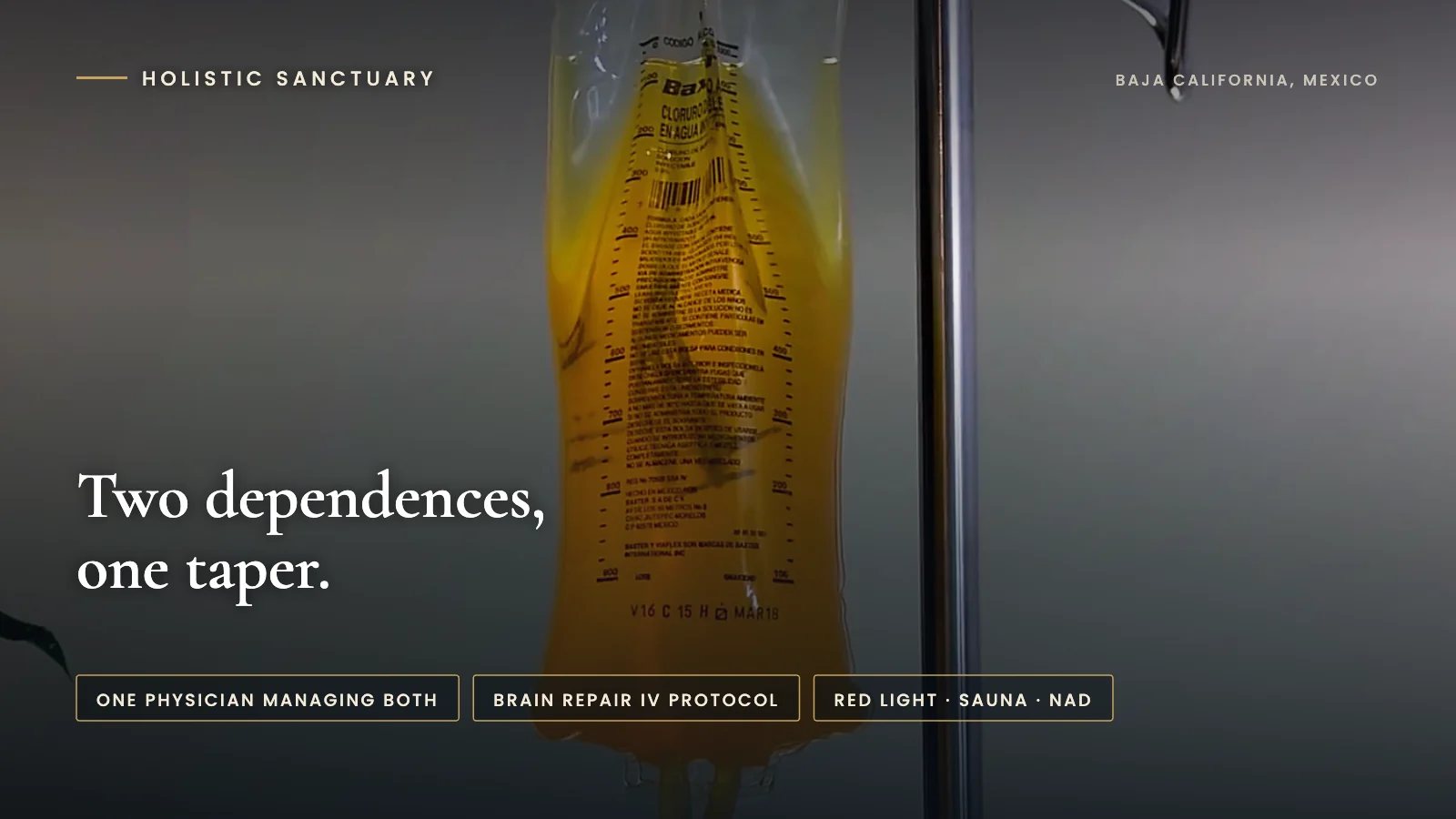
What we do not do is the point. There is no group therapy, no talk therapy in place of medicine, and no psychobabble. There is no strategy of replacing one dependence-forming drug with another as the treatment, which is exactly the trap that turns an alcohol detox into a benzodiazepine dependence. There is no alcohol on the property. The Brain Repair IV protocol, a proprietary intravenous protocol our founder developed for exactly this work, runs side by side with red light therapy, infrared sauna, NAD, daily massage, reiki and morning yoga, whose evidence and limits are set out honestly on the timeline page.
Every guest sleeps in a private oceanfront suite and eats organic food with no seed oils and no processed food.
Where the claim stops on benzodiazepines and alcohol: we do not claim to change anyone’s biology, we do not publish a success percentage, and we do not promise that a combined dependence will be resolved in twelve weeks. What we can say is that the program is designed around that window, that we have run it for fifteen years, and that treating benzodiazepines and alcohol as one problem, under one physician, in a place with no alcohol and no substitute sedatives, is, in my experience, the version that holds.
For the alcohol side, read luxury alcohol rehab; for the benzodiazepine side, how benzodiazepine treatment is built here and the pillar on benzodiazepine withdrawal. Admission is by medical clearance.
Frequently Asked Questions
Why are benzodiazepines and alcohol so dangerous together?
Both act on the GABA-A receptor and both depress breathing; together the effect is additive. The benzodiazepine label warns that combining them with alcohol can cause profound sedation, respiratory depression, coma and death, and CDC data from 2010 found alcohol involved in 27.2 percent of benzodiazepine-related emergency visits and 21.4 percent of benzodiazepine-related deaths.
What is cross-tolerance between benzodiazepines and alcohol?
Because both drugs act at the same receptor, the brain’s adaptation to one is adaptation to the other: a heavy drinker needs more of a benzodiazepine to feel it, and withdrawal from either resembles withdrawal from the other. It is why benzodiazepines are used to treat alcohol withdrawal, and why alcohol during a benzodiazepine taper undoes it.
Why do doctors give benzodiazepines for alcohol withdrawal?
The 2020 ASAM alcohol withdrawal guideline names benzodiazepines as first-line treatment for moderate and severe withdrawal because they reduce symptoms, seizures and delirium. The same guideline says the prescription should be discontinued after treatment; it is a bridge, not a long-term medication.
Can I have a drink while tapering off a benzodiazepine?
No. Alcohol acts on the same receptor the taper is asking to recover, so a drink erases the reduction that night and deepens rebound the next day. The Ashton Manual advises against anything that acts on the GABA-A receptor during a taper. The rule is none for the whole taper and the recovery after it.
What is kindling?
For benzodiazepines and alcohol alike, the phenomenon, described by Becker in 1998 for alcohol, by which repeated withdrawal episodes become progressively more severe. A similar pattern is described for benzodiazepines. It is why a slow taper that never has to be restarted is safer than a fast one that fails and is repeated.
How does Holistic Sanctuary treat benzodiazepine and alcohol dependence together?
Medical screening before admission, one physician writing one plan against both drugs, a twelve-to-sixteen-week residential program when a benzodiazepine taper is involved, nursing around the clock, no alcohol and no substitute sedatives, no group or talk therapy, and the Brain Repair IV protocol alongside red light therapy, infrared sauna, NAD, massage, reiki and yoga. No outcome is promised.
References
- Ativan (lorazepam) tablets, prescribing information, Warnings. DailyMed, U.S. National Library of Medicine. dailymed.nlm.nih.gov
- U.S. Food and Drug Administration. FDA requiring Boxed Warning updated to improve safe use of benzodiazepine drug class. 2020. fda.gov
- Jones CM, Paulozzi LJ, Mack KA. Alcohol involvement in opioid pain reliever and benzodiazepine drug abuse-related emergency department visits and drug-related deaths, United States, 2010. MMWR Morb Mortal Wkly Rep. 2014;63(40):881–885. cdc.gov
- Substance Abuse and Mental Health Services Administration. The DAWN Report: Benzodiazepines in combination with opioid pain relievers or alcohol: greater risk of more serious ED visit outcomes. 2014. samhsa.gov
- American Society of Addiction Medicine. The ASAM Clinical Practice Guideline on Alcohol Withdrawal Management. J Addict Med. 2020;14(3S). pubmed.ncbi.nlm.nih.gov
- Schuckit MA. Recognition and management of withdrawal delirium (delirium tremens). N Engl J Med. 2014;371(22):2109–2113. pubmed.ncbi.nlm.nih.gov
- Becker HC. Kindling in alcohol withdrawal. Alcohol Health Res World. 1998;22(1):25–33. pubmed.ncbi.nlm.nih.gov
- Griffin CE, et al. Benzodiazepine pharmacology and central nervous system-mediated effects. Ochsner J. 2013. pmc.ncbi.nlm.nih.gov
- Vinkers CH, Olivier B. Mechanisms underlying tolerance after long-term benzodiazepine use. Adv Pharmacol Sci. 2012. pubmed.ncbi.nlm.nih.gov
- Ashton H. Benzodiazepines: How They Work and How to Withdraw (the Ashton Manual), Chapter II. 2002. benzo.org.uk
- Brunner E, et al. Joint Clinical Practice Guideline on Benzodiazepine Tapering. J Gen Intern Med. 2025. link.springer.com
Medical disclaimer: this page is general information about benzodiazepines and alcohol and is not medical advice or a taper schedule. Do not stop, reduce, or substitute a prescribed benzodiazepine, or stop drinking abruptly after heavy daily use, without a physician; abrupt discontinuation can be life-threatening. Holistic Sanctuary does not diagnose, treat, or cure disease; individual results vary and no outcome is promised. In an emergency call 911. If you are thinking about suicide, call or text 988.