How to Choose a Luxury Rehab: Twelve Questions to Ask Before You Pay a Deposit
September 5, 2026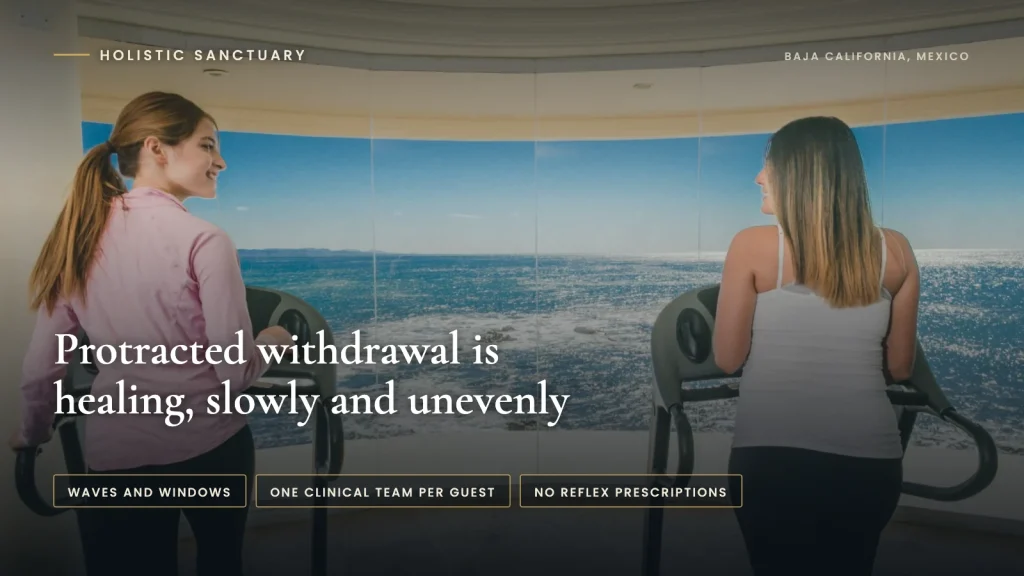
Protracted Benzodiazepine Withdrawal: Why It Can Last Months, and What Helps
September 5, 2026

How Long Does Benzo Withdrawal Last? The Timeline, Week by Week
 Johnny Tabaie, Founder & CEO, Holistic Sanctuary·Medically reviewed by
  Dr. Jose A. Jimenez, MD, Medical Director·Published · Last medically reviewed
 Benzo withdrawal is not two weeks and it is not forever. Here is the honest timeline from day one to month six, what the research says about protracted symptoms, why the standard outpatient taper takes months to years, and how we structure it here.
Read This Part First
If you are asking how long benzo withdrawal lasts, you are probably somewhere inside it, or you are watching someone you love go through it, and the internet has already given you two useless answers: “a couple of weeks” from the clinics and “years” from the forums. Both are true for somebody. Neither is the answer for you. This page is the honest version, week by week, with the research next to it, and then what we have learned in fifteen years of taking people through it here.
One thing before the timeline, and it is not a formality. Do not stop a benzodiazepine abruptly. The FDA’s boxed warning for the entire class says that abrupt discontinuation or rapid dose reduction can produce withdrawal reactions that are life-threatening, including seizures. Nothing on this page is a reason to skip a physician. If you or someone near you is thinking about suicide, call or text 988.
The Honest Answer, in One Paragraph
How long benzo withdrawal lasts depends on four things: which benzodiazepine, how much, for how long, and how fast it is being reduced. Acute benzo withdrawal, the physical storm, typically runs one to four weeks after the last dose reduction. A slower, quieter phase of returning symptoms follows and usually eases over the following weeks to months. And for a meaningful minority, a protracted phase of waves and windows continues for months, sometimes longer.
The 2025 joint clinical practice guideline from the American Society of Addiction Medicine puts it plainly: with the standard outpatient approach, “it may take months to years to fully taper off,” particularly after high doses over long periods. That is the clock the conventional model is working with. The rest of this page is about why, and about what changes it.

Why the Pill Decides the Clock
Benzodiazepines all act on the same receptor, but they leave the body at very different speeds, and the speed sets the shape of benzo withdrawal. Alprazolam (Xanax) has an elimination half-life of roughly eleven hours, lorazepam (Ativan) around twelve, clonazepam (Klonopin) thirty to forty, and diazepam (Valium) forty-three hours or more with an active metabolite that lingers for days. A short half-life means the drug drops out fast: withdrawal can begin within a day of a missed or reduced dose and hits hard and early.
A long half-life means a slower onset, sometimes a week or more, and a longer, flatter tail. This is why a person on Xanax and a person on Valium can both be told “two weeks” and have completely different experiences, and why the timeline below is a map, not a promise.
The Timeline, Week by Week
Days one to three
With a short-acting benzodiazepine, rebound arrives within a day: anxiety that is sharper than the anxiety the drug was prescribed for, insomnia, a racing heart, sweating, tremor, sensitivity to light and sound. With a long-acting one, these first days can be deceptively quiet, which is exactly when people decide they are fine and stop entirely. Seizure risk is highest in this early window after an abrupt stop or a large cut. Nobody should be doing this window alone.
Weeks one and two
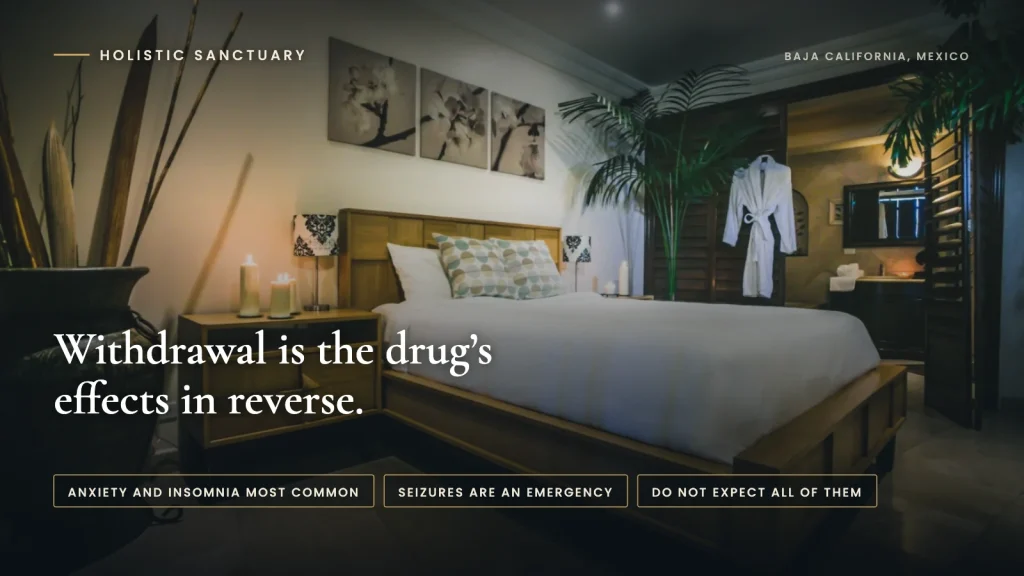
This is the acute peak of benzo withdrawal for most people. The nervous system, which has spent months or years being held down by the drug, is now firing without the brake. The classic picture described by Heather Ashton and by Pétursson’s review in Addiction includes insomnia, anxiety and panic, muscle pain and stiffness, tremor, nausea, palpitations, perceptual distortions, depersonalization, and, in some, a flat, hollow depression. Symptoms come in waves rather than a steady line. In a physician-managed taper, this is the phase where the dose is adjusted day by day to keep the storm survivable rather than heroic.
Weeks two to four
For most people the worst physical symptoms begin to loosen. Sleep is still broken, and the psychological symptoms, anxiety, dread, intrusive thoughts, tend to outlast the physical ones. This is the window in which the seven-day detox model discharges people and calls it done, and it is the window in which many of them relapse, because the body has not finished and nobody prepared them for what comes next.
Weeks four to eight
The pattern most people describe is “windows and waves”: stretches of hours or days that feel almost normal, interrupted by returns of symptoms that feel like a setback and are not. The windows lengthen and the waves shorten. Energy is low, concentration is poor, and the body is still recalibrating everything the drug was regulating: sleep architecture, heart rate, digestion, temperature.
Months two to six
For the majority, this is the long tail of recovery: symptoms that surface under stress, poor sleep, or illness, then recede. For a minority, this is where protracted benzo withdrawal establishes itself. Ashton’s 1991 paper described it clearly, and it remains the honest description: a syndrome that can persist for months and, in some, longer, with anxiety, insomnia, sensory symptoms, gastrointestinal problems, and cognitive fog as the most stubborn residents.
Beyond six months
A 2023 survey of 1,207 benzodiazepine users published in PLOS ONE found that more than half of those reporting low energy, distractedness, memory problems, nervousness, and anxiety said those symptoms lasted a year or longer, and a subset reported symptoms persisting a year or more after discontinuation. It was a self-selected survey, so it over-represents people who did badly, and I say so. But the people who did badly are real, and the research community now has a name for what they describe: benzodiazepine-induced neurological dysfunction.
If you have been told that what you are feeling at month eight “cannot be the drug,” you have been told something the literature does not support.
Why Benzo Withdrawal Comes in Waves
The wave pattern is not in your head; it is in your receptors. Benzodiazepines work by amplifying GABA, the brain’s main braking signal, at the GABA-A receptor. Used daily, the brain adapts: receptor subtypes shift, sensitivity falls, and the system learns to run with the drug’s extra braking built in. Vinkers and Olivier’s 2012 review of tolerance describes these subtype-specific changes in detail.
Take the drug away and the brake is suddenly too weak for the amount of accelerator the brain has grown used to, which is the anxiety, the insomnia, and the sensory overload of benzo withdrawal in one sentence. Receptors do not reset in a straight line. They recover in fits and starts, which is why a good week at week five can be followed by a bad one at week six, and why the honest description of a benzo withdrawal timeline is a trend, not a slope.
Every wave that is shorter than the last one is the recovery, even when it does not feel like it.
Why the Standard Model Takes One to Two Years
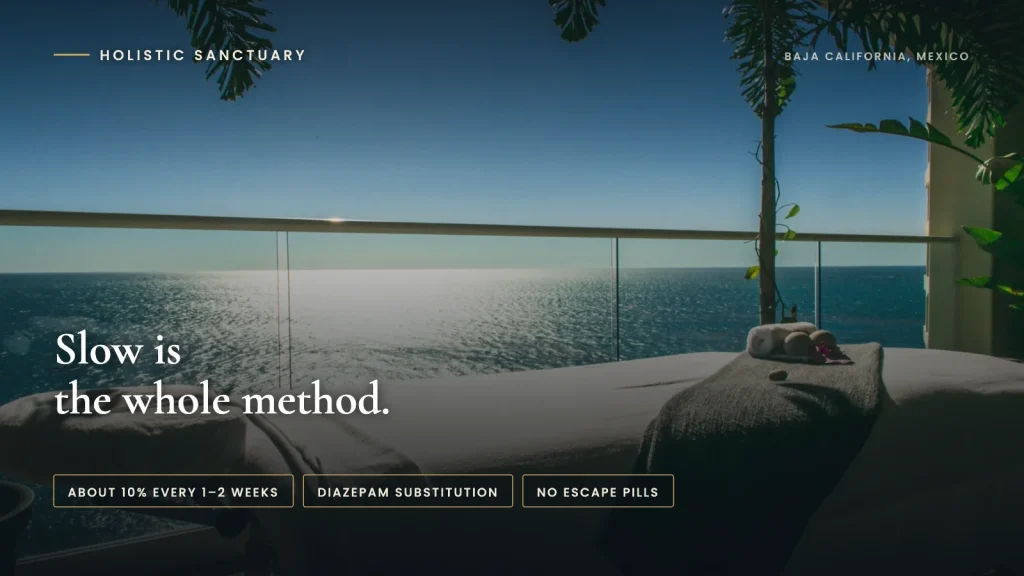
The conventional outpatient taper is built for safety in the absence of support, and it is right to be cautious. The 2025 ASAM guideline recommends dose reductions of five to ten percent every two to four weeks, never more than twenty-five percent in two weeks, with the pace slowed further near the end. Do the arithmetic on a person who has been on a moderate dose for years and you arrive at the guideline’s own words: months to years. That is not because the biology demands a year.
It is because the outpatient model has to plan for a person who is still working, still parenting, still sleeping badly in the same bed, seeing a prescriber once a month, with no one adjusting the dose on a Tuesday afternoon when the wave hits. Every one of those constraints slows the clock, and every one of them is a constraint of the setting, not of the nervous system.

What Changes the Clock Here: Twelve to Sixteen Weeks, Not Years
I will tell you what we do and where our claim stops, in that order, because I have watched this industry promise people the moon and I would rather you trust the next paragraph than be impressed by it.
Programs here for benzodiazepine dependence are built around twelve to sixteen weeks, in residence, one guest to one clinical team, with a physician managing the taper and licensed nurses present twenty-four hours a day. The taper itself follows the same principle as the guideline, gradual and individualized, but it is adjusted day by day rather than month by month, because the doctor is here and so are you. What surrounds the taper is the difference.
The nervous system is not being asked to recalibrate on top of a commute, a job, and a family; it is being asked to recalibrate on the Pacific coast with nothing else to do. And the body is supported the entire time by the Brain Repair IV protocol, a proprietary intravenous protocol our founder developed for exactly this work, individually dosed and delivered under nursing, running side by side with the therapies below.
Where the claim stops: we do not claim to change anyone’s biology, we do not publish a success percentage, and we do not promise that your timeline will be twelve weeks. What we can say is that this program is designed around that window, that we have run it for fifteen years, and that it exists because the alternative, a year or two of white-knuckling it at home, is what most of our guests had already tried.
What runs alongside the taper in benzo withdrawal, and what the evidence says
Red light therapy. A real but early evidence base for photobiomodulation, laid out in Hamblin’s 2016 review; non-invasive, well tolerated, and something guests continue at home. Infrared sauna. A 2015 JAMA Internal Medicine study found frequent sauna bathing associated with lower cardiovascular and all-cause mortality in a general population; what it reliably provides in withdrawal is deep relaxation and better sleep, for guests cleared for heat.
NAD. No controlled trials in addiction or mental health, and an FDA warning letter in January 2026 documented harm from a contaminated compounded lot; we use it carefully, under physician oversight, and never sell it as a cure. NAD is not the Brain Repair protocol, and neither are the other adjuncts here. Massage, daily. The best-supported physical therapy on the list; Field’s research review summarizes trials showing moderate-pressure massage lowers cortisol and reduces measured anxiety.
Reiki. The Cochrane review found insufficient evidence either way; we use it because guests in withdrawal describe it as the calmest hour of the day, and we present that as experience. Yoga and breathwork. A 2018 meta-analysis of randomized trials found meaningful short-term reductions in anxiety. Daily Dead Sea salt baths, organic food, a private oceanfront suite. Because the nervous system heals at night, and a body cannot repair on processed food and broken sleep.
None of that is a menu. Every program is designed after medical screening, bloodwork, blood pressure, an EKG, a stress test and an echocardiogram, for one person, and it changes as that person changes. If you want the whole picture of how benzodiazepine treatment is structured here, read the treatment page, and for the pillar on withdrawal itself, benzodiazepine withdrawal, explained.
What Makes Benzo Withdrawal Last Longer
Four things reliably lengthen benzo withdrawal. Stopping abruptly or cutting too fast, which can convert a manageable taper into a seizure and a protracted syndrome. Alcohol, which acts on the same receptor and quietly re-creates the dependence you are trying to leave. Caffeine and stimulants, which pour fuel on an already overfiring nervous system. And the seven-day detox, the program that discharges you in the middle of week two with a folder and a prescription for something else. If you have done one of those and are now in month nine, you are not weak and you are not imagining it. You were rushed.
Frequently Asked Questions
How long does benzo withdrawal last?
Acute withdrawal typically runs one to four weeks after the last dose reduction, a slower phase of returning symptoms eases over the following weeks to months, and a minority experience protracted symptoms for months or longer. The 2025 ASAM guideline says a standard outpatient taper can take months to years.
What is the benzo withdrawal timeline?
Days one to three: rebound anxiety and insomnia, earlier with short-acting drugs like Xanax. Weeks one and two: the acute peak. Weeks two to four: physical symptoms loosen, psychological ones persist. Weeks four to eight: windows and waves. Months two to six: the long tail, or the start of protracted withdrawal for a minority.
Can benzo withdrawal last for years?
For a minority, yes. Ashton described protracted withdrawal persisting for months and sometimes longer, and a 2023 survey in PLOS ONE reported symptoms lasting a year or more in many respondents. The research community now uses the term benzodiazepine-induced neurological dysfunction for these persistent effects.
Is it dangerous to stop benzos cold turkey?
Yes. The FDA’s boxed warning for the benzodiazepine class states that abrupt discontinuation or rapid dose reduction can cause life-threatening withdrawal reactions, including seizures. Any reduction should be managed by a physician.
How long is the benzodiazepine program at Holistic Sanctuary?
Programs for benzodiazepine dependence are built around twelve to sixteen weeks in residence, one guest to one clinical team, with a physician managing the taper, nursing around the clock, and the Brain Repair IV protocol running alongside red light therapy, infrared sauna, NAD, massage, reiki and yoga. No timeline is promised before medical screening.
Which benzo has the worst withdrawal?
Short-acting benzodiazepines such as alprazolam (Xanax) and lorazepam (Ativan) tend to produce faster, sharper withdrawal because they leave the body within hours; long-acting ones such as diazepam produce a slower onset and a longer tail. Dose and duration of use matter as much as the drug.
References
- U.S. Food and Drug Administration. FDA requiring Boxed Warning updated to improve safe use of benzodiazepine drug class. September 2020. fda.gov
- Brunner E, et al. Joint Clinical Practice Guideline on Benzodiazepine Tapering: Considerations When Risks Outweigh Benefits. J Gen Intern Med. 2025. link.springer.com
- American Society of Addiction Medicine. Benzodiazepine Tapering guideline page. asam.org
- Griffin CE, et al. Benzodiazepine pharmacology and central nervous system-mediated effects. Ochsner J. 2013. pmc.ncbi.nlm.nih.gov
- Ashton H. Benzodiazepines: How They Work and How to Withdraw (the Ashton Manual). 2002. benzo.org.uk
- Pétursson H. The benzodiazepine withdrawal syndrome. Addiction. 1994;89(11):1455–1459. pubmed.ncbi.nlm.nih.gov
- Ashton H. Protracted withdrawal syndromes from benzodiazepines. J Subst Abuse Treat. 1991;8(1-2):19–28. pubmed.ncbi.nlm.nih.gov
- Ritvo AD, et al. Long-term consequences of benzodiazepine-induced neurological dysfunction: a survey. PLOS ONE. 2023. journals.plos.org
- Fluyau D, Revadigar N, Manobianco BE. Challenges of the pharmacological management of benzodiazepine withdrawal, dependence, and discontinuation. Ther Adv Psychopharmacol. 2018. pmc.ncbi.nlm.nih.gov
- Hamblin MR. Shining light on the head: photobiomodulation for brain disorders. BBA Clin. 2016. pmc.ncbi.nlm.nih.gov
- Laukkanen T, et al. Association between sauna bathing and fatal cardiovascular and all-cause mortality events. JAMA Intern Med. 2015. jamanetwork.com
- U.S. Food and Drug Administration. Warning letter to GenoGenix LLC (NAD+ compounded product), January 20, 2026. fda.gov
- Field T. Massage therapy research review. Complement Ther Clin Pract. 2014. pmc.ncbi.nlm.nih.gov
- Joyce J, Herbison GP. Reiki for depression and anxiety. Cochrane Database Syst Rev. 2015. pubmed.ncbi.nlm.nih.gov
- Cramer H, et al. Yoga for anxiety: a systematic review and meta-analysis of randomized controlled trials. Depress Anxiety. 2018. pubmed.ncbi.nlm.nih.gov
- Vinkers CH, Olivier B. Mechanisms underlying tolerance after long-term benzodiazepine use: a future for subtype-selective GABA(A) receptor modulators? Adv Pharmacol Sci. 2012. pubmed.ncbi.nlm.nih.gov
Medical disclaimer: this page is general information about benzodiazepine withdrawal and is not medical advice. Do not stop or reduce a prescribed benzodiazepine without a physician; abrupt discontinuation can be life-threatening. Holistic Sanctuary does not diagnose, treat, or cure disease; individual results vary and no timeline is promised. In an emergency call 911. If you are thinking about suicide, call or text 988.