How Long Does Benzo Withdrawal Last? The Timeline, Week by Week
September 5, 2026
Can You Die From Benzo Withdrawal? What the Evidence Actually Says
September 5, 2026

Protracted Benzodiazepine Withdrawal: Why It Can Last Months, and What Helps
 Johnny Tabaie, Founder & CEO, Holistic Sanctuary·Medically reviewed by
  Dr. Jose A. Jimenez, MD, Medical Director·Published · Last medically reviewed
 Protracted benzodiazepine withdrawal is real, it affects a minority of people who stop these drugs, and it is not “all in your head.” Here is what the research says about why it happens, how long it lasts, what helps, what makes it worse, and how we approach it.
Read This Part First
Protracted benzodiazepine withdrawal is the thing nobody warned you about. You did the taper, or you did the seven-day detox, or you stopped on your own, and the first month was as bad as promised. Then month three arrived and you were still not right, and then month six, and somewhere in there a doctor told you it “could not still be the drug.” This page is for the people who were told that.
It explains what protracted withdrawal is, how common it actually is, why it happens, what the research says helps, what makes it worse, and how we approach it here, without pretending anyone can promise you a date.
Two things before we start. If you are still taking a benzodiazepine, do not stop it abruptly; the FDA’s boxed warning for the class is explicit that rapid discontinuation can cause life-threatening withdrawal, including seizures. And if you are thinking about suicide, which is not rare in protracted withdrawal, call or text 988 now.
What Protracted Benzodiazepine Withdrawal Is
Acute benzodiazepine withdrawal is the storm that follows the last dose reduction and typically runs one to four weeks. Protracted benzodiazepine withdrawal, sometimes called post-acute or post-withdrawal syndrome, is what happens when symptoms persist, or return in waves, for months after the drug is gone. Heather Ashton, the Newcastle pharmacologist who ran a benzodiazepine withdrawal clinic for twelve years, described it in a 1991 paper as a syndrome that can continue for many months and, in some people, longer, with anxiety, insomnia, depression, sensory and motor symptoms, and gastrointestinal disturbance as the most persistent features.
In her manual she estimated that perhaps ten to fifteen percent of long-term users develop a post-withdrawal syndrome, and that the proportion is lower among those who taper gradually.
The research community now has a broader term for the lasting effects of these drugs: benzodiazepine-induced neurological dysfunction, or BIND, which the 2025 joint clinical practice guideline from the American Society of Addiction Medicine formally recognizes. A 2023 survey of 1,207 benzodiazepine users in PLOS ONE found that among people reporting low energy, distractedness, memory problems, nervousness and anxiety, more than half said those symptoms lasted a year or longer.
It was a self-selected sample and it over-represents the people who did badly, and I will say that plainly rather than let you find out later. But it documents something the forums have described for two decades and the clinics denied: for a real minority, this lasts.
What Protracted Benzodiazepine Withdrawal Feels Like, and Why It Is Not “Just Anxiety”
The people I have taken through protracted benzodiazepine withdrawal describe the same cluster, in their own words. Anxiety that is not about anything, arriving at four in the morning with a racing heart. Insomnia that no sleep hygiene touches. A body that hums: tingling, burning skin, muscle twitches, jelly legs, inner vibration. Sensitivity to light and sound so sharp that a supermarket is unbearable. Depersonalization, the feeling of watching your own life through glass. Gut symptoms, from bloating to food intolerances that appeared from nowhere. Cognitive fog, poor memory, difficulty reading a page. And a flat, hollow depression that has none of the content of ordinary sadness.
Two features distinguish it from a relapse of the original anxiety, and Ashton pointed them out thirty years ago. First, the symptoms are new: people who took the drug for insomnia develop sensory symptoms they never had before. Second, they come in waves and windows, stretches of near-normal interrupted by returns, which is not how an anxiety disorder behaves. If a clinician tells you that what you have at month eight is your original condition coming back, ask them why you have symptoms you never had before you took the pill.
Why It Happens
The honest answer is that the mechanism is not fully mapped, and I will not pretend otherwise. What is established is this. Benzodiazepines amplify GABA, the nervous system’s main braking signal, at the GABA-A receptor. With daily use the brain adapts: receptor subunits shift, sensitivity falls, and the entire excitatory-inhibitory balance is re-tuned around the drug. Vinkers and Olivier’s 2012 review lays out these subtype-specific changes in detail. When the drug is removed, the brake is gone and the accelerator, the glutamate system, is still set high. Receptors do not reset on a schedule; they recover unevenly, which is the waves and windows.
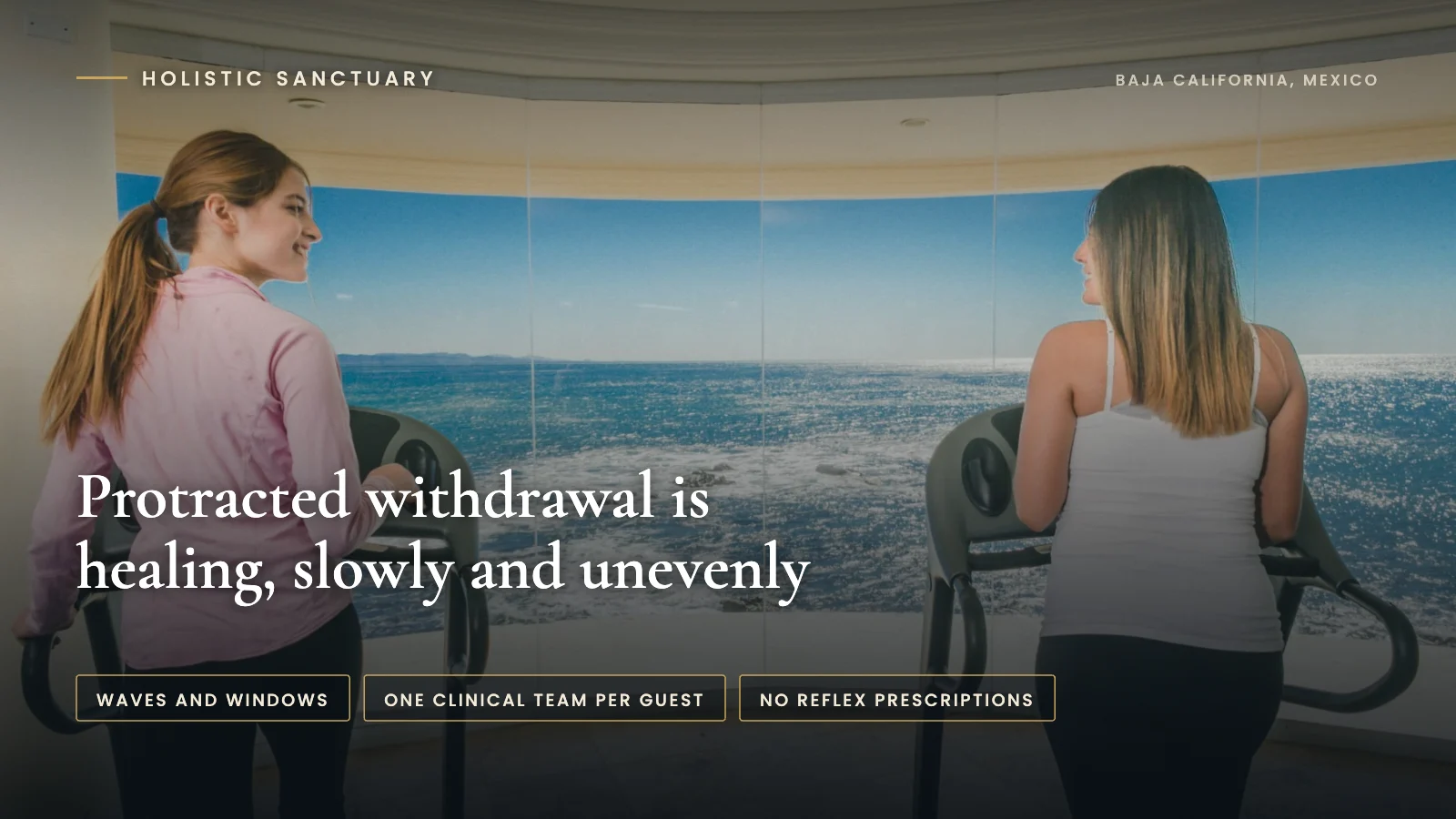
Layered on top of that are the systems the drug was quietly regulating: the stress axis, sleep architecture, the gut, and the body’s sensory gating. Each recovers at its own pace, and a period of stress or illness can pull any of them backward for a time. What this means in practice is that protracted benzodiazepine withdrawal is not a sign of damage that will not heal. It is a sign of a nervous system that is healing slowly and unevenly, and the trend, over months, is the thing to watch, not the individual bad week.
The Course Most People Describe
Nobody can give you a date for protracted benzodiazepine withdrawal, but there is a shape, and knowing it helps. The first three months after the last dose are usually the most intense, with symptoms present most days. Between months three and six, windows begin: a morning, then a day, then several days that feel close to normal, followed by a wave that feels like falling back to the start and is not.
Between six and twelve months the windows lengthen and the waves shorten and soften, and the symptoms that leave last tend to be sleep, sensory sensitivity, and the early-morning anxiety.
Beyond a year, most people who reached this point describe themselves as largely recovered, with occasional short waves under stress. That is a description drawn from Ashton’s clinic and from fifteen years of listening to people here, not a promise, and your course will be your own.
A note on “fixes”
You will read about flumazenil infusions, supplements, and protocols that claim to reset the receptor in days. Low-dose flumazenil has been studied in small trials for benzodiazepine dependence, and the results are preliminary; nothing on the market has controlled-trial evidence for protracted benzodiazepine withdrawal, and anything that promises a reset in days should be treated with the same suspicion as the seven-day detox that may have put you here. Our own protocol, described below, is presented with that same honesty.
What the Research Says Helps, and What Does Not
Start with what does not help, because that is where people get hurt. Reinstating the benzodiazepine at a high dose and stopping again, the pattern of repeated withdrawals, is associated with worse and longer syndromes; the literature on kindling in sedative withdrawal is the reason clinicians warn against repeated rapid discontinuations, and the 2025 ASAM guideline is explicit that abrupt discontinuation should be avoided in anyone likely to be dependent. Adding a second sedative, a sleeping pill or an alcohol habit, re-creates the same receptor dependence under a different name.
And the seven-day detox, the program that discharges you at the peak of acute withdrawal with a folder, is the single most common history among the people who arrive here in month nine.
What helps protracted benzodiazepine withdrawal has a thinner evidence base than anyone would like, so I will describe it at the strength it deserves. Time is the treatment with the strongest evidence; the trajectory in Ashton’s clinic and in every follow-up since is toward recovery, unevenly. A physician who understands the syndrome and does not reach for a new prescription every visit changes the experience more than any single therapy. Sleep, protected and prioritized, because the nervous system does its repair at night. Removing alcohol and caffeine, which act on the very systems trying to recalibrate.
Gentle movement rather than intense exercise, which can provoke waves. And nutrition that gives a depleted body what it needs to rebuild: whole food, protein, hydration, no processed food.

How We Approach Protracted Benzodiazepine Withdrawal Here
I will describe what we do and then tell you where the claim stops. People come to us in two situations: still on the drug and needing a taper that is managed properly, or off the drug and stuck in a protracted syndrome that nobody around them recognizes. For both, the program is built around twelve to sixteen weeks in residence, one guest to one clinical team, with a physician overseeing every decision and licensed nurses present twenty-four hours a day. Where a taper is still needed, it is gradual and individualized, adjusted day by day rather than month by month, because the doctor is here.
What surrounds it is the difference. The nervous system is asked to recalibrate on the Pacific coast, with nothing else to do, rather than on top of a commute and a family. The body is supported the entire time by the Brain Repair IV protocol, a proprietary intravenous protocol our founder developed for exactly this work, individually dosed and delivered under nursing, and it runs side by side with red light therapy, infrared sauna, NAD, daily massage, reiki, and morning yoga, each of which has its evidence set out honestly on the timeline page.
Every guest sleeps in a private oceanfront suite, eats organic food cooked that day with no seed oils and no processed food, and takes a Dead Sea salt bath every night, because the nervous system heals at night.
Where the claim stops: we do not claim to change anyone’s biology, we do not publish a success percentage, and we do not promise that a syndrome that has lasted a year will resolve in twelve weeks. What we can say is that this program is designed for precisely this situation, that we have run it for fifteen years, and that the people who arrive in month nine having been told it is all in their head are, in my experience, the people who most need to hear that it is not.
If you want the full structure, read how benzodiazepine treatment is built here and the pillar on benzodiazepine withdrawal. Admission is by medical clearance.
What to Say to a Doctor Who Says It Cannot Be the Drug
This conversation is the one most people in protracted benzodiazepine withdrawal dread, so here is how to have it. Bring the 2025 ASAM guideline, which is written by and for physicians and recognizes benzodiazepine-induced neurological dysfunction by name; a doctor who has not read it is far more likely to listen to a guideline than to a forum. Bring a written symptom timeline: when the drug started, when it stopped, and which symptoms are new since. New symptoms are the point, because a return of the original anxiety does not produce burning skin, tinnitus, or food intolerances that did not exist before the prescription.
Ask three questions. Is there a medical cause for these symptoms that we should rule out, because thyroid, cardiac and neurological conditions can mimic protracted benzodiazepine withdrawal and deserve to be excluded. If the tests are clear, what is your plan other than a new prescription. And what would you expect a nervous system to do, twelve months after a decade on a GABA-A agonist, if not this. A good physician will engage with all three. A physician who answers by reaching for a prescription pad has told you what you need to know about whether to keep seeing them.
And if you are the physician reading this, on behalf of a patient who printed it out: thank you for reading it. The people who arrive here in month nine almost always describe the same turning point, which was the first clinician who said, simply, I believe you.
If You Are Watching Someone Go Through This
Believe them. That is the whole instruction, and it is the one most families fail, not out of cruelty but because the person looks fine on the good days and the doctors keep saying it cannot be the drug. Protracted benzodiazepine withdrawal is invisible from the outside and total from the inside. Do not push them to “get back to normal.” Do not let anyone talk them into a fast reinstatement or a new sedative without a physician who understands this syndrome. Keep alcohol out of the house. And if they say they are thinking about not being here, take it seriously and call 988 together.
Frequently Asked Questions
What is protracted benzodiazepine withdrawal?
A syndrome in which withdrawal symptoms persist or return in waves for months after a benzodiazepine is stopped, described by Ashton in 1991 and now discussed under the broader term benzodiazepine-induced neurological dysfunction, which the 2025 ASAM guideline recognizes.
How long does protracted benzo withdrawal last?
Protracted benzodiazepine withdrawal lasts months for most who develop it, and longer for some. A 2023 survey in PLOS ONE found many respondents reporting symptoms lasting a year or more. The trend over months is toward recovery, unevenly, in waves and windows.
How common is protracted withdrawal?
Ashton estimated that perhaps ten to fifteen percent of long-term users develop a post-withdrawal syndrome, fewer among those who taper gradually. Estimates vary with how it is defined and who is counted; it is a minority, and it is a real one.
Is protracted withdrawal permanent?
The literature describes protracted benzodiazepine withdrawal as a syndrome that improves over time, unevenly. It is best understood as slow, uneven healing rather than fixed damage, though no one can promise an individual timeline.
What makes protracted benzodiazepine withdrawal worse?
Protracted benzodiazepine withdrawal is made worse by repeated rapid discontinuations, reinstating at high doses and stopping again, adding another sedative or alcohol, caffeine and stimulants, intense exercise during waves, and poor sleep.
How does Holistic Sanctuary treat protracted benzodiazepine withdrawal?
A twelve-to-sixteen-week residential program, one guest to one clinical team, physician oversight and nursing around the clock, the Brain Repair IV protocol alongside red light therapy, infrared sauna, NAD, massage, reiki and yoga, protected sleep and organic food. No outcome or timeline is promised before medical screening.
References
- Ashton H. Protracted withdrawal syndromes from benzodiazepines. J Subst Abuse Treat. 1991;8(1-2):19–28. pubmed.ncbi.nlm.nih.gov
- Ashton H. Benzodiazepines: How They Work and How to Withdraw (the Ashton Manual), Chapter III: Benzodiazepine withdrawal symptoms, acute and protracted. 2002. benzo.org.uk
- Brunner E, et al. Joint Clinical Practice Guideline on Benzodiazepine Tapering: Considerations When Risks Outweigh Benefits. J Gen Intern Med. 2025. link.springer.com
- Ritvo AD, et al. Long-term consequences of benzodiazepine-induced neurological dysfunction: a survey. PLOS ONE. 2023. journals.plos.org
- U.S. Food and Drug Administration. FDA requiring Boxed Warning updated to improve safe use of benzodiazepine drug class. 2020. fda.gov
- Vinkers CH, Olivier B. Mechanisms underlying tolerance after long-term benzodiazepine use. Adv Pharmacol Sci. 2012. pubmed.ncbi.nlm.nih.gov
- Pétursson H. The benzodiazepine withdrawal syndrome. Addiction. 1994;89(11):1455–1459. pubmed.ncbi.nlm.nih.gov
- Fluyau D, Revadigar N, Manobianco BE. Challenges of the pharmacological management of benzodiazepine withdrawal, dependence, and discontinuation. Ther Adv Psychopharmacol. 2018. pmc.ncbi.nlm.nih.gov
- Hamblin MR. Shining light on the head: photobiomodulation for brain disorders. BBA Clin. 2016. pmc.ncbi.nlm.nih.gov
- Laukkanen T, et al. Association between sauna bathing and fatal cardiovascular and all-cause mortality events. JAMA Intern Med. 2015. jamanetwork.com
- Field T. Massage therapy research review. Complement Ther Clin Pract. 2014. pmc.ncbi.nlm.nih.gov
- Cramer H, et al. Yoga for anxiety: a systematic review and meta-analysis of randomized controlled trials. Depress Anxiety. 2018. pubmed.ncbi.nlm.nih.gov
- Lane MM, et al. Ultra-processed food exposure and adverse health outcomes: umbrella review. BMJ. 2024;384:e077310. bmj.com
Medical disclaimer: this page is general information about protracted benzodiazepine withdrawal and is not medical advice. Do not stop or reduce a prescribed benzodiazepine without a physician; abrupt discontinuation can be life-threatening. Holistic Sanctuary does not diagnose, treat, or cure disease; individual results vary and no timeline is promised. In an emergency call 911. If you are thinking about suicide, call or text 988.