Protracted Benzodiazepine Withdrawal: Why It Can Last Months, and What Helps
September 5, 2026
Benzo Withdrawal Insomnia: Why You Cannot Sleep, and What Works
September 5, 2026

Can You Die From Benzo Withdrawal? What the Evidence Actually Says
 Johnny Tabaie, Founder & CEO, Holistic Sanctuary·Medically reviewed by
  Dr. Jose A. Jimenez, MD, Medical Director·Published · Last medically reviewed
 Yes, rarely, and almost always after an abrupt stop. Here is how benzo withdrawal can kill, who is most at risk, what the FDA boxed warning and the 2025 ASAM guideline say, and what a safe, supervised withdrawal looks like.
Read This Part First
Can you die from benzo withdrawal? Yes. It is rare, it is almost always the result of stopping abruptly or being stopped abruptly, and it is preventable, which is the reason this page exists. If you searched that question at two in the morning because you ran out of pills or because a doctor cut you off, the single most important sentence on this page is the next one: do not stop a benzodiazepine on your own, and if you already have and you are having any of the symptoms described below, go to an emergency room tonight.
I am not a physician. I am a former patient who has spent fifteen years watching people arrive here after somebody told them benzo withdrawal was “not dangerous like alcohol.” That sentence has hurt more people than I can count. What follows is what the evidence actually says, in plain language, with the sources next to it, and then what a safe withdrawal looks like. If you or someone near you is thinking about suicide, which is a real feature of withdrawal, call or text 988.
The Short Answer, and What the FDA Says
In September 2020 the U.S. Food and Drug Administration required a boxed warning, its strongest, on every benzodiazepine, and the reason was withdrawal. The warning states that abrupt discontinuation or rapid dose reduction can produce withdrawal reactions that are life-threatening, including seizures, and that the drugs should be tapered gradually and under supervision. That is not a forum opinion. It is the federal regulator, printed on the label of Xanax, Klonopin, Ativan and Valium, telling every prescriber in the country that stopping these drugs the wrong way can kill.
The 2025 joint clinical practice guideline on benzodiazepine tapering, developed by the American Society of Addiction Medicine with a coalition of other medical societies, says the same thing from the clinical side: clinicians should not discontinue benzodiazepines abruptly in patients who are likely to be physically dependent, because rapid cessation can cause serious and potentially life-threatening withdrawal. So the honest answer to “can you die from benzo withdrawal” is yes, and the more useful answer is how, to whom, and how it is prevented.
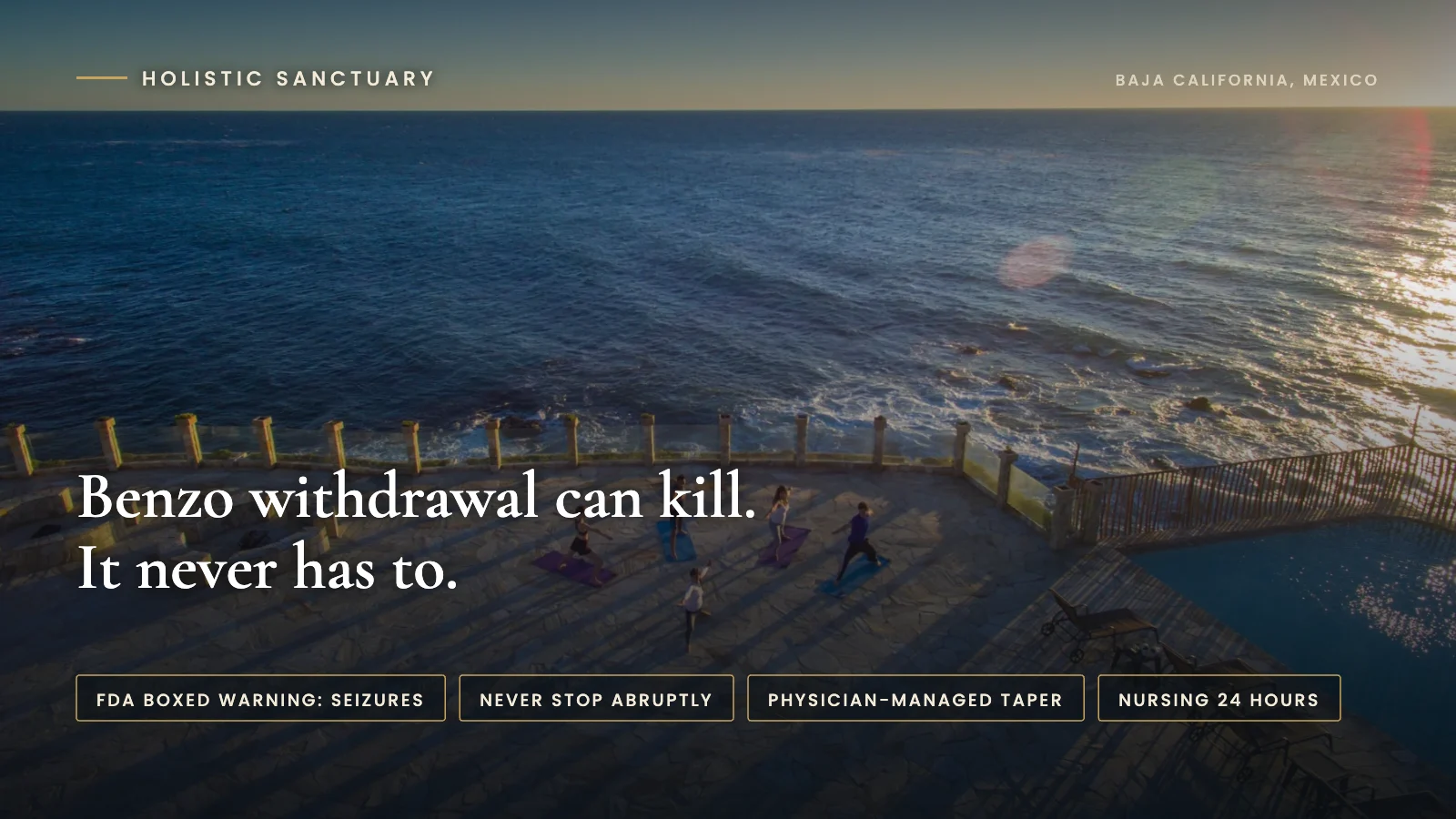
How Benzo Withdrawal Can Kill
Seizures
This is the mechanism behind most of the deaths. Benzodiazepines amplify GABA, the brain’s braking signal. Used daily for months, the brain adapts by turning the brake down; take the drug away suddenly and the accelerator, the glutamate system, is running unopposed. The result can be a grand mal seizure, typically in the first days after an abrupt stop, and with short-acting drugs like alprazolam it can come within a day. A single seizure in the wrong place, driving, in a bath, on stairs, can be fatal.
Repeated seizures without recovery in between, status epilepticus, is a medical emergency with its own mortality. Pétursson’s review of the benzodiazepine withdrawal syndrome in Addiction lists seizures among the severe features of abrupt withdrawal, and the case literature includes deaths in which withdrawal seizures were the cause.
Delirium and cardiovascular collapse
Severe withdrawal can produce a delirium indistinguishable from the delirium tremens of alcohol withdrawal: confusion, hallucinations, agitation, a racing heart, soaring blood pressure, and a body temperature that climbs. In a person with heart disease, that autonomic storm is dangerous in itself, and in an older person it can be fatal through dehydration, arrhythmia, or a fall. A 2009 case report in the American Journal of Forensic Medicine and Pathology documented a death attributed to benzodiazepine withdrawal, which is the kind of paper that should end the argument about whether this is “really” dangerous.
Catatonia
Less known and under-recognized: abrupt benzodiazepine withdrawal can precipitate catatonia, a state of immobility, mutism and autonomic instability that, untreated, carries real mortality through dehydration, clotting, and cardiac complications. The Fluyau review in Therapeutic Advances in Psychopharmacology discusses it among the serious complications of withdrawal. The irony is that the treatment for catatonia is a benzodiazepine, which is one more reason nobody should be managing this alone.
Suicide and accidents
The acute phase of benzo withdrawal produces a level of anxiety, insomnia and despair that people who have not felt it cannot imagine, and it produces it in a person whose judgment and impulse control are impaired. Suicidal thinking during withdrawal is common enough that every page on this site about benzodiazepines carries the 988 number, and I would rather print it a thousand times than leave it off once. Accidents, from falls to car crashes, follow the same impaired state.
Why “It Is Not as Dangerous as Alcohol” Is Wrong
The comparison people reach for is alcohol, and the belief that benzo withdrawal is the safer of the two is exactly backwards in one important way. Alcohol and benzodiazepines act on the same GABA-A receptor, which is why the withdrawal syndromes look alike: tremor, sweating, racing heart, seizures, delirium. The ASAM alcohol withdrawal guideline treats severe alcohol withdrawal as a medical emergency, and every hospital has a protocol for it.
Benzo withdrawal produces the same emergency with less recognition, because a person arriving with a prescription bottle does not look like a person in danger, and because the drug itself is what the emergency room would normally use to treat the seizure.
There is a second difference that makes benzo withdrawal harder to manage, not easier. Alcohol leaves the body in hours, so the withdrawal window is compressed into days. A benzodiazepine like diazepam, with an active metabolite that lingers for days, can produce a withdrawal syndrome that arrives late and lasts longer, which means the danger window is wider and easier to misjudge.
A person who stopped Valium on Monday and feels fine on Wednesday has not escaped; the drug has simply not left yet.
What happens in the body after an abrupt stop
With a short-acting drug, the first signs of benzo withdrawal can appear within six to twelve hours: rebound anxiety, insomnia, sweating. By twenty-four to seventy-two hours the autonomic symptoms build, tremor, palpitations, rising blood pressure, and this is the highest-risk window for a seizure.
Days three to seven bring the peak of the acute syndrome, including the perceptual distortions and, in severe cases, delirium. With a long-acting drug, shift the whole picture later by several days. Nothing about that timeline is a reason to be frightened if the dose is coming down gradually under supervision; all of it is a reason not to let anyone, including yourself, stop a benzodiazepine on the spot.
Who Is Most at Risk in Benzo Withdrawal
The risk of dying from benzo withdrawal is not evenly spread, and knowing where it concentrates is what lets a physician plan. Risk rises with higher doses and longer duration of use, because the brain has adapted further. It rises with short-acting drugs, alprazolam and lorazepam, because they leave the body fast and the drop is steep. It rises sharply with abrupt discontinuation, whether by choice, by running out, or by a prescriber who cuts a patient off.
It rises with alcohol, which acts on the same receptor and doubles the withdrawal when both are stopped, and with a history of seizures or of previous withdrawal episodes, because the nervous system appears to become more reactive with each one. And it rises with age and with medical illness, because an older heart tolerates an autonomic storm less well than a younger one.
None of these means you will die from benzo withdrawal. All of them mean that a person carrying two or three of them should not be reducing the dose without a physician, and should almost certainly not be doing it at home.
The Most Dangerous Sentence in This Industry
“We can have you off in seven days.” I have heard it from the mouths of people running detox centers, and I have taken in the people who believed it. A seven-day benzodiazepine detox is, in most cases, an abrupt discontinuation with a bed attached. The ASAM guideline recommends dose reductions of five to ten percent every two to four weeks, never more than twenty-five percent in two weeks, with the pace slowed near the end, and it notes plainly that for people on high doses for long periods the process can take months.
A program that compresses that into a week is not running a faster version of the guideline. It is running the thing the guideline was written to prevent, and it is discharging people into the window when seizures and delirium are most likely.
The other dangerous version is the prescriber who simply stops writing the prescription. It happens after a pharmacy flag, a change of doctor, or a prescription monitoring review, and the patient, who did nothing wrong, is left to withdraw abruptly. If that is you, call a physician today and say the words “I am physically dependent on a benzodiazepine and I need a supervised taper.” Those words are not an admission of anything. They are a medical fact that any competent doctor will act on.

What a Safe Benzo Withdrawal Actually Looks Like
A safe benzo withdrawal looks slow, supervised, and boring, which is exactly what you want. The dose comes down gradually, on a schedule set by a physician who adjusts it to the person rather than the calendar. Someone with a license is watching for the early signs of trouble: rising pulse, rising blood pressure, tremor, confusion, twitching. The things that make withdrawal worse, alcohol above all, are out of the picture. And the person is not alone at three in the morning when the wave hits.
Here is how that is built at Holistic Sanctuary, stated as fact rather than promise. Admission is by medical clearance: bloodwork, blood pressure, an EKG, a stress test and an echocardiogram are reviewed by our medical director before any program is designed, which is how the cardiac and seizure risks above are identified before they become emergencies. Licensed nurses are on site twenty-four hours a day. The taper is physician-managed and adjusted day by day.
Programs for benzodiazepine dependence are built around twelve to sixteen weeks in residence, one guest to one clinical team, and the body is supported throughout by the Brain Repair IV protocol alongside red light therapy, infrared sauna, NAD, massage, reiki and yoga, whose evidence is set out honestly on the timeline page.
In fifteen years of operation there has been no guest death at this facility. I state that once, as a fact about the past, and I attach it to the practices above rather than to luck, because it is the screening, the nursing and the physician that produce it, and any facility that offers you the number without the practices is offering you a sentence. If you want the full structure, read how benzodiazepine treatment is built here and the pillar on benzodiazepine withdrawal.
When to Go to the Emergency Room Tonight
Benzo withdrawal becomes an emergency fast. If you or someone you are with has stopped a benzodiazepine in the last week, or cut the dose sharply, and any of the following is happening, this is not a wait-and-see situation: a seizure or a suspected seizure, confusion or hallucinations, a heart rate that will not come down, a fever, severe agitation, inability to keep fluids down, or any talk of suicide. Tell the emergency staff exactly which drug, what dose, and when the last dose was taken. They can stabilize withdrawal safely, and the embarrassment you may feel about the visit is not worth your life.
Frequently Asked Questions
Can you die from benzo withdrawal?
Yes, rarely, and almost always after abrupt discontinuation. The FDA’s boxed warning for the benzodiazepine class states that abrupt discontinuation or rapid dose reduction can cause life-threatening withdrawal, including seizures. Deaths are documented in the medical literature and are preventable with a supervised taper.
How does benzo withdrawal kill?
Benzo withdrawal kills mainly through seizures, including status epilepticus, and through severe withdrawal delirium with cardiovascular instability. Catatonia, suicide during the acute phase, and accidents while impaired are the other routes.
Is benzo withdrawal more dangerous than alcohol withdrawal?
They are the two withdrawal syndromes that can be fatal, because both act on the GABA-A receptor. Stopping both at once compounds the risk. Neither should be attempted without medical supervision.
Is a seven-day benzo detox safe?
In most cases a seven-day benzo withdrawal is an abrupt discontinuation, which is what the FDA warning and the ASAM guideline exist to prevent. The guideline describes reductions of five to ten percent every two to four weeks, and discharge in the first week places a person in the highest-risk window.
What if my doctor stopped my prescription suddenly?
Contact a physician today and state that you are physically dependent on a benzodiazepine and need a supervised taper. If withdrawal symptoms are already severe, go to an emergency room.
How does Holistic Sanctuary make benzodiazepine withdrawal safe?
Medical clearance before admission (bloodwork, blood pressure, EKG, stress test, echocardiogram), licensed nurses on site around the clock, a physician-managed taper adjusted daily, and a twelve-to-sixteen-week residential program with the Brain Repair IV protocol and supporting therapies. No outcome is promised before screening.
References
- U.S. Food and Drug Administration. FDA requiring Boxed Warning updated to improve safe use of benzodiazepine drug class. September 2020. fda.gov
- Brunner E, et al. Joint Clinical Practice Guideline on Benzodiazepine Tapering: Considerations When Risks Outweigh Benefits. J Gen Intern Med. 2025. link.springer.com
- Pétursson H. The benzodiazepine withdrawal syndrome. Addiction. 1994;89(11):1455–1459. pubmed.ncbi.nlm.nih.gov
- Lann MA, Molina DK. A fatal case of benzodiazepine withdrawal. Am J Forensic Med Pathol. 2009. pubmed.ncbi.nlm.nih.gov
- Fluyau D, Revadigar N, Manobianco BE. Challenges of the pharmacological management of benzodiazepine withdrawal, dependence, and discontinuation. Ther Adv Psychopharmacol. 2018. pmc.ncbi.nlm.nih.gov
- Griffin CE, et al. Benzodiazepine pharmacology and central nervous system-mediated effects. Ochsner J. 2013. pmc.ncbi.nlm.nih.gov
- Ashton H. Benzodiazepines: How They Work and How to Withdraw (the Ashton Manual). 2002. benzo.org.uk
- Vinkers CH, Olivier B. Mechanisms underlying tolerance after long-term benzodiazepine use. Adv Pharmacol Sci. 2012. pubmed.ncbi.nlm.nih.gov
- American Society of Addiction Medicine. Clinical Practice Guideline on Alcohol Withdrawal Management. 2020. asam.org
- 988 Suicide and Crisis Lifeline. 988lifeline.org
Medical disclaimer: this page is general information about the risks of benzodiazepine withdrawal and is not medical advice. Do not stop or reduce a prescribed benzodiazepine without a physician; abrupt discontinuation can be life-threatening. Holistic Sanctuary does not diagnose, treat, or cure disease; individual results vary and no outcome is promised. In an emergency call 911. If you are thinking about suicide, call or text 988.