Can You Die From Benzo Withdrawal? What the Evidence Actually Says
September 5, 2026
Akathisia and Benzodiazepine Withdrawal: The Symptom Nobody Names
September 5, 2026

Benzo Withdrawal Insomnia: Why You Cannot Sleep, and What Works
 Johnny Tabaie, Founder & CEO, Holistic Sanctuary·Medically reviewed by
  Dr. Jose A. Jimenez, MD, Medical Director·Published · Last medically reviewed
 Benzo withdrawal insomnia is the symptom that breaks people. Here is why benzodiazepines wreck sleep on the way out, how long it lasts, what makes it worse, what the research says actually helps, and how we build the evening around sleep here.
Read This Part First
Benzo withdrawal insomnia is the symptom that breaks people. Not the anxiety, not the tremor, not the burning skin. It is lying in the dark at three in the morning for the ninth night in a row, wide awake with a heart that will not slow down, knowing that the one thing that would put you to sleep is the pill you are trying to leave. I have been in that bed. I have taken hundreds of people through it since.
This page explains why benzodiazepine withdrawal does this to sleep, what the research says about how long it lasts and what helps, what makes it worse, and how we approach it here, without pretending anyone can hand you eight hours on a schedule.
Before anything else: do not stop a benzodiazepine abruptly to “get it over with.” The FDA’s boxed warning for the class is explicit that abrupt discontinuation can cause life-threatening withdrawal, including seizures. And if the sleeplessness has brought you to thoughts of not wanting to be here, which it does to people, call or text 988 tonight.
Why Benzo Withdrawal Destroys Sleep
Benzodiazepines put people to sleep by amplifying GABA, the nervous system’s main braking signal. They do not produce natural sleep; they produce sedation, and the sleep they produce is measurably different. Studies of sleep architecture under benzodiazepines show reduced slow-wave sleep, the deep, restorative stage, and altered REM, which is why people can sleep eight hours on a benzodiazepine and wake unrefreshed. Used every night for months, the brain adapts by turning down its own GABA sensitivity, so the drug is now required to reach the same shallow sleep it once produced on its own.
Remove the drug and two things happen at once. The brake is gone, so the nervous system is overactive: racing thoughts, a pounding heart, sensitivity to every sound. And the sleep systems the drug was suppressing come roaring back in the wrong proportions. That second effect has a name. In 1978 Anthony Kales and colleagues described “rebound insomnia” in Science: after withdrawal of a benzodiazepine, sleep becomes worse than it was before the drug was ever started, sometimes dramatically so. That paper is nearly fifty years old, and it explains what you are feeling better than anything on a forum.

What Benzo Withdrawal Insomnia Looks Like
Benzo withdrawal insomnia is not ordinary insomnia. People describe the same features, in the same words. Difficulty falling asleep, with a body that feels wired rather than tired. Waking at two or three in the morning with a jolt of adrenaline, and not returning to sleep. Sleep that, when it comes, is shallow and full of vivid, exhausting dreams, the REM rebound that follows years of REM suppression. Total nights, sometimes several in a row, with no sleep at all in the early weeks.
And a peculiar feature that frightens people: the sense of being on the edge of sleep and being yanked back by a jerk or a sudden surge of anxiety, over and over, a phenomenon of the overactive nervous system that fades as the receptors recover.
Two things to know about it. First, zero-sleep nights in acute benzo withdrawal are frightening but they are not, in themselves, medically dangerous in an otherwise healthy person; the body will take the sleep it needs in fragments, and the danger in withdrawal comes from seizures and delirium, not from tiredness. Second, it improves, and the improvement is uneven: a good night, then two bad ones, then three good ones. That is the pattern of a recovering nervous system, not a broken one.
How Long Benzo Withdrawal Insomnia Lasts
The honest answer is that it depends on the drug, the dose, the duration, and the pace of the taper, and that sleep is usually the last symptom to normalize. In a gradual, physician-managed taper, rebound insomnia tends to flare with each dose reduction for a few nights and then settle. After the last dose, the acute phase of poor sleep typically runs several weeks. For most people, sleep is meaningfully better by two to three months and continues to improve over the following months in windows and waves.
For the minority who develop protracted withdrawal, insomnia is one of the persistent features that Ashton described, and it can wax and wane for many months. Even then, the trajectory in her clinic and in every follow-up since is toward normal sleep. The nervous system does not forget how to sleep; it has to relearn the timing without the drug, and that takes as long as it takes. What shortens it is not a new pill. It is everything that lets the nervous system settle.
A Night in Benzo Withdrawal, Hour by Hour
Knowing the shape of the night takes some of the fear out of it. Bedtime arrives and the body is exhausted but the mind is not; this is the wired-tired feeling of an overactive nervous system, and it is the moment people reach for the extra dose. If sleep comes, it often comes late and light. Then the two-to-three a.m. wake: a surge of adrenaline, a pounding heart, sometimes a jolt in the chest, and a certainty that the night is over.
In benzo withdrawal insomnia this wake is the most consistent feature, and it is the cortisol rhythm reasserting itself at the wrong volume.
What you do in that hour matters more than what you did at bedtime. Lying in the dark and fighting it teaches the brain that the bed is a place of alarm. Getting up, sitting somewhere dim, breathing slowly, and returning when drowsy teaches it the opposite, and over weeks that is what rebuilds the association. Toward dawn there is often a stretch of real sleep, the deepest of the night, and then the alarm. Keep the wake time. Get into daylight. The next night of benzo withdrawal insomnia will be built on today’s rhythm, and a fixed morning is the one lever you hold.
What Makes It Worse
Taking a different sedative to sleep. This is the trap in benzo withdrawal insomnia, and it catches most people. A “non-benzo” sleeping pill such as zolpidem acts on the same GABA-A receptor and re-creates the dependence under a new name; the American Academy of Sleep Medicine’s 2017 guideline on insomnia medications rates the evidence for most sleep drugs as weak and recommends them, where used, for the short term only. Alcohol, the oldest sleep aid, acts on the same receptor, fragments sleep, and makes the withdrawal deeper.
Caffeine, obviously, and less obviously the coffee at nine in the morning that is still in your blood at midnight. Screens in bed. Lying awake in the dark trying to force it, which teaches the brain that the bed is a place of fear. And the seven-day detox that discharges you at the peak of rebound with a prescription for something else.

What the Research Says Helps
The strongest evidence for benzo withdrawal insomnia that does not involve a pill is cognitive behavioral therapy for insomnia, and it is not talk therapy. A 2015 meta-analysis in the Annals of Internal Medicine found it produced lasting improvements in sleep onset, time awake at night, and sleep efficiency, and the American Academy of Sleep Medicine recommends it as first-line treatment for chronic insomnia. Its core is behavioral: a fixed wake time every day regardless of the night, getting out of bed when awake rather than lying there, and rebuilding the association between the bed and sleep.
Those principles apply in withdrawal with one adjustment: the timeline is longer and the patience required is greater.
Beyond that, the evidence favors the unglamorous. Morning daylight and evening darkness, to reset a circadian rhythm the drug has been overriding. A warm bath before bed, because the drop in core temperature afterward is one of the body’s own sleep signals; a 2005 study found magnesium-rich Dead Sea salt bathing also improved skin barrier function and reduced inflammation, which is a smaller benefit but a real one.
Heat exposure earlier in the day: a 2015 JAMA Internal Medicine study found frequent sauna bathing associated with lower cardiovascular and all-cause mortality in a general population, and what it reliably provides is deep relaxation and better sleep. Massage, the best-supported physical therapy on this page: Field’s research review summarizes trials showing moderate-pressure massage lowers cortisol and reduces measured anxiety. Yoga and breathwork, which a 2018 meta-analysis found reduced anxiety in the short term. And food: a body trying to rebuild sleep architecture on processed food and sugar is working against itself.
How We Approach Benzo Withdrawal Insomnia Here
I will describe what we do and then say where the claim stops. Programs here for benzodiazepine dependence are built around twelve to sixteen weeks in residence, one guest to one clinical team, with a physician managing the taper day by day and licensed nurses present twenty-four hours a day, which means the three a.m. wave is met by a person, not a pill. The nervous system is asked to relearn sleep on the Pacific coast, with no commute, no inbox, and nothing to do at midnight but be tired.
And the body is supported the whole time by the Brain Repair IV protocol, a proprietary intravenous protocol our founder developed for exactly this work, running side by side with red light therapy, infrared sauna, NAD, daily massage, reiki and morning yoga, whose evidence is set out honestly on the timeline page.
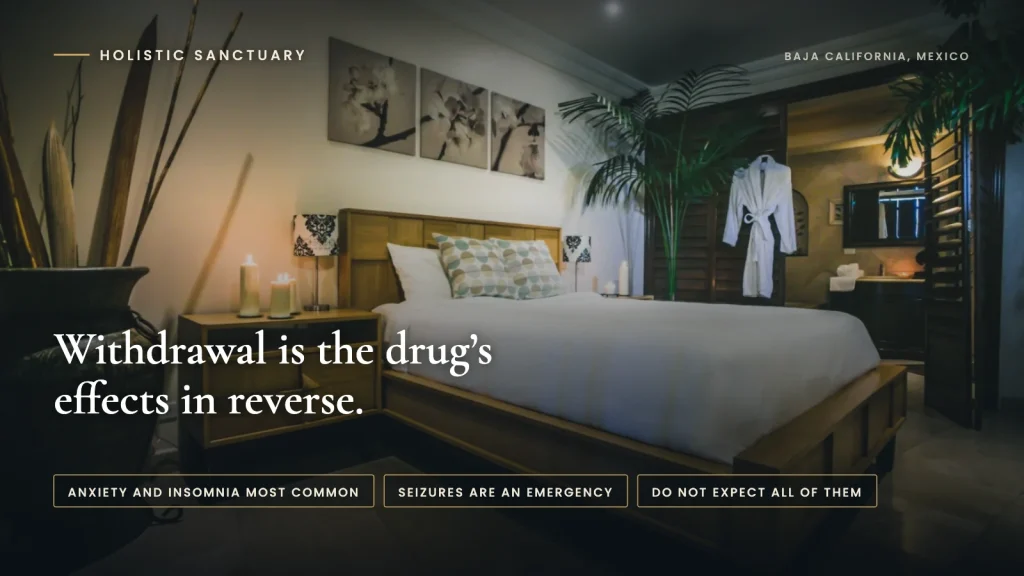
The evening here is built for sleep. A Dead Sea salt bath every night. A private oceanfront master suite with organic sheets and grounding pillows; a 2012 review summarized the early research on grounding, including reported effects on sleep and cortisol rhythm, and the evidence is preliminary, so we use it because guests sleep better, not because it is proven. Organic food, no seed oils, no processed food, nothing with caffeine after the morning. Darkness at night and daylight in the morning, which is the oldest sleep medicine there is.
Where the claim stops: we do not claim to change anyone’s biology, we do not publish a success percentage, and we do not promise you a night’s sleep by a date. What we can say is that this program is designed around the thing that breaks people in withdrawal, that we have run it for fifteen years, and that the guest who has not slept in nine nights is, in my experience, the one who most needs someone awake beside them at three in the morning. Read how benzodiazepine treatment is built here and the pillar on benzodiazepine withdrawal. Admission is by medical clearance.
If You Cannot Sleep Tonight
Benzo withdrawal insomnia tempts everyone toward the same three mistakes. Do not take an extra dose, a leftover pill, or a drink. Get out of bed and sit somewhere dim until you are drowsy, then go back; lying awake in the dark makes tomorrow night worse. Keep the wake time fixed no matter how the night went.
Remember that a night without sleep in withdrawal is miserable and not dangerous, and that it will not be every night. And if what you are feeling in the dark is not just sleeplessness but a wish not to wake up, that is the withdrawal talking, and 988 answers at three in the morning.
Frequently Asked Questions
Why does benzo withdrawal cause insomnia?
Benzodiazepines produce sleep by amplifying GABA and suppressing deep and REM sleep. The brain adapts, and when the drug is removed the nervous system is overactive and the suppressed sleep stages rebound in the wrong proportions. Kales described this rebound insomnia in Science in 1978.
How long does benzo withdrawal insomnia last?
It flares for a few nights after each dose reduction, runs for several weeks after the last dose, and is usually meaningfully better by two to three months, improving in windows and waves. For a minority with protracted withdrawal it can persist longer. Sleep is typically the last symptom to normalize.
Can I take a sleeping pill during benzo withdrawal?
Most sleeping pills, including zolpidem, act on the same GABA-A receptor and re-create the dependence. The American Academy of Sleep Medicine rates the evidence for most sleep medications as weak. Any medication decision in withdrawal belongs with the physician managing the taper.
Is it dangerous not to sleep during withdrawal?
Sleepless nights in withdrawal are miserable but not, in themselves, medically dangerous in an otherwise healthy person. The dangers of withdrawal are seizures and delirium from abrupt discontinuation, which is why the taper must be supervised.
What actually helps benzo withdrawal insomnia?
The principles of cognitive behavioral therapy for insomnia (fixed wake time, out of bed when awake), morning daylight, no caffeine or alcohol, an evening bath, sauna earlier in the day, massage, yoga and breathwork, and time. No pill replaces those.
How does Holistic Sanctuary treat benzo withdrawal insomnia?
Within a twelve-to-sixteen-week residential program: a physician-managed taper, nursing around the clock, the Brain Repair IV protocol alongside red light therapy, infrared sauna, NAD, massage, reiki and yoga, a nightly Dead Sea salt bath, a private oceanfront suite with organic sheets and grounding pillows, and organic food. No timeline is promised before medical screening.
References
- Kales A, Scharf MB, Kales JD. Rebound insomnia: a new clinical syndrome. Science. 1978;201(4360):1039–1041. pubmed.ncbi.nlm.nih.gov
- U.S. Food and Drug Administration. FDA requiring Boxed Warning updated to improve safe use of benzodiazepine drug class. 2020. fda.gov
- Ashton H. Benzodiazepines: How They Work and How to Withdraw (the Ashton Manual). 2002. benzo.org.uk
- Brunner E, et al. Joint Clinical Practice Guideline on Benzodiazepine Tapering. J Gen Intern Med. 2025. link.springer.com
- Trauer JM, et al. Cognitive behavioral therapy for chronic insomnia: a systematic review and meta-analysis. Ann Intern Med. 2015. pubmed.ncbi.nlm.nih.gov
- Sateia MJ, et al. Clinical practice guideline for the pharmacologic treatment of chronic insomnia in adults: an American Academy of Sleep Medicine clinical practice guideline. J Clin Sleep Med. 2017. jcsm.aasm.org
- Griffin CE, et al. Benzodiazepine pharmacology and central nervous system-mediated effects. Ochsner J. 2013. pmc.ncbi.nlm.nih.gov
- Vinkers CH, Olivier B. Mechanisms underlying tolerance after long-term benzodiazepine use. Adv Pharmacol Sci. 2012. pubmed.ncbi.nlm.nih.gov
- Laukkanen T, et al. Association between sauna bathing and fatal cardiovascular and all-cause mortality events. JAMA Intern Med. 2015. jamanetwork.com
- Field T. Massage therapy research review. Complement Ther Clin Pract. 2014. pmc.ncbi.nlm.nih.gov
- Cramer H, et al. Yoga for anxiety: a systematic review and meta-analysis of randomized controlled trials. Depress Anxiety. 2018. pubmed.ncbi.nlm.nih.gov
- Proksch E, et al. Bathing in a magnesium-rich Dead Sea salt solution improves skin barrier function. Int J Dermatol. 2005. pubmed.ncbi.nlm.nih.gov
- Chevalier G, et al. Earthing: health implications of reconnecting the human body to the Earth’s surface electrons. J Environ Public Health. 2012. pmc.ncbi.nlm.nih.gov
- Hamblin MR. Shining light on the head: photobiomodulation for brain disorders. BBA Clin. 2016. pmc.ncbi.nlm.nih.gov
Medical disclaimer: this page is general information about insomnia in benzodiazepine withdrawal and is not medical advice. Do not stop or reduce a prescribed benzodiazepine, or start or stop any sleep medication, without a physician; abrupt discontinuation can be life-threatening. Holistic Sanctuary does not diagnose, treat, or cure disease; individual results vary and no outcome is promised. In an emergency call 911. If you are thinking about suicide, call or text 988.