What Is Ibogaine? The Complete Guide to the Medicine
August 30, 2026
How Long Does Benzo Withdrawal Last? The Timeline, Week by Week
September 5, 2026

How to Choose a Luxury Rehab: Twelve Questions to Ask Before You Pay a Deposit
 Johnny Tabaie, Founder & CEO, Holistic Sanctuary·Medically reviewed by
  Dr. Jose A. Jimenez, MD, Medical Director·Published · Last medically reviewed
 If you are working out how to choose a luxury rehab, ask these twelve questions before you pay anyone a deposit. Here is why each one matters, what the research says about the therapies behind the answers, and how we answer every one of them.
Read This Part First
I paid for seventeen programs before I built this one. I paid deposits to places with waterfalls in the brochure and a group meeting in the basement, places that called themselves luxury because the sheets were good, places that handed me a prescription on the way out and a relapse three weeks later. Nobody told me what to ask. So this page is the list of questions I wish someone had handed me, with the honest answer a good program should be able to give you, and the answer we give here.
Where the evidence for something we do is strong, I will say so and show you the study. Where it is thin, I will say that too. You have been sold to enough.
One thing before the questions. If the person you are calling about is drinking heavily every day or takes a benzodiazepine every day, stopping abruptly can cause seizures and can be fatal. Whatever program you choose, the first question is whether a physician will manage that taper. Do not let anyone talk you out of it with a testimonial.
How to Choose a Luxury Rehab: The Twelve Questions
1. How long is the program, and who decides when it ends?
Ask this first because it tells you what the business is built on. Twenty-eight days is not a clinical number; it is the historic insurance reimbursement window, and most of the industry organized itself around it. The National Institute on Drug Abuse’s own guidance says that for residential or outpatient treatment, participation for less than ninety days is of limited effectiveness, and that longer durations are associated with better outcomes. If a program’s length is set by a package rather than by a physician’s assessment, you are buying a stay, not a treatment.
Here every program is four to twelve weeks. Not because twelve is a magic number, but because the body and the nervous system do not repair on a billing calendar, and because a program that ends on day twenty-eight ends at exactly the moment the hardest work begins.
2. Is it one-to-one, or is it group therapy?
Most programs, including most that charge luxury prices, run on group therapy because a group is the cheapest way to fill a day. Group work helps some people. It also means that a chief executive, a surgeon, or a mother of three sits in a circle with strangers and reads a workbook while the clinical team handles thirty people at once. Ask what the ratio actually is: how many clients, how many clinicians, how many hours of individual attention a day.
Here there is no group therapy. Every guest has a clinical team assigned to them alone, and the daily schedule is built around one person: roughly nine hours of hands-on holistic therapy a day, delivered one-to-one, in a setting where the other guests are not part of your treatment.
3. What medical screening happens before I am admitted?
This is the question that separates a medical program from a hospitality product. A serious program will not admit you, and certainly will not administer anything to you, before it has looked at your heart and your bloodwork. Ask specifically: bloodwork, blood pressure, EKG, echocardiogram, stress test. If the answer is a questionnaire, keep looking.
Here admission is by medical clearance. Our medical director reviews bloodwork, blood pressure, an EKG, a stress test and an echocardiogram before any protocol is designed, and nursing is on site twenty-four hours a day. The screening is what allows the rest of this page to exist.
4. Who is physically on site, and what are their licenses?
“Medical supervision” can mean a physician who reads your chart on Tuesdays, or a nurse who is on call from another town. Ask who is in the building at three in the morning. Ask whether the facility itself is licensed to treat, not just to host.
Here the facility is licensed, a physician oversees every program, and licensed nurses are present around the clock. Our founder is not a physician and does not present himself as one; the medicine is practiced by the medical team, and the program design is his.
5. What happens if I arrive on alcohol, a benzodiazepine, or an antidepressant?
Ask this even if it does not apply to you, because the answer tells you whether the program understands pharmacology. Alcohol and benzodiazepines require a supervised taper, and the American Society of Addiction Medicine’s guideline on alcohol withdrawal is explicit that severe withdrawal can involve seizures and delirium and belongs under medical management. A program that promises to have you “clean in days” has not read it.
Here the taper is physician-managed, the timeline follows the person and not the brochure, and our own protocol for people coming off benzodiazepines and antidepressants, the Brain Repair IV protocol, is described on its own page rather than paraphrased here.
6. What is your treatment model, in one sentence?
If the sentence contains the phrase “disease model” and ends with a referral to a twelve-step group, you know the program: talk therapy, group work, and a maintenance prescription. That model has helped some people and it has failed a great many, and if you are reading this page you have probably already been through it. Ask what the program does that the last one did not.
Here the model is total holistic healing: no group therapy, no talk-therapy-as-treatment, no psychobabble, and no medication-based maintenance as the plan. The body is treated as the thing that has to heal, the nervous system as the thing that has to be repaired, and the person as the one who has to be met. That is the Pouyan Method, the system our founder built over twenty years, and it is a different answer to a different question.
7. What therapies do you actually use, and what does the evidence say?
This is the longest answer on the page because it is where the brochures lie hardest. Every therapy below is used here, every day, as part of a program that is designed per person. Nobody receives all of them; a guest in her eighties who is not cleared for one thing receives another. And next to each one is what the published research actually supports, because you deserve to know which of these has a thick evidence base and which has a thin one.
Massage
The best-supported physical therapy on this list. Tiffany Field’s research review in Complementary Therapies in Clinical Practice summarizes decades of trials showing that moderate-pressure massage lowers cortisol, increases vagal activity, and reduces measured anxiety and depression. Here it is daily, on a terrace facing the Pacific, and it is treatment, not a spa add-on.
Reiki and energy work
I will be honest about the evidence: the Cochrane review on reiki for depression and anxiety found insufficient high-quality trials to draw a conclusion either way. We use it because our guests consistently describe it as one of the most settling hours of their day, and because a calm nervous system is the platform everything else stands on. That is our experience, not a clinical finding, and I present it as such.
Yoga and breathwork
A 2018 meta-analysis of randomized trials in Depression and Anxiety found yoga produced meaningful short-term reductions in anxiety compared with no treatment. Here it is on an oceanfront terrace, every morning, taught one-to-one or in a pair at most.
Hyperbaric oxygen
The FDA has cleared hyperbaric oxygen for a specific list of conditions, including decompression sickness, carbon monoxide poisoning, and certain non-healing wounds, and its consumer guidance says plainly that it has not been cleared for depression, addiction, or brain injury. We use a medical-grade chamber for general physiological support during a period of intense repair, for guests cleared by the medical director, and we do not claim more than that.
Red light therapy
Photobiomodulation has a real but early evidence base; Michael Hamblin’s 2016 review in BBA Clinical lays out both the mitochondrial mechanism and how far the human trials still have to go. It is non-invasive, well tolerated, and one of the therapies guests ask to continue at home.
Infrared sauna
The most surprising evidence on the list. A 2015 study in JAMA Internal Medicine followed more than two thousand Finnish men for about twenty years and found frequent sauna bathing associated with substantially lower cardiovascular and all-cause mortality. That is an association in a general population, not a trial in recovery, and the liver and kidneys do the actual detoxifying. What sauna reliably gives is cardiovascular conditioning, deep relaxation, and better sleep, and here it is part of the daily rhythm for every guest cleared for heat.
NAD IV infusions
NAD has no controlled trials in addiction or mental health, and in January 2026 the FDA issued a warning letter to a compounder after three patients were sent to an emergency room by a contaminated NAD lot. I tell you this because other centers will not. We use NAD carefully, from pharmaceutical-grade sourcing, under physician oversight, as one adjunct among many, and we do not sell it as a cure for anything.
The Brain Repair IV protocol
This is separate from NAD and separate from a generic vitamin drip. It is a proprietary intravenous protocol our founder developed, individually dosed and delivered under nursing over a defined number of weeks, and it is the center of how we work with people coming off benzodiazepines and antidepressants. It has its own page, which also states plainly where our claim for it stops.
Coffee enemas
Here is the honest version. A 2020 systematic review of case reports in the journal Medicine found no evidence that coffee enemas are effective for the purposes they are usually sold for, and documented cases of harm from self-administration at home. We include them because they are part of a cleanse tradition our guests value and because, administered by staff under a medical protocol, the home-use risks in that review do not apply. We do not claim they detoxify the liver.
Dead Sea salt baths
A 2005 study in the International Journal of Dermatology found bathing in magnesium-rich Dead Sea salt improved skin barrier function and reduced inflammation in dry skin. Beyond the skin, a warm mineral bath every day is one of the simplest ways we have found to help a wired nervous system come down at night.
Food: organic, no seed oils, no processed food
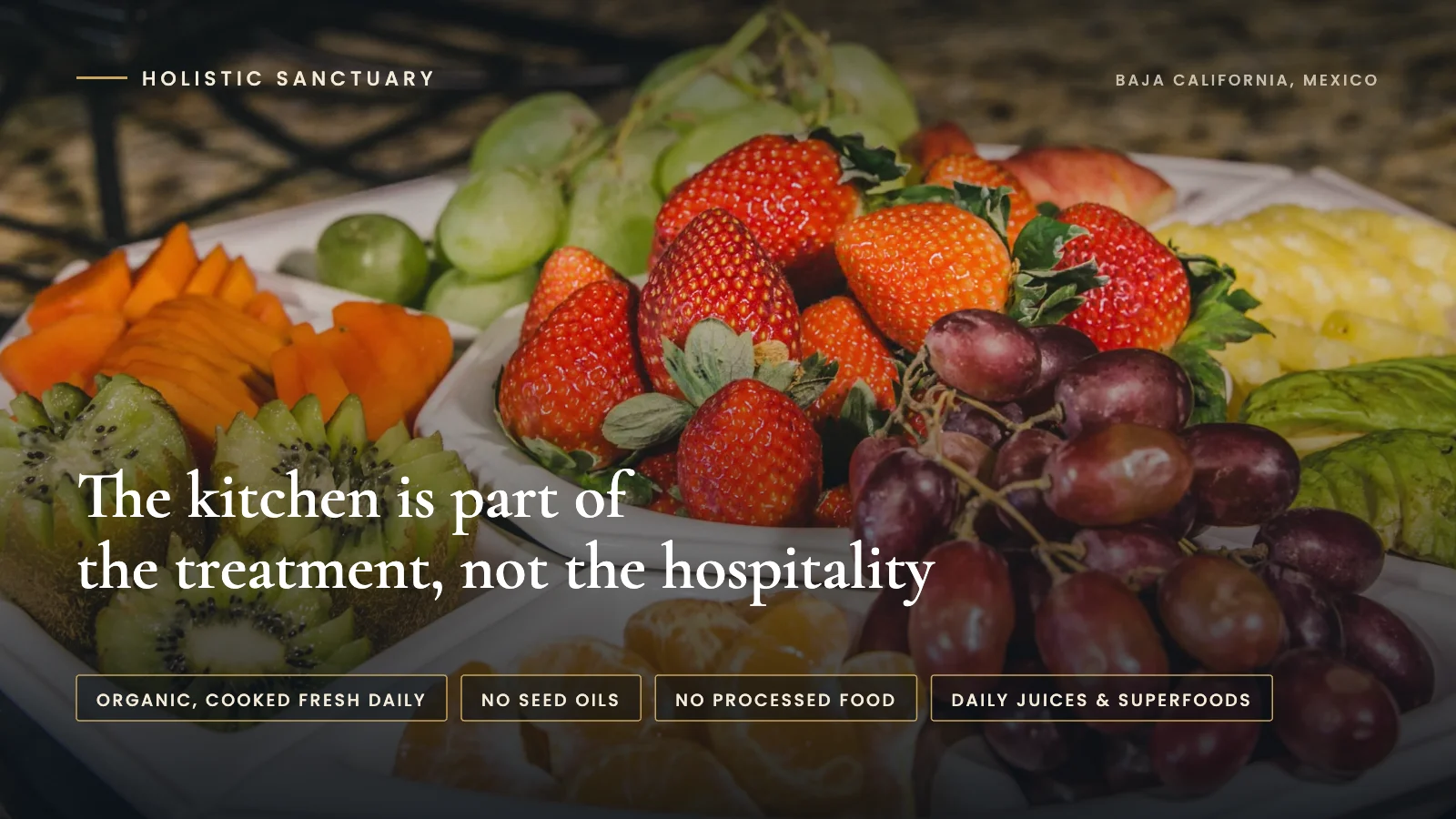
The kitchen is part of the program, not the hospitality. Everything is organic and prepared fresh; there are no seed oils and no processed foods, because a 2024 umbrella review in the BMJ across nearly ten million people linked higher ultra-processed food intake to worse outcomes across cardiovascular, metabolic, and mental health measures, including depression and anxiety. A body that is trying to repair itself should not be doing it on the fuel that helped break it.
8. Do you offer psychedelic therapy, and is it licensed and medically supervised?
Five years ago this question would have marked you as a fringe patient. In 2026 it marks you as someone who reads. On April 24, 2026, the FDA awarded Commissioner’s National Priority Vouchers to three companies developing psilocybin and methylone for treatment-resistant depression, major depression, and PTSD, putting them on a review track of one to two months, and the Commissioner said the agency owed it to veterans and “all Americans who are suffering from these conditions to evaluate these potential therapies with urgency.”
Then, on August 26, 2026, the Substance Abuse and Mental Health Services Administration published a report telling every state to prepare, now, for FDA-approved psychedelic-assisted therapy, because those decisions “are likely to come whether or not states are ready for them.” The same report notes that the 1970 scheduling of these compounds was viewed by many as a response to cultural panic rather than a science-based assessment.
Our founder, Johnny Tabaie, saw this coming twenty years ago. He is not a physician and not a scientist; he is a former patient who refused the standard of care and spent two decades building a system in which these medicines could be given the way they should be given: medically screened, physician-supervised, one person at a time, in a licensed facility, in a country where that is legal. The federal government is now telling the states to get ready for what this facility has been doing for fifteen years.
What we offer, and what the evidence says about each:
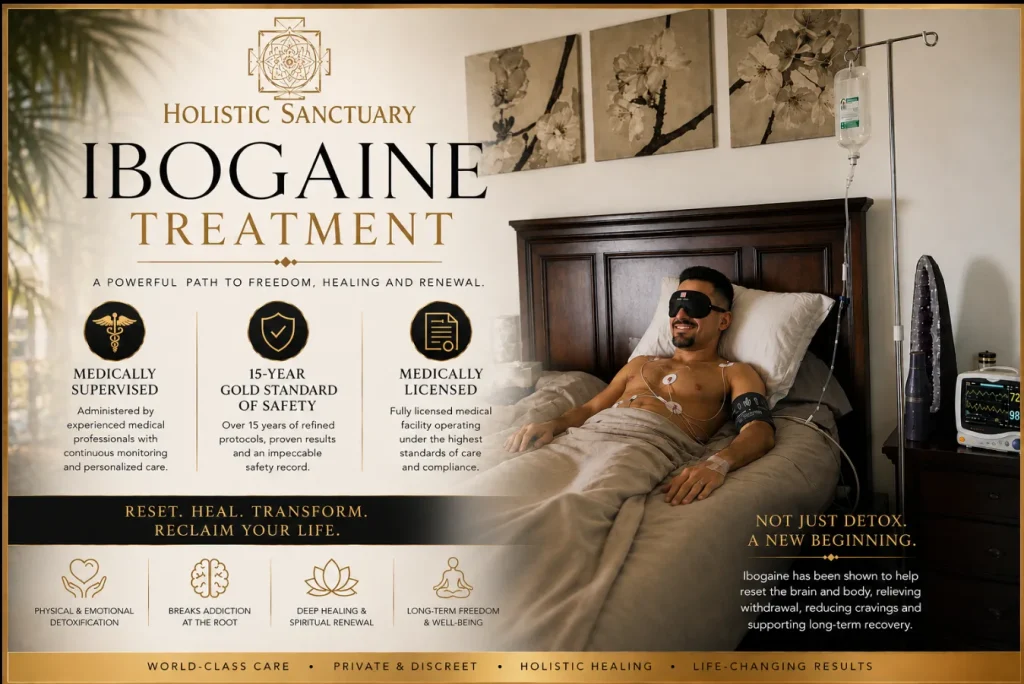
Ibogaine. A 2024 study in Nature Medicine from Stanford followed thirty special-operations veterans with traumatic brain injury treated with magnesium-ibogaine at a clinic in Mexico and reported large reductions in PTSD, depression and anxiety symptoms at one month, with no serious cardiac events under monitoring. Earlier observational studies in Mexico and New Zealand reported meaningful reductions in opioid withdrawal and use. TIME magazine has called ibogaine one of the most promising and perilous psychedelics for addiction, and the peril is real: it affects heart rhythm, which is exactly why the screening in question three exists.
Here it is never given alongside a benzodiazepine taper; it is sequenced at the end, after stabilization.
Ayahuasca. A randomized, placebo-controlled trial published in Psychological Medicine in 2019 found a single dose produced rapid antidepressant effects in treatment-resistant depression. Here it is given in a medically supervised ceremony, not a jungle retreat.
Psilocybin. A phase 2b trial in the New England Journal of Medicine in 2022 found a single 25 mg dose reduced depression scores in treatment-resistant depression at three weeks, and a Johns Hopkins trial in JAMA Psychiatry reported large, rapid effects in major depression. This is the compound now on the FDA’s fastest track.
DMT, 5-MeO-DMT, bufo, and changa. A phase 1/2 trial in Frontiers in Psychiatry in 2023 reported rapid reductions in treatment-resistant depression after a single vaporized dose of 5-MeO-DMT. The evidence base here is the youngest on this page, and we say so.
None of these is a cure. All of them carry real risk without screening. The difference between a medicine and a danger is the medical supervision around it, and that is the whole reason this facility exists.
9. What will I eat, and who is cooking?
Ask whether the food is treatment or catering. Ask about seed oils and sugar, because most programs serve institutional food and call it nutrition. Here every meal is organic, cooked fresh that day, with daily juices, and it is designed as part of the repair.
10. Where will I sleep?
Sleep is where the nervous system repairs, and it is the first thing a program built on volume compromises. Ask about roommates. Here every guest has a private master suite, oceanfront, with organic sheets and grounding pillows. A 2012 review in the Journal of Environmental and Public Health summarized the early research on grounding, including reported effects on sleep and cortisol rhythm; the evidence is preliminary, and we use it because guests sleep better, not because it is proven.
11. What happens at week thirteen?
Most programs discharge you with a folder. Ask what the plan is for month four, month six, and the first bad night at home. A program that has thought about that will have an answer. One that has not will tell you about the alumni Facebook group.
12. What will you not promise me?
This is the one that tells you whether to sign. A serious program will refuse to promise you a cure, a success rate, or a timeline before it has met you. Here we do not publish a success percentage, because no honest single number exists. What we will tell you is what fifteen years looks like: more than a thousand clients since 2011, more than five thousand medically supervised ceremonies, and, in fifteen years of operation, no guest death at the facility, a record that belongs to the screening, the nursing, and the physician, not to luck. Any facility that promises more than that is promising something it cannot know.
Why People Who Ask These Questions End Up Here
Not because we are the most expensive or the most beautiful, though the Pacific outside the window does not hurt.
They end up here because when they ask the twelve questions, this is one of the very few places where the answers are all yes: four to twelve weeks, one clinical team per guest, medical screening before anything is administered, a physician and nurses on site, a taper managed by a doctor, a model that is not group therapy and a prescription, nine hours a day of hands-on holistic work, licensed and medically supervised psychedelic therapy, food that is part of the treatment, a private oceanfront suite, and a founder who will tell you exactly where the evidence stops.
This combination, at this ratio, for this duration, under this oversight, is what we built. If you have already paid for the other kind, you know why it matters.
Admission is by medical clearance. If you are ready to ask the questions, start here, or read what a luxury rehab center should actually give you before you call anyone, including us.
Frequently Asked Questions
What is the most important question to ask a luxury rehab?
Who decides when the program ends, and what medical screening happens before admission. Those two answers tell you whether the program is built on a physician’s assessment or on an insurance calendar.
Is group therapy necessary for recovery?
It helps some people, and most programs rely on it because it is the least expensive way to fill a day. Holistic Sanctuary uses no group therapy; every guest has a clinical team assigned to them alone and roughly nine hours of one-to-one holistic therapy a day.
Is psychedelic therapy legal and safe?
Legality depends on the country and the compound; Holistic Sanctuary operates as a licensed facility in Mexico. Safety depends on screening: ibogaine in particular affects heart rhythm, which is why bloodwork, an EKG, an echocardiogram and a stress test come first. In April 2026 the FDA fast-tracked psilocybin and methylone, and in August 2026 SAMHSA told states to prepare for approval.
Does Holistic Sanctuary publish a success rate?
No. No honest single number exists. It publishes its record instead: more than a thousand clients since 2011, more than five thousand supervised ceremonies, and no guest death at the facility in fifteen years of operation.
How long is the program at Holistic Sanctuary?
Four to twelve weeks for every guest, designed individually after medical screening.
References
- National Institute on Drug Abuse. Principles of Drug Addiction Treatment: How long does drug addiction treatment usually last? nida.nih.gov
- American Society of Addiction Medicine. Clinical Practice Guideline on Alcohol Withdrawal Management. 2020. asam.org
- Field T. Massage therapy research review. Complement Ther Clin Pract. 2014. pmc.ncbi.nlm.nih.gov
- Joyce J, Herbison GP. Reiki for depression and anxiety. Cochrane Database Syst Rev. 2015. pubmed.ncbi.nlm.nih.gov
- Cramer H, et al. Yoga for anxiety: a systematic review and meta-analysis of randomized controlled trials. Depress Anxiety. 2018. pubmed.ncbi.nlm.nih.gov
- U.S. Food and Drug Administration. Hyperbaric Oxygen Therapy: Get the Facts. fda.gov
- Hamblin MR. Shining light on the head: photobiomodulation for brain disorders. BBA Clin. 2016. pmc.ncbi.nlm.nih.gov
- Laukkanen T, et al. Association between sauna bathing and fatal cardiovascular and all-cause mortality events. JAMA Intern Med. 2015;175(4):542–548. jamanetwork.com
- U.S. Food and Drug Administration. Warning letter to GenoGenix LLC (NAD+ compounded product, endotoxin contamination), January 20, 2026. fda.gov
- Son H, et al. The safety and effectiveness of self-administered coffee enema: a systematic review of case reports. Medicine (Baltimore). 2020. pubmed.ncbi.nlm.nih.gov
- Proksch E, et al. Bathing in a magnesium-rich Dead Sea salt solution improves skin barrier function. Int J Dermatol. 2005. pubmed.ncbi.nlm.nih.gov
- Lane MM, et al. Ultra-processed food exposure and adverse health outcomes: umbrella review. BMJ. 2024;384:e077310. bmj.com
- Chevalier G, et al. Earthing: health implications of reconnecting the human body to the Earth’s surface electrons. J Environ Public Health. 2012. pmc.ncbi.nlm.nih.gov
- Fierce Biotech. Compass, Usona and Transcend score FDA national priority vouchers. April 24, 2026. fiercebiotech.com
- CNN Health. FDA moves to fast-track review of psilocybin and methylone for mental health. April 24, 2026. cnn.com
- Substance Abuse and Mental Health Services Administration. Current Research, Regulatory, and Policy Considerations: Psychedelics Medicine. PEP26-01-004, August 2026. library.samhsa.gov
- TIME. What to know about Trump’s new executive order on psychedelics. April 21, 2026. time.com
- Cherian KN, et al. Magnesium–ibogaine therapy in veterans with traumatic brain injuries. Nat Med. 2024. nature.com
- Noller GE, Frampton CM, Yazar-Klosinski B. Ibogaine treatment outcomes for opioid dependence from a twelve-month follow-up observational study. Am J Drug Alcohol Abuse. 2018. pubmed.ncbi.nlm.nih.gov
- TIME. Inside ibogaine, one of the most promising and perilous psychedelics for addiction. time.com
- Palhano-Fontes F, et al. Rapid antidepressant effects of the psychedelic ayahuasca in treatment-resistant depression: a randomized placebo-controlled trial. Psychol Med. 2019. pubmed.ncbi.nlm.nih.gov
- Goodwin GM, et al. Single-dose psilocybin for a treatment-resistant episode of major depression. N Engl J Med. 2022;387:1637–1648. nejm.org
- Davis AK, et al. Effects of psilocybin-assisted therapy on major depressive disorder: a randomized clinical trial. JAMA Psychiatry. 2021. jamanetwork.com
- CNN Health. What experts say about taking psilocybin as an alternative treatment for depression. October 2024. cnn.com
- Reckweg JT, et al. A phase 1/2 trial to assess safety and efficacy of a vaporized 5-methoxy-N,N-dimethyltryptamine formulation (GH001) in patients with treatment-resistant depression. Front Psychiatry. 2023. frontiersin.org
Medical disclaimer: this page is general information to help families evaluate treatment programs and is not medical advice. Stopping alcohol or benzodiazepines abruptly can be life-threatening; any change to a prescribed medication belongs with a physician. Psychedelic compounds carry real risks and are administered here only after medical screening, in a licensed facility. Holistic Sanctuary does not diagnose, treat, or cure disease; individual results vary. In an emergency call 911. If you are thinking about suicide, call or text 988.