High Functioning Anxiety and Benzodiazepine Dependence: When the Prescription Becomes the Condition
September 5, 2026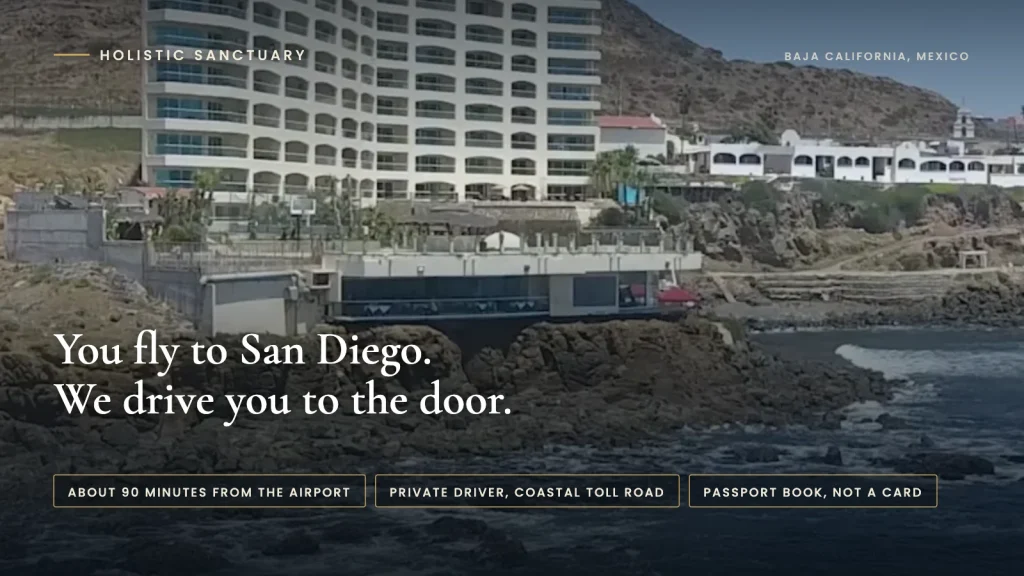
Rehab in Mexico: Traveling to Holistic Sanctuary, Honestly
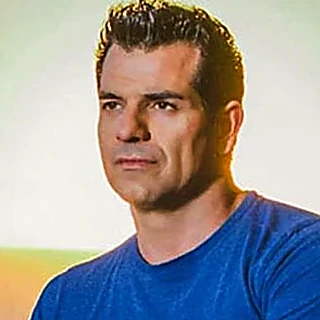 Johnny Tabaie, Founder & CEO, Holistic Sanctuary·Medically reviewed by
 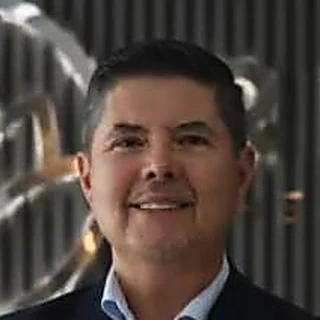 Dr. Jose A. Jimenez, MD, Medical Director·Published · Last medically reviewed
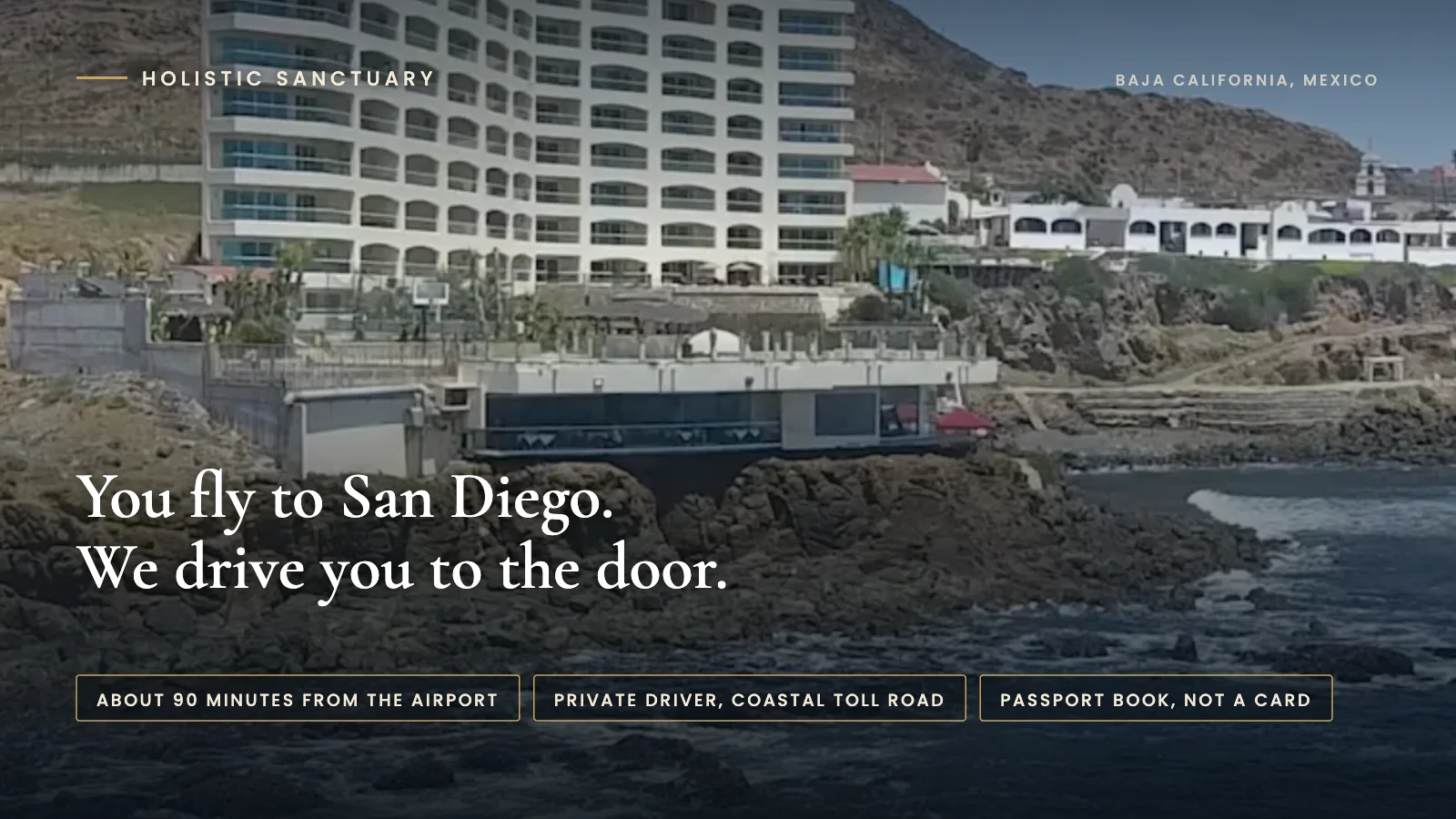
 You fly to San Diego. We drive you to the door. Passports, medication at the border, the State Department advisory answered plainly, insurance, and what a Tuesday looks like once you arrive.
Read This Part First
Rehab in Mexico is a decision most people make in two stages: first the medical one, whether a program on the Pacific coast of Baja California is the right treatment, and then the practical one, which is where the calls to us usually begin. How do I get there, what do I need, is it safe, what happens at the border with my medication, will my insurance pay, and what does a Tuesday look like once I arrive.
This page answers those questions plainly, with the government sources where government sources exist, and says where the claim stops. If the medical question is still open, start with how to choose a luxury rehab and come back.
One non-negotiable before travel of any kind: do not stop a benzodiazepine, an antidepressant or heavy daily drinking to “arrive clean.” Abrupt discontinuation can be life-threatening. Our physician reviews every medication before you travel and manages every change after you arrive. If you are thinking about suicide, call or text 988.
Where We Are, and How You Get Here
Holistic Sanctuary is on the Pacific coast of Baja California, Mexico, on the ocean south of the San Diego border, in the Rosarito area. That geography is the whole logistics answer to rehab in Mexico. You fly to San Diego International Airport, which is served by every major American carrier and by direct flights from most large U.S. cities, and a private driver meets you at the terminal and brings you to the sanctuary door.
The drive crosses the border at San Ysidro or Otay Mesa and follows the coastal toll road south; with normal border traffic it is roughly ninety minutes from the airport to your suite. You do not rent a car, you do not navigate a border crossing alone, and you do not stand in a line with your luggage.
Guests arriving from outside the United States, or from cities with better connections to Mexico than to San Diego, can fly into Tijuana International Airport instead, which handles domestic Mexican flights and a growing number of international ones, and is closer to us than San Diego is; the same private car meets you there. Tijuana’s airport is also joined to San Diego by Cross Border Xpress, a private pedestrian bridge that connects the Mexican terminal directly to a building on the U.S. side at Otay Mesa, so that a guest can land in Tijuana and walk across into California, or the reverse, without the road border at all.
Guests who travel privately for rehab in Mexico can use Tijuana or the general-aviation airport at Brown Field in San Diego; tell admissions, and the transfer is arranged from there.
Passports, Entry and Your Medication
For rehab in Mexico, a U.S. citizen needs a valid passport book to fly; the U.S. passport card is valid only for land and sea crossings and is not accepted for air travel, which matters if you might fly home from Tijuana. No visa is required for a tourist stay: on entry you receive Mexico’s visitor permit, the FMM, and an immigration officer grants a stay of up to 180 days, which is the officer’s discretion and can be less.
Tell the officer the truth about the purpose of your visit to rehab in Mexico, which is a residential wellness program; it is legal, common, and unremarkable at this border. Guests from other countries should check Mexico’s requirements for their passport; our admissions team walks through it before anyone books a flight.
Medication is the question people considering rehab in Mexico are most anxious about, and it has a simple answer. Bring every prescribed medication in its original pharmacy container with the label intact, in a quantity consistent with personal use, and carry a copy of the prescription. Controlled substances, benzodiazepines among them, are controlled in Mexico as well as in the United States, and the original container with a matching prescription is what makes carrying them lawful in both directions.
Before you travel, our physician reviews your complete medication list, including anything you take that is not prescribed, and tells you exactly what to bring and how much; nothing is stopped or changed until you are here and under his care. Do not bring anything you would not want a border officer to see, and do not bring alcohol.
Is It Safe? The Honest Answer
Anyone considering rehab in Mexico will read the U.S. State Department’s Mexico travel advisory before they come, so here is what it says. As of its May 29, 2026 update, the advisory for Baja California state is Reconsider Travel, citing terrorism, crime and kidnapping, with a note that criminal groups contest the border areas over trafficking routes. The same advisory states that there are no additional travel restrictions for U.S. government employees in Baja California, including in Tijuana, Ensenada and Rosarito, and that travelers should remain on main highways and avoid remote locations.
That is the government’s own description: a state with real risks in specific places, in which the corridor we use is one U.S. officials are permitted to travel.
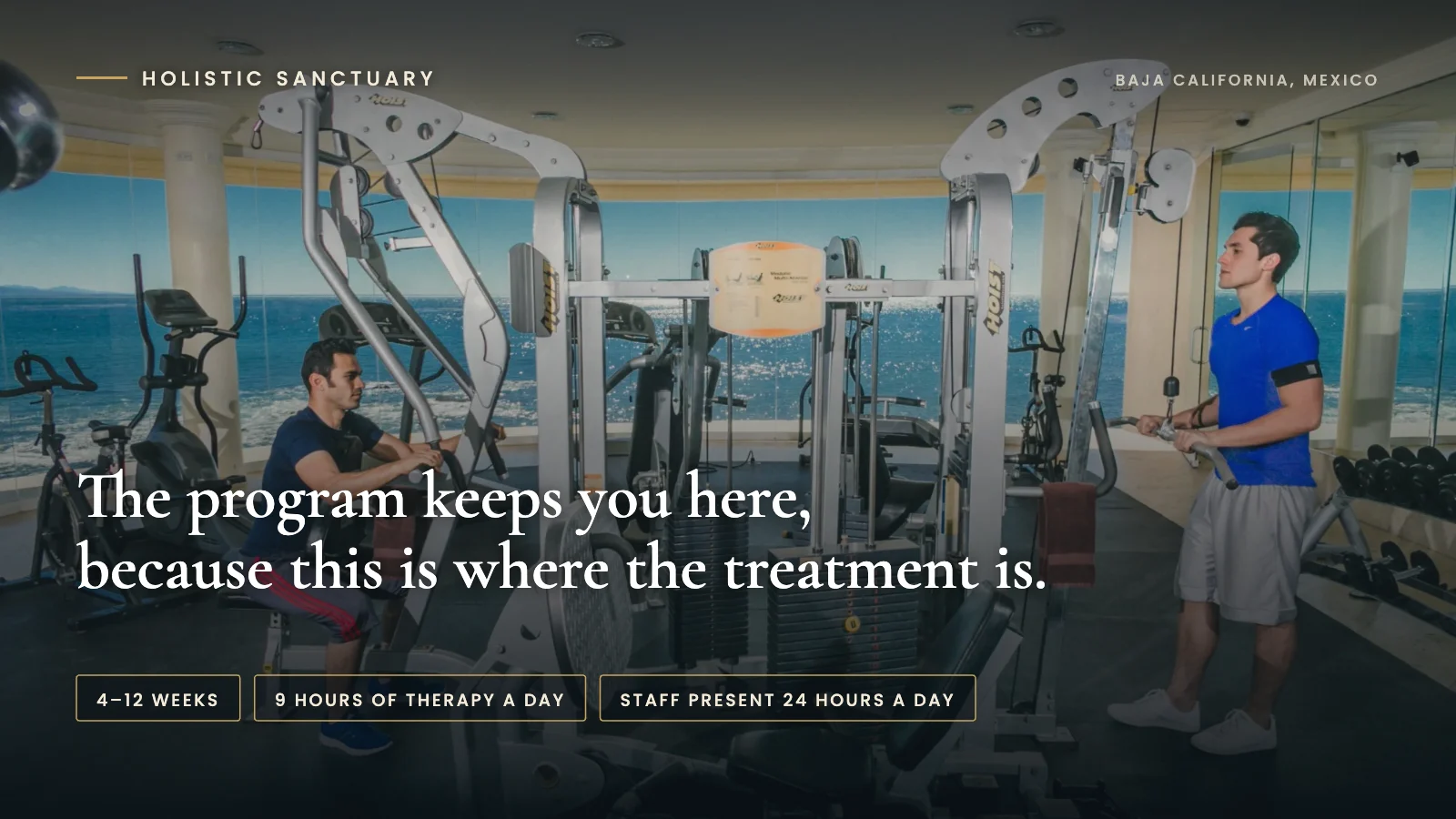
Here is how we handle safety for rehab in Mexico, and it is not complicated. You are met inside the airport by a driver who works for us and has made the trip hundreds of times. The route is the coastal toll road, in daylight, door to door. The sanctuary is a private oceanfront property with staff present twenty-four hours a day and licensed nurses on site around the clock, and the program keeps you on the property for the length of your stay, because that is where the treatment is.
You will not be walking through Tijuana at night looking for a taxi, because there is no part of the program in which that happens. Fifteen years of guests have arrived and left this way. That is a description of practice, not a guarantee; there is no such thing as a guarantee about any place on earth, including the city you live in.
Why Mexico, and Why Here
People choose rehab in Mexico for three reasons, and the honest ones should be said out loud. The first is that certain therapies are available here that are not available in the United States: licensed, medically supervised psychedelic therapy with ibogaine, ayahuasca, psilocybin and DMT in its forms, offered where they are legal, under a physician, after medical screening, to guests for whom they are appropriate, which is the subject of its own pages and its own exclusion criteria.
In April 2026 the FDA fast-tracked the review of psilocybin for mental health conditions and in August 2026 SAMHSA told states to prepare for psychedelic medicine; our founder built this program around that future twenty years before it arrived, on the condition that it be done authentically, medically supervised and ethically.
The second reason people choose rehab in Mexico is that a program of the kind we run, four to twelve weeks in residence, one guest to one clinical team, around nine hours of holistic therapy a day, a private oceanfront suite, organic food and no group therapy, is not a product that exists inside the American insurance system at any price, and where something like it exists, the cost is a multiple of ours. The third is privacy. A person who cannot be seen walking into a treatment center in their own city can be entirely unseen here, and the Pacific coast of Baja is a long way from anyone’s boardroom.
The cost question about rehab in Mexico deserves one plain sentence: American health insurance generally does not cover care in Mexico, Medicare, by its own statement, usually does not cover health care outside the United States, and our programs are private pay. What you receive for that is set out on the treatment methods page and the program pages, and the length is set by the physician, not by a package.
What Happens When You Arrive, and What a Day Looks Like
Before you travel for rehab in Mexico, you will have completed the medical screening that every guest completes: bloodwork, blood pressure, an EKG, a stress test and an echocardiogram reviewed by our medical director, and a full history taken by a physician, so that the plan exists before the car does. On arrival you meet the physician and the clinical team that will be yours for the whole stay, one guest to one team, and you sleep, in a private oceanfront suite on organic sheets, with the Pacific outside the window and nothing scheduled that night.
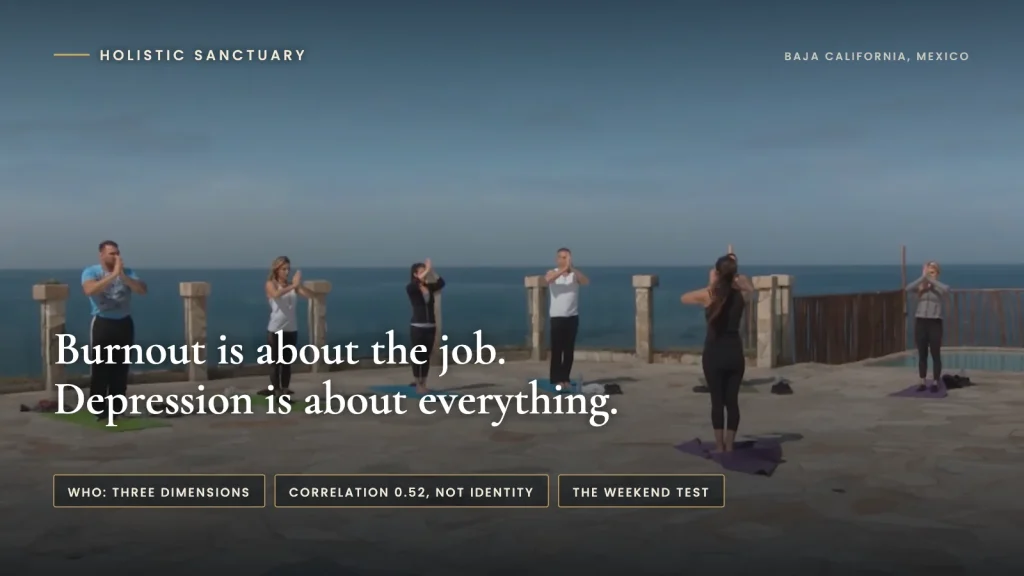
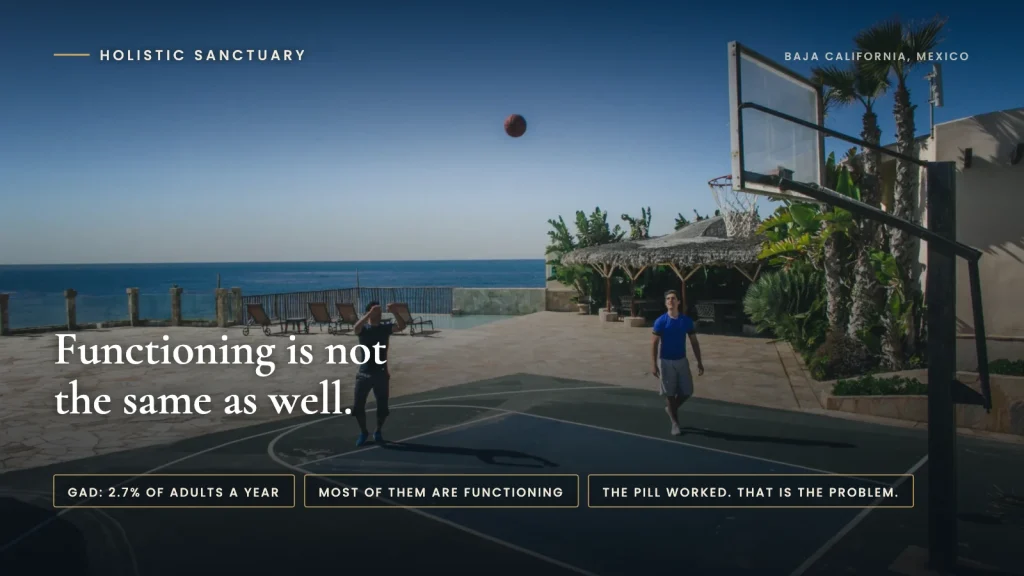
The days of rehab in Mexico after that are full. Morning yoga on the terrace above the water; the Brain Repair IV protocol and NAD infusions; massage, reiki, hyperbaric oxygen, red light therapy, infrared sauna, coffee enemas and a daily Dead Sea salt bath, individualized rather than identical; organic meals with no seed oils and no processed food; the gym, the pool, the ocean; and a physician who sees you every day and adjusts the plan the day something changes.
There is no group therapy, no talk therapy in place of medicine, and no psychobabble. Privacy is absolute. Programs run four to twelve weeks, a minimum of four and an average of twelve, and longer when a benzodiazepine taper or a complicated case needs it. When it is time to go home, the same driver takes you back to San Diego.
What to pack for rehab in Mexico is shorter than people expect: the passport book, the medications in their labeled containers with prescriptions, comfortable clothes for yoga and the gym, a swimsuit, a light jacket for the evenings on the coast, and whatever you read. Everything else, from organic sheets to Dead Sea salt, is here. Leave the alcohol, leave anything you would not want a border officer to see, and leave the plan to stop something on your own before you arrive; that is the physician’s job, and it begins the day you land.
Where the Claim Stops
We do not claim that rehab in Mexico is right for everyone, that any therapy here will do for you what treatment at home did not, or that any journey is without risk. We do not publish a success percentage. What we can say is that the logistics are handled by us and not by you, that the medical screening happens before you travel, that the government’s own advisory permits its employees to travel the corridor we use, that the property is private, staffed around the clock and on the ocean, and that we have brought guests here and home again for fifteen years.
Read about the luxury rehab center, the executive program, and why the length of the program matters. Admission is by medical clearance.
Frequently Asked Questions
How do I get to Holistic Sanctuary?
For rehab in Mexico with us, fly to San Diego International Airport. A private driver meets you at the terminal and brings you across the border and down the coastal toll road to the sanctuary door, roughly ninety minutes with normal traffic. Guests can also fly into Tijuana International Airport, which is closer, or arrive privately via Tijuana or Brown Field in San Diego.
Do I need a passport for rehab in Mexico?
Yes. U.S. citizens need a valid passport book to fly to Mexico; the passport card is valid only for land and sea crossings. No visa is needed for a tourist stay; you receive Mexico’s visitor permit on entry and the officer grants up to 180 days at their discretion.
Can I bring my medication across the border?
Yes, in the original pharmacy container with the label intact, in a personal-use quantity, with a copy of the prescription. Benzodiazepines and other controlled substances are controlled in Mexico too, and the labeled container with a matching prescription is what makes carrying them lawful. Our physician reviews your full list before you travel. Do not stop any medication before you arrive.
Is Baja California safe for rehab in Mexico?
The State Department’s May 2026 advisory lists Baja California as Reconsider Travel for crime and kidnapping, and in the same advisory states there are no additional restrictions for U.S. government employees in Tijuana, Ensenada and Rosarito, advising travelers to stay on main highways. Our guests are met inside the airport by our driver, travel the coastal toll road in daylight, and stay on a private oceanfront property staffed around the clock for the length of the program. That is practice, not a guarantee.
Will my insurance cover rehab in Mexico?
Generally no. American health insurance usually does not cover care in Mexico, and Medicare states that it usually does not cover health care outside the United States. Holistic Sanctuary’s programs are private pay, and the length of the program is set by the physician rather than by a package.
Why do people travel to Mexico for treatment?
People choose rehab in Mexico for therapies not available in the United States, including licensed medically supervised psychedelic therapy offered where legal and after screening; for a residential program of a kind and length the American insurance system does not produce; and for privacy. The physician decides which of those applies to any individual guest.
References
- U.S. Department of State. Mexico Travel Advisory. Updated May 29, 2026. travel.state.gov
- U.S. Department of State. Mexico International Travel Information. travel.state.gov
- Mexperience. Mexico entry requirements for leisure, business or residency. mexperience.com
- Cross Border Xpress. The bridge connecting Tijuana International Airport with San Diego. crossborderxpress.com
- Medicare.gov. Travel outside the U.S. medicare.gov
- U.S. Food and Drug Administration. FDA requiring Boxed Warning updated to improve safe use of benzodiazepine drug class. 2020. fda.gov
- CNN Health. FDA moves to fast-track review of psilocybin and methylone for mental health. April 24, 2026. cnn.com
- Substance Abuse and Mental Health Services Administration. Current Research, Regulatory, and Policy Considerations: Psychedelics Medicine. PEP26-01-004, August 2026. library.samhsa.gov
- National Institute on Drug Abuse. Principles of Drug Addiction Treatment: How long does drug addiction treatment usually last? nida.nih.gov
Medical and travel disclaimer: this page is general information and is not medical, legal or travel advice. Entry requirements and travel advisories change; check the U.S. Department of State and Mexican government sources before traveling. Do not stop a prescribed medication or heavy daily drinking without a physician. Holistic Sanctuary does not diagnose, treat, or cure disease; individual results vary and no outcome is promised. Psychedelic therapies are provided only where legal, after medical screening, under physician supervision, and are not approved by the FDA for these uses. In an emergency call 911. If you are thinking about suicide, call or text 988.