Burnout vs Depression: How to Tell the Difference, and Why It Matters
September 5, 2026
Rehab in Mexico: Traveling to Holistic Sanctuary, Honestly
September 5, 2026

High Functioning Anxiety and Benzodiazepine Dependence: When the Prescription Becomes the Condition
 Johnny Tabaie, Founder & CEO, Holistic Sanctuary·Medically reviewed by
  Dr. Jose A. Jimenez, MD, Medical Director·Published · Last medically reviewed
 The pill worked, which is the problem. Why the people who function best are the ones most likely to end up quietly dependent, how the drug turns anxiety into a worse anxiety, and the four signs it already has.
Read This Part First
High functioning anxiety is not a diagnosis, and it is the most accurate description of most of the people who call here. It names the person who runs the company, the surgery, the firm or the family with a mind that never stops, who is praised for the very traits, vigilance, perfectionism, the inability to rest, that are eating them, and who has, somewhere along the way, been given a benzodiazepine to take the edge off.
The pill worked, which is the problem. This page sets out what high functioning anxiety is and is not, why it is the profile most likely to end in quiet benzodiazepine dependence, how the drug turns anxiety into a worse anxiety, the four warning signs that the prescription has become the condition, what the research says actually reduces anxiety without a receptor, and how it is treated at Holistic Sanctuary.
The non-negotiable first: if you take a benzodiazepine daily, do not stop it abruptly. The FDA’s boxed warning states that abrupt discontinuation or rapid dose reduction can cause withdrawal reactions that are life-threatening, including seizures. Everything below assumes a physician managing any change. If you are thinking about suicide, call or text 988.
What High Functioning Anxiety Is, and Is Not
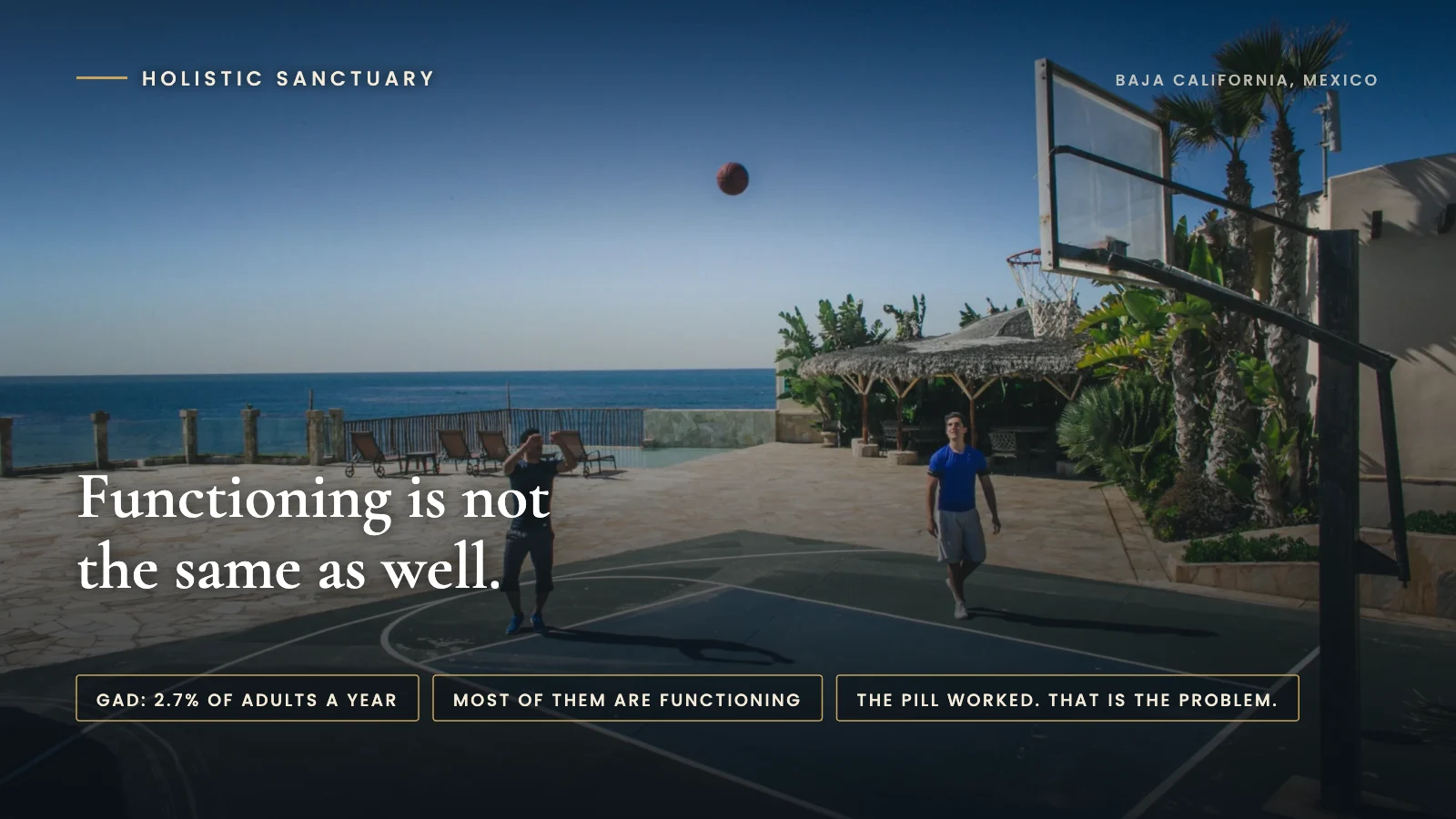
The diagnosis underneath is usually generalized anxiety disorder: excessive, difficult-to-control worry on more days than not for at least six months, with restlessness, fatigue, poor concentration, irritability, muscle tension and disturbed sleep. The National Institute of Mental Health estimates that 2.7 percent of American adults have generalized anxiety disorder in a given year and 5.7 percent at some point in their lives, and that about a third of those with it in the past year have serious impairment. The other two thirds are, by the survey’s own measure, functioning. Many of them are functioning extremely well.
That is what the phrase high functioning anxiety points at: the anxiety disorder that does not look like one from the outside because its energy is aimed at achievement. The worry becomes preparation; the restlessness becomes productivity; the fear of failure becomes a career. The cost is internal and cumulative: sleep that is never quite deep, a body that never quite lets go, a mind that treats every quiet moment as an unanswered email.
And because the person is succeeding, nobody, including their doctor, treats the anxiety as the medical condition it is. They treat the symptom that finally forces a visit, which is almost always sleep, or a panic attack on a flight, and the treatment is almost always a benzodiazepine.
Why This Profile Ends in Benzodiazepine Dependence
A benzodiazepine is the perfect drug for high functioning anxiety, for about four months. It works within the hour, it asks nothing of the person’s schedule, and it produces exactly the calm competence the person has been performing without help. The label on the drug tells the rest of the story. The Ativan prescribing information states that the effectiveness of the drug in long-term use, meaning more than four months, has not been assessed by systematic clinical studies; the drug was approved for short-term relief.
The Ashton Manual, written from twelve years of a benzodiazepine withdrawal clinic, records the British advice from 1988 that benzodiazepines should in general be reserved for short-term use, two to four weeks only.
The person with high functioning anxiety does not stop at four weeks, or four months, because the drug is working and the life it supports is demanding. Olfson, King and Schoenbaum’s 2015 analysis in JAMA Psychiatry found that long-term use ranged from about one in seven of the youngest adults who filled a benzodiazepine prescription to nearly a third of the oldest, rising sharply with age, and that most long-term prescriptions came from physicians who were not psychiatrists. That is the executive’s prescription: written by a family doctor for sleep or nerves, renewed by a nurse’s phone call, and never revisited, because the person taking it looks fine.
How the Drug Turns Anxiety Into a Worse Anxiety
Every benzodiazepine works by amplifying GABA, the brain’s main inhibitory neurotransmitter, at the GABA-A receptor. With daily use the brain compensates by reducing its own GABA sensitivity, a process Vinkers and Olivier describe in their 2012 review of tolerance, until the drug is no longer producing calm so much as preventing withdrawal. At that point the anxiety returns underneath the dose, and the person with high functioning anxiety concludes, reasonably and wrongly, that the disorder is getting worse and that they need more.
Then comes the part of high functioning anxiety almost nobody is warned about. With a short-acting drug like alprazolam or lorazepam, the level rises and falls with every dose, and between doses the brain experiences a small withdrawal: the return of dread, tremor, a racing heart, a sense that something is wrong. The Ashton Manual calls this interdose withdrawal, and it is indistinguishable, from the inside, from an anxiety attack. The person takes the next dose early, the anxiety lifts, and the lesson learned is that the drug is the only thing holding them together.
It is the drug that is producing the attack. The FDA’s 2020 boxed warning states plainly that continued use can lead to clinically significant physical dependence and that withdrawal reactions can be life-threatening; what it does not say, and what fifteen years of intake conversations do, is that the first sign of dependence in a high functioning person is usually a worsening of the very anxiety the drug was prescribed for.
Four Warning Signs the Prescription Has Become the Condition
First, in high functioning anxiety, the dose has crept. Not dramatically, never in a way that would alarm a pharmacist, but the half-tablet at bedtime has become a whole one and a half at lunch, and the reason given is that things have been stressful. Second: the anxiety now has a schedule. It arrives in the hours before the next dose, on the mornings after a skipped one, on the flights where the bottle was in the checked bag, and lifts within an hour of taking it. Anxiety that keeps the drug’s timetable is withdrawal, not the disorder.
Third: the drug is being used to do things it was never prescribed for, to sleep, to present, to get through a dinner, to stop a hangover, and alcohol has quietly joined it, because both act at the same receptor and each makes the other feel like enough. Fourth: the thought of a week without it produces more fear than the original anxiety ever did.
A person with high functioning anxiety who recognizes two of those four is not weak and not an addict. They are physically dependent on a prescribed medicine, which the FDA says can happen within days to weeks of steady use, and the way out is a physician and a slow taper, not a decision.
What Reduces Anxiety Without a Receptor
The evidence that a body with high functioning anxiety can be taught to hold it without a sedative is as strong as it is ignored. Stubbs and colleagues’ 2017 meta-analysis in Psychiatry Research pooled randomized trials of exercise in people with anxiety and stress-related disorders and found a significant reduction in anxiety symptoms compared with control conditions.
Cramer and colleagues’ 2018 meta-analysis in Depression and Anxiety found yoga reduced anxiety in randomized trials, with the strongest effects in people with clinically elevated symptoms. Field’s 2014 review of massage therapy research reports reduced anxiety and cortisol across a range of studies. Laukkanen’s Finnish cohort work associated regular sauna bathing with lower cardiovascular and all-cause mortality.
None of those replaces a physician in the months of a taper, and none of them is a cure. What they have in common is that they act on the same nervous system a benzodiazepine sedates, from the outside in rather than through the receptor, and that they can be done every day for the rest of a life without producing tolerance or withdrawal. For a person with high functioning anxiety, who has spent years turning energy into output, they are also the first things in a long time that ask the body to do something for itself.
How High Functioning Anxiety and Benzodiazepine Dependence Are Treated Here
I will describe how high functioning anxiety with benzodiazepine dependence is handled at Holistic Sanctuary and then say where the claim stops. It begins with the honest conversation the person has not had: a physician, a full history of the prescription, the dose, the alcohol, the sleep and the work, and a medical workup, bloodwork including thyroid and inflammatory markers, blood pressure, an EKG, a stress test and an echocardiogram reviewed by our medical director.
Where a benzodiazepine is being taken daily, the program is built around twelve to sixteen weeks in residence, one guest to one clinical team, with a physician managing a gradual, individualized taper adjusted day by day and licensed nurses present twenty-four hours a day, following the Ashton method and the 2025 ASAM guideline’s five to ten percent every two to four weeks, slower at the end.
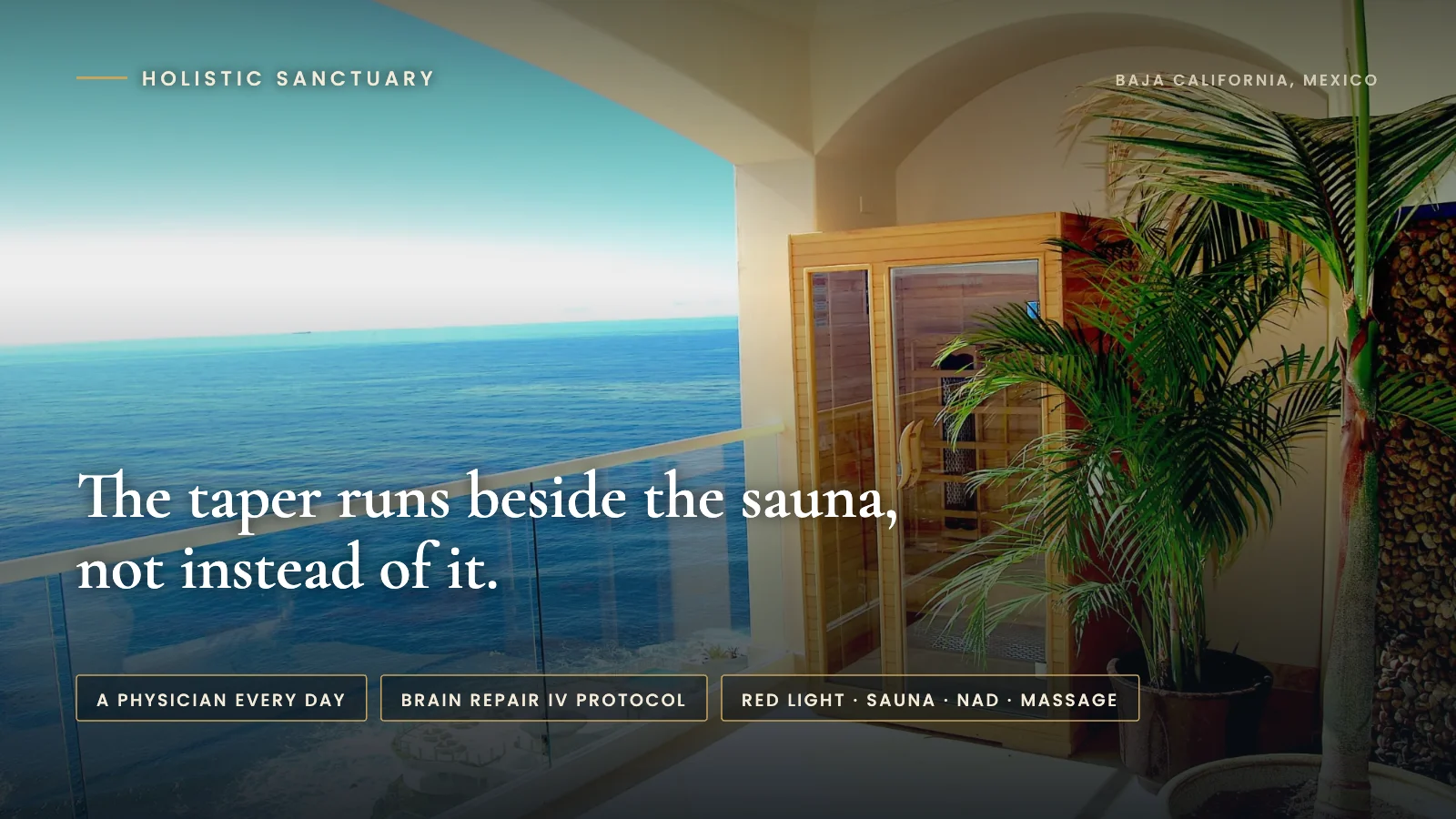
The high functioning anxiety is treated in the same months, without a receptor. Around nine hours of holistic therapy a day: massage, reiki, morning yoga, hyperbaric oxygen, red light therapy, infrared sauna, NAD IV infusions, the Brain Repair IV protocol our founder developed for exactly this work, running side by side with the taper, coffee enemas and daily Dead Sea salt baths, individualized rather than identical.
There is no group therapy, no talk therapy in place of medicine, no psychobabble, and no strategy of replacing the benzodiazepine with another dependence-forming medication. There is no alcohol on the property. Privacy is absolute, because the high functioning person’s greatest fear is being seen, and the executive program is built around that.
Every guest sleeps in a private oceanfront suite on organic sheets, eats organic food with no seed oils and no processed food, and is, for the first time in years, unreachable and unhurried. Where the claim stops on high functioning anxiety: we do not claim to cure anxiety, we do not publish a success percentage, and we do not promise that a taper begun after ten years will be finished in twelve weeks.
What we can say is that the program is designed around that window, that we have run it for fifteen years, and that the person who has performed calm for a decade with a bottle in the drawer is, in my experience, the person for whom a slower, smoother, supervised taper in a place built for it, with the anxiety treated at the same time, is the first thing that holds.
For the drug itself, read the Xanax taper, Ativan withdrawal and the Klonopin taper; for the structure of treatment, how benzodiazepine treatment is built here; for the condition, the anxiety program. Admission is by medical clearance.
Frequently Asked Questions
What is high functioning anxiety?
Not a formal diagnosis but a common profile: an anxiety disorder, usually generalized anxiety disorder, in a person who channels the worry into achievement and so looks fine from the outside. NIMH estimates 2.7 percent of American adults have GAD in a given year, and about two thirds of them are not seriously impaired.
Why do people with high functioning anxiety end up dependent on benzodiazepines?
Because the drug works immediately and asks nothing of the schedule, and because the person looks well enough that the prescription is renewed for years. Benzodiazepines were approved for short-term use; the Ativan label says effectiveness beyond four months has not been studied, and the FDA says physical dependence can develop within days to weeks of steady use.
Can a benzodiazepine make anxiety worse?
Yes. With daily use the brain reduces its own GABA sensitivity, so the anxiety returns underneath the dose, and with short-acting drugs the level falls between doses, producing interdose withdrawal that feels exactly like an anxiety attack. Anxiety that keeps the drug’s timetable is withdrawal, not the disorder.
What are the warning signs of benzodiazepine dependence?
A dose that has crept, anxiety that arrives before the next dose and lifts after it, using the drug for sleep or social situations it was not prescribed for with alcohol alongside, and more fear of a week without it than of the original anxiety. Two of the four mean a physician and a slow taper.
What actually reduces anxiety without medication?
For high functioning anxiety as for any anxiety, meta-analyses of randomized trials support exercise (Stubbs 2017), yoga (Cramer 2018) and massage (Field 2014) for reducing anxiety symptoms, and regular sauna bathing has been associated with lower cardiovascular and all-cause mortality. None replaces a physician during a taper; all act on the nervous system without producing tolerance or withdrawal.
How does Holistic Sanctuary treat high functioning anxiety with benzodiazepine dependence?
A physician-managed, individualized taper adjusted daily within a twelve-to-sixteen-week residential program, one guest to one clinical team, nursing around the clock, medical screening before admission, the anxiety treated at the same time with nine hours of holistic therapy a day, absolute privacy, no group or talk therapy, and no substitute sedative. No outcome is promised.
References
- National Institute of Mental Health. Generalized Anxiety Disorder: Statistics. nimh.nih.gov
- Ativan (lorazepam) tablets, prescribing information. DailyMed, U.S. National Library of Medicine. dailymed.nlm.nih.gov
- U.S. Food and Drug Administration. FDA requiring Boxed Warning updated to improve safe use of benzodiazepine drug class. 2020. fda.gov
- Ashton H. Benzodiazepines: How They Work and How to Withdraw (the Ashton Manual), Chapters I–III. 2002. benzo.org.uk
- Olfson M, King M, Schoenbaum M. Benzodiazepine use in the United States. JAMA Psychiatry. 2015;72(2):136–142. jamanetwork.com
- Vinkers CH, Olivier B. Mechanisms underlying tolerance after long-term benzodiazepine use. Adv Pharmacol Sci. 2012. pubmed.ncbi.nlm.nih.gov
- Brunner E, et al. Joint Clinical Practice Guideline on Benzodiazepine Tapering: Considerations When Risks Outweigh Benefits. J Gen Intern Med. 2025. link.springer.com
- Stubbs B, et al. An examination of the anxiolytic effects of exercise for people with anxiety and stress-related disorders: a meta-analysis. Psychiatry Res. 2017;249:102–108. pubmed.ncbi.nlm.nih.gov
- Cramer H, et al. Yoga for anxiety: a systematic review and meta-analysis of randomized controlled trials. Depress Anxiety. 2018;35(9):830–843. pubmed.ncbi.nlm.nih.gov
- Field T. Massage therapy research review. Complement Ther Clin Pract. 2014. pmc.ncbi.nlm.nih.gov
- Laukkanen T, et al. Association between sauna bathing and fatal cardiovascular and all-cause mortality events. JAMA Intern Med. 2015. jamanetwork.com
Medical disclaimer: this page is general information about anxiety and benzodiazepine dependence and is not medical advice or a diagnosis. Do not stop, reduce, or substitute a prescribed benzodiazepine without a physician; abrupt discontinuation can be life-threatening. Holistic Sanctuary does not diagnose, treat, or cure disease; individual results vary and no outcome is promised. In an emergency call 911. If you are thinking about suicide, call or text 988.