Treatment Resistant Depression: What the Research Shows, and What Has Changed
September 5, 2026
High Functioning Anxiety and Benzodiazepine Dependence: When the Prescription Becomes the Condition
September 5, 2026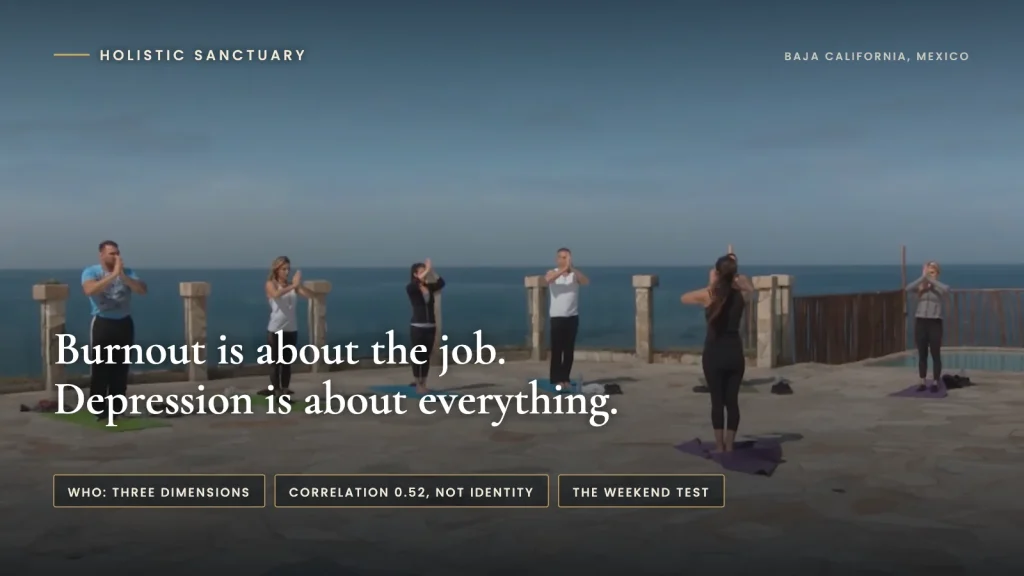

Burnout vs Depression: How to Tell the Difference, and Why It Matters
 Johnny Tabaie, Founder & CEO, Holistic Sanctuary·Medically reviewed by
  Dr. Jose A. Jimenez, MD, Medical Director·Published · Last medically reviewed
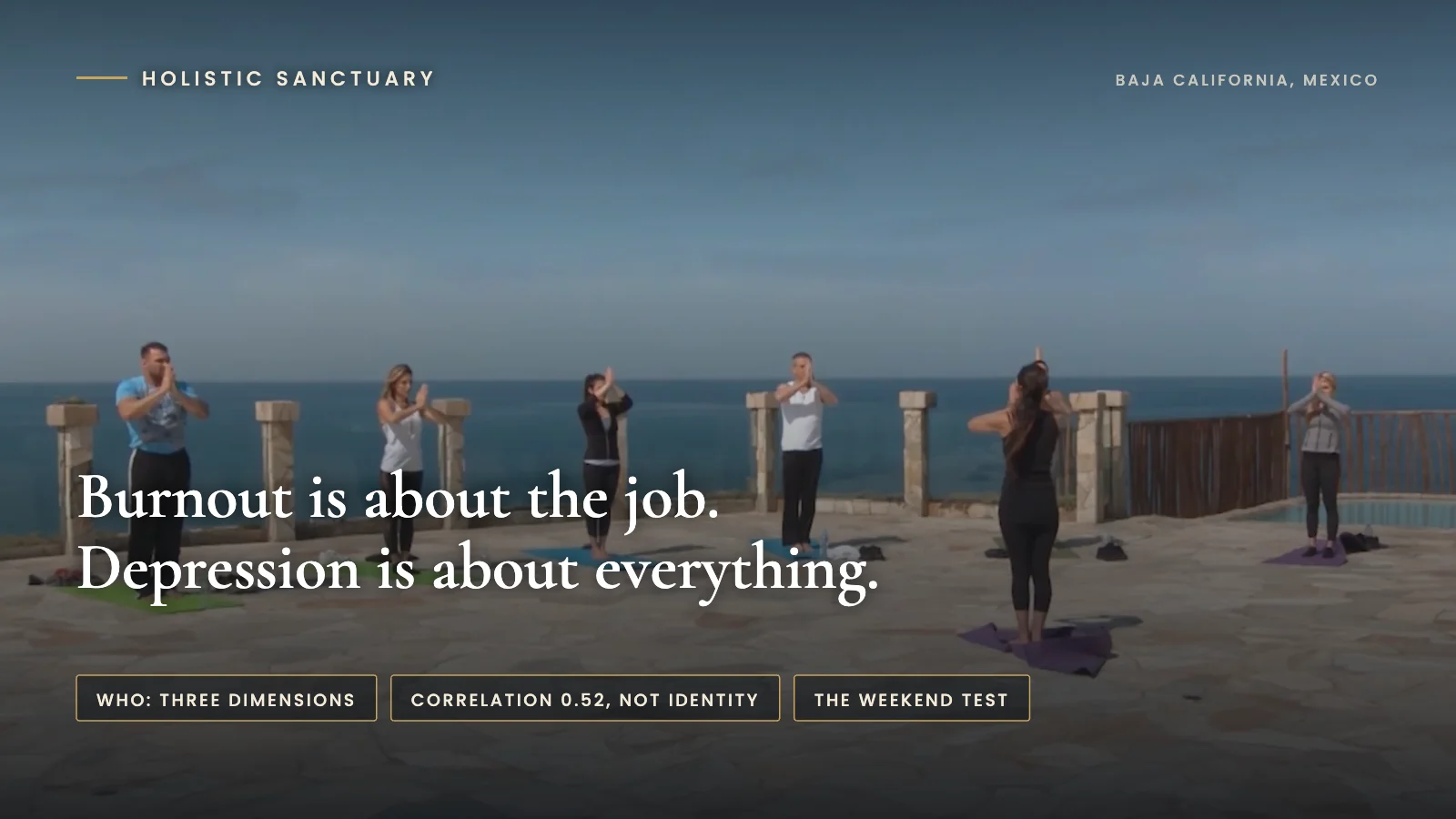
 Burnout is about the job. Depression is about everything. The two overlap so heavily that the research is still arguing, and they differ in exactly the ways that decide what should happen next.
Read This Part First
Burnout vs depression is the question most of the executives who call here have already asked their doctor and been given the wrong answer to, in one of two directions. Either the exhaustion was called depression and answered with an antidepressant, or the depression was called burnout and answered with a vacation, and in both cases the person is back on the phone a year later, worse. The two conditions overlap so heavily that the research literature is still arguing about whether they are different things at all; and they differ in exactly the ways that decide what should happen next.
This page sets out what burnout is according to the body that defines it, what depression is, where the research says the two overlap and where it says they part, six honest ways to tell them apart, why the distinction matters, and how both are approached at Holistic Sanctuary.
The non-negotiable first: if you are thinking about suicide, that is not burnout, and it is not a question of definitions. Call or text 988. And do not stop an antidepressant or a benzodiazepine on your own; changes to either are made by a physician, gradually.
What Burnout Is, According to the WHO
In May 2019 the World Health Organization included burn-out in the eleventh revision of the International Classification of Diseases, and was careful about what it was doing. Burnout is classified as an occupational phenomenon, not a medical condition. It is defined as a syndrome resulting from chronic workplace stress that has not been successfully managed, with three dimensions: feelings of energy depletion or exhaustion; increased mental distance from one’s job, or feelings of negativism or cynicism related to it; and reduced professional efficacy. The WHO adds that burn-out refers specifically to phenomena in the occupational context and should not be applied to describe experiences in other areas of life.
That definition carries the first clue in the burnout vs depression question. Burnout, by definition, is about work: it is the job that is exhausting, the job that is being held at a cynical distance, the job that is no longer being done well. A person with burnout can, at least at first, still enjoy the weekend, the children, the tennis. Depression does not respect that boundary. It arrives at the weekend too.
What Depression Is
The other half of burnout vs depression is a medical condition with diagnostic criteria: at least two weeks of depressed mood or loss of interest or pleasure in nearly all activities, most of the day, nearly every day, together with several of a list that includes changes in sleep and appetite, fatigue, feelings of worthlessness or excessive guilt, difficulty concentrating, slowed or agitated movement, and recurrent thoughts of death. It is not a reaction to a particular stressor, though a stressor can set it off; it is a state that persists after the stressor is removed, colors everything, and in its severe forms carries a risk of death.
The overlap with burnout is obvious on the page. Exhaustion, difficulty concentrating, and a loss of engagement appear in both. The differences are in the reach and the depth: depression’s loss of pleasure is global rather than occupational, its guilt and worthlessness are turned inward rather than outward at an employer, and its thoughts of death are its own. That is why the burnout vs depression question cannot be answered by counting symptoms; it is answered by asking where they live.
Where the Research Agrees and Disagrees
The honest position on burnout vs depression is that the science is divided, and a page that pretends otherwise is selling something. Bianchi, Schonfeld and Laurent’s 2015 review in Clinical Psychology Review concluded that the current state of the art suggests the distinction between burnout and depression is conceptually fragile, and that evidence for burnout’s distinctiveness has been inconsistent, with the most recent studies casting doubt on it. In their reading, burnout at its severe end is depression that has been given a more acceptable name.
Koutsimani, Montgomery and Georganta’s 2019 systematic review and meta-analysis in Frontiers in Psychology reached the opposite conclusion from a pooled analysis of the studies: burnout and depression correlated at 0.52, burnout and anxiety at 0.46, and the authors concluded that these are different and robust constructs, meaningfully associated but not the same disorder. A correlation of 0.52 is exactly the kind of number that supports both camps: strong enough that half of what one measures the other measures too, weak enough that a great deal is left over.
What both sides of the burnout vs depression debate agree on is the clinical point. Severe burnout and depression frequently coexist, one can become the other, and mislabeling either leads to the wrong treatment. The burnout vs depression question is therefore not academic. A person told they are depressed when they are burned out is medicated for a job; a person told they are burned out when they are depressed is sent on holiday with an illness that will follow them there.
Six Honest Ways to Tell Burnout vs Depression Apart
These are the questions asked at intake here, and none of them is a diagnosis; a physician makes that. First, the weekend test: does the exhaustion lift, even partly, when you are away from work for two days, or does it follow you? Burnout lifts, at least early on. Depression does not. Second, the pleasure test: can you still enjoy anything, the food, the sea, a friend, when work is not in the picture? Loss of pleasure across the board is depression’s signature.
Third, the direction of the blame. Burnout’s cynicism points outward, at the company, the client, the industry; depression’s guilt points inward, at the self, and it is disproportionate. Fourth, the body. Both bring fatigue and broken sleep, but marked appetite change, slowed movement, and early-morning waking with dread belong more to depression. Fifth, the thoughts. Burnout produces fantasies of quitting; depression produces thoughts of not existing, and the moment those appear, the burnout vs depression question is over and the answer is a physician today.
Sixth, and the one nobody asks: what are you drinking and taking to get through it? The alcohol at night, the benzodiazepine for the flight, the stimulant for the morning, the sleeping pill for the trip home. Every one of those blurs the picture, because alcohol and benzodiazepines produce a depression of their own and their withdrawal produces the anxiety and insomnia of both conditions.
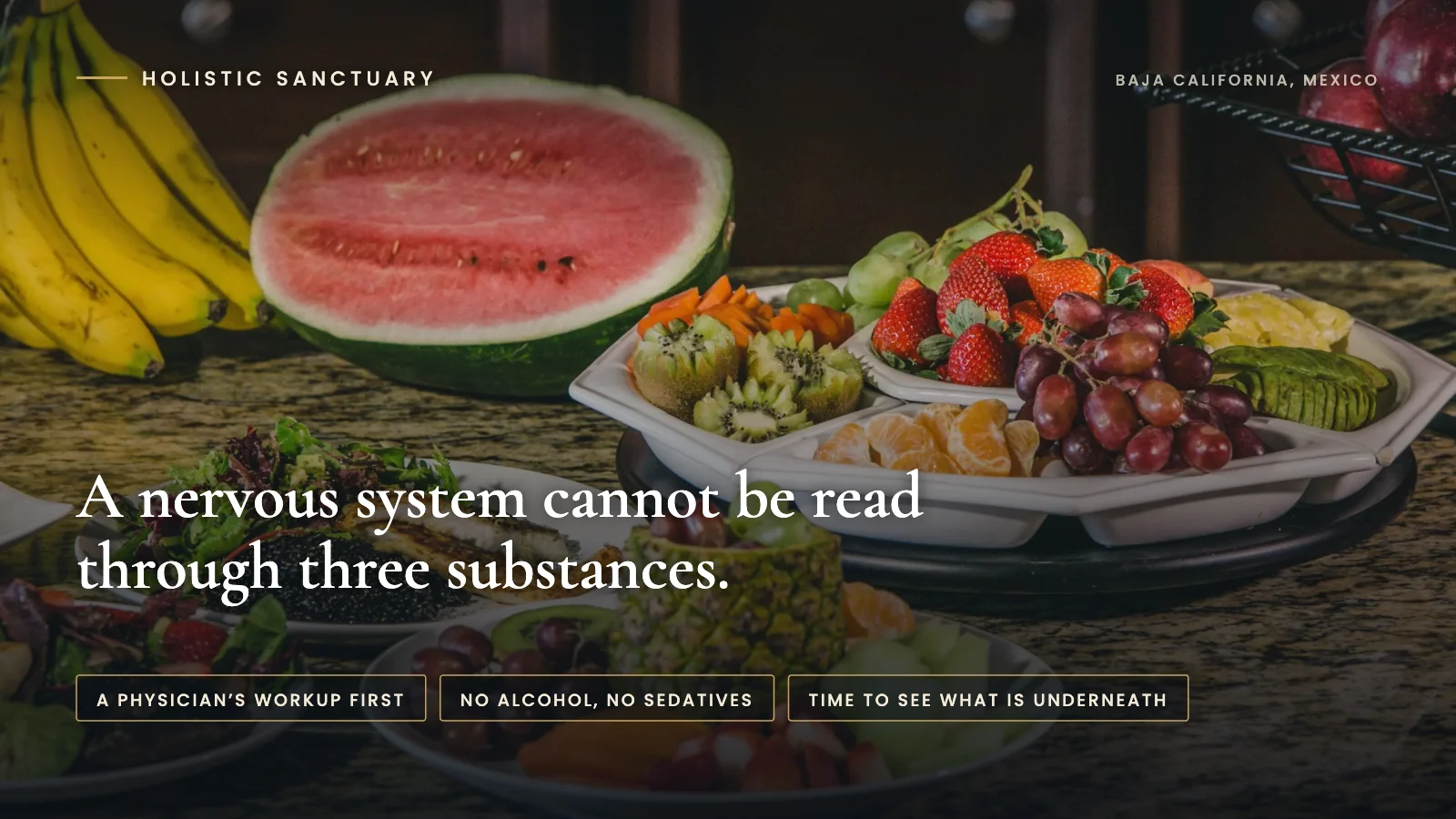
In fifteen years of intake conversations, the person who cannot tell whether they are burned out or depressed is very often a person whose nervous system is being pushed in three directions by three substances, and no one can read the underlying condition until those are addressed.
Why the Distinction Matters, Especially at the Top
The people most exposed to the burnout vs depression confusion are the ones least likely to be asked the questions. Shanafelt and colleagues’ 2012 national survey in Archives of Internal Medicine found that 45.8 percent of American physicians reported at least one symptom of burnout, higher than the general working population. Krill, Johnson and Albert’s 2016 study of nearly thirteen thousand American lawyers found 28 percent with depression, 19 percent with anxiety, and 20.6 percent screening positive for problematic drinking.
Oreskovich and colleagues’ 2012 survey of American surgeons found alcohol abuse or dependence in about one in seven, more often in those reporting burnout and depression. These are people whose jobs punish the admission of either condition and reward the substances that mask both.
For that person, getting the burnout vs depression question wrong is expensive in both directions. Treating burnout as depression medicates a structural problem and adds a drug with its own withdrawal to a person who did not need it. Treating depression as burnout sends a person with a potentially fatal illness to a resort and calls the next episode a relapse of stress. And treating either without addressing the alcohol and the sedatives is treating a photograph rather than a face. The right answer begins with a physician, a full medical picture, and enough time away from the substances and the schedule to see what is underneath.
How Burnout and Depression Are Approached Here
I will describe how the burnout vs depression question is handled at Holistic Sanctuary and then say where the claim stops. It begins with a physician and a workup: bloodwork including thyroid and inflammatory markers, blood pressure, an EKG, a stress test and an echocardiogram reviewed by our medical director, a full history of sleep, alcohol, medications and work, and the six questions above asked properly, by one clinician, over more than fifteen minutes.
If alcohol or a benzodiazepine is part of the picture, that is addressed first, slowly and medically, because the underlying condition cannot be read until it is. Antidepressant changes, where they are made, are made by the physician and gradually.
Then the program, which for burnout vs depression is the same in structure and different in emphasis. Programs here run four to twelve weeks, a minimum of four and an average of twelve, and longer when a case needs it, one guest to one clinical team, with around nine hours of holistic therapy a day: massage, reiki, yoga, hyperbaric oxygen, red light therapy, infrared sauna, NAD IV infusions, the Brain Repair IV protocol our founder developed, coffee enemas and daily Dead Sea salt baths, individualized rather than identical.
There is no group therapy, no talk therapy in place of medicine, and no psychobabble. Privacy is absolute, which for an executive is not a luxury but the condition of coming at all; the executive program is built around it.
For guests with depression for whom it is appropriate, and only after that screening, licensed and medically supervised psychedelic therapy is available under a physician, which is the subject of its own pages and its own exclusion criteria. Every guest sleeps in a private oceanfront suite on organic sheets, eats organic food with no seed oils and no processed food, and is, for the first time in years, unreachable.
Where the claim stops on burnout vs depression: we do not diagnose over the phone, we do not claim to cure either condition, we do not publish a success percentage, and we do not promise that twelve weeks will settle a question that a year of appointments did not.
What we can say is that the workup is real, the substances are removed, the program is long enough to see what is underneath, and that people who have been bounced between the two labels are, in my experience, the people for whom a longer, individual, medically supervised program that treats the whole body is the first one that answers the question.
Read about the mental health program and treatment resistant depression. Admission is by medical clearance.
Frequently Asked Questions
What is the difference between burnout and depression?
The WHO defines burnout as an occupational phenomenon, not a medical condition: exhaustion, cynicism and reduced efficacy tied specifically to work. Depression is a medical condition whose loss of mood and pleasure is global, persists away from the stressor, turns guilt inward, and can carry thoughts of death. They overlap heavily and often coexist.
Is burnout just depression with a nicer name?
The research is divided. A 2015 review concluded the distinction is conceptually fragile; a 2019 meta-analysis found a correlation of 0.52 and concluded they are different and robust constructs. Both agree that severe burnout and depression frequently coexist and that mislabeling leads to the wrong treatment.
How can I tell if I am burned out or depressed?
Ask whether the exhaustion lifts away from work, whether you can still enjoy anything outside it, whether the blame points outward at the job or inward at yourself, whether appetite and early waking have changed, whether there are thoughts of not existing, and what you are drinking or taking to cope. A physician makes the diagnosis; those questions tell you how urgently to see one.
Can burnout turn into depression?
Yes, and that is why burnout vs depression is not a fixed line. Prolonged, unmanaged burnout is associated with the development of depression, and the two frequently coexist in the same person. That is one reason both sides of the research agree the distinction matters clinically.
Why does alcohol make it hard to tell?
Because in the burnout vs depression picture, alcohol and benzodiazepines produce a depression of their own, and their withdrawal produces the anxiety, insomnia and fatigue of both burnout and depression. Until they are removed, under a physician, the underlying condition cannot be read.
How does Holistic Sanctuary approach burnout vs depression?
A physician’s workup first, substances addressed first, then a four-to-twelve-week individualized program, one guest to one clinical team, nine hours of holistic therapy a day, absolute privacy, no group or talk therapy, and, for depression where appropriate and after screening, licensed medically supervised psychedelic therapy. No outcome is promised.
References
- World Health Organization. Burn-out an “occupational phenomenon”: International Classification of Diseases. May 28, 2019. who.int
- Bianchi R, Schonfeld IS, Laurent E. Burnout–depression overlap: a review. Clin Psychol Rev. 2015;36:28–41. pubmed.ncbi.nlm.nih.gov
- Koutsimani P, Montgomery A, Georganta K. The relationship between burnout, depression, and anxiety: a systematic review and meta-analysis. Front Psychol. 2019;10:284. frontiersin.org
- Shanafelt TD, et al. Burnout and satisfaction with work-life balance among US physicians relative to the general US population. Arch Intern Med. 2012;172(18):1377–1385. pubmed.ncbi.nlm.nih.gov
- Krill PR, Johnson R, Albert L. The prevalence of substance use and other mental health concerns among American attorneys. J Addict Med. 2016;10(1):46–52. pubmed.ncbi.nlm.nih.gov
- Oreskovich MR, et al. Prevalence of alcohol use disorders among American surgeons. Arch Surg. 2012;147(2):168–174. pubmed.ncbi.nlm.nih.gov
- Miller AH, Raison CL. The role of inflammation in depression: from evolutionary imperative to modern treatment target. Nat Rev Immunol. 2016;16(1):22–34. pubmed.ncbi.nlm.nih.gov
- U.S. Food and Drug Administration. FDA requiring Boxed Warning updated to improve safe use of benzodiazepine drug class. 2020. fda.gov
Medical disclaimer: this page is general information about burnout and depression and is not medical advice or a diagnosis. Do not stop or change an antidepressant or benzodiazepine without a physician. Holistic Sanctuary does not diagnose, treat, or cure disease; individual results vary and no outcome is promised. Psychedelic therapies are provided only where legal, after medical screening, under physician supervision, and are not approved by the FDA for these uses. In an emergency call 911. If you are thinking about suicide, call or text 988.