Tapering Off Xanax: The Half-Life Problem, and Why Fast Tapers Fail
September 5, 2026
The Ashton Manual, Explained
September 5, 2026

Ativan (Lorazepam) Withdrawal and Side Effects: What the Research Shows
 Johnny Tabaie, Founder & CEO, Holistic Sanctuary·Medically reviewed by
  Dr. Jose A. Jimenez, MD, Medical Director·Published · Last medically reviewed
 Lorazepam leaves the body in about twelve hours and is ten times as potent as diazepam by weight. Those two facts explain most of what the research shows about Ativan withdrawal, and most of why home tapers fail.
Read This Part First
Ativan withdrawal is misunderstood in a specific way. Lorazepam, the drug inside the Ativan tablet, is usually described as a “milder” or “cleaner” benzodiazepine because the liver handles it simply and it leaves the body in about twelve hours. Both of those facts are true, and both of them are the reason Ativan withdrawal can be so hard: a drug that leaves in twelve hours produces withdrawal in twelve hours, and a drug that is ten times as potent as diazepam by weight makes a one-milligram tablet a much larger dose than it looks.
This page sets out what the research shows about how lorazepam works, its side effects in the short and the long term, what Ativan withdrawal looks like and why, how a safe taper is built, and how we treat lorazepam dependence here.
The non-negotiable first: do not stop Ativan abruptly and do not run a taper on your own. The FDA’s boxed warning for the benzodiazepine class states that abrupt discontinuation or rapid dose reduction can cause withdrawal reactions that are life-threatening, including seizures, and the Ativan label itself instructs prescribers to use a gradual taper to discontinue the drug or reduce the dose. If you are thinking about suicide, call or text 988.
What Ativan Is and How It Works
Ativan is the brand name for lorazepam, a benzodiazepine approved for the management of anxiety disorders and for the short-term relief of anxiety symptoms. Like every benzodiazepine, it works by amplifying the effect of GABA, the brain’s main inhibitory neurotransmitter, at the GABA-A receptor, which is why it calms anxiety, relaxes muscle, prevents seizures and produces sleep, and why it also produces sedation, memory impairment and, with daily use, tolerance.
Those same properties are what make Ativan withdrawal what it is. The tablet comes in 0.5 mg, 1 mg and 2 mg strengths; the label says most patients with anxiety start at 2 to 3 mg a day in divided doses, and that older or debilitated patients should start at 1 to 2 mg a day.
Two properties set lorazepam apart from the other benzodiazepines people commonly ask about. The first is how it is metabolized. Lorazepam is conjugated directly in the liver into lorazepam glucuronide and excreted in the urine; the glucuronide has no demonstrable central nervous system activity. There are no active metabolites lingering for days, which is why clinicians favor it in older adults and in liver disease. The second is its half-life: about twelve hours for unconjugated lorazepam, according to the label, which puts it between Xanax at roughly eleven hours and Klonopin at thirty to forty.
The third property is potency, and it is the one people underestimate. The Ashton Manual’s equivalence table puts 1 mg of lorazepam at approximately 10 mg of diazepam. A person taking 3 mg of Ativan a day is, in diazepam terms, taking around 30 mg, a substantial dose. And a fact from the label that almost no one is told at the pharmacy counter: the effectiveness of Ativan in long-term use, meaning more than four months, has not been assessed by systematic clinical studies. The drug was approved for short-term relief. Most of the people who arrive here have been taking it for years.

Ativan Side Effects: The Short Term
The common side effects of lorazepam follow directly from what it does. Sedation is the most frequent, followed by dizziness, weakness and unsteadiness, which matter more than they sound because unsteadiness in a person over sixty-five is a fall waiting to happen. Griffin and colleagues’ 2013 review of benzodiazepine pharmacology describes the same set of central nervous system effects across the class: drowsiness, impaired coordination, slowed reaction time and reduced concentration, all dose-dependent, all worse when combined with alcohol or any other central nervous system depressant. None of these is Ativan withdrawal; they are the drug working, and they are the reason the label says dose and duration should be individualized.
Memory is the side effect people notice last and mind most. Benzodiazepines produce anterograde amnesia, a reduced ability to form new memories while the drug is active, and lorazepam is among the drugs most studied for it; the label warns about it specifically. Less commonly, benzodiazepines produce paradoxical reactions, meaning agitation, irritability, disinhibition or aggression rather than calm, most often in children, in older adults and at higher doses.
And the label warns that the combination of lorazepam with alcohol or other central nervous system depressants can produce profound sedation, respiratory depression, coma and death, which is why the alcohol question is asked at every intake here and answered honestly or not at all.
Long-Term Side Effects: Tolerance, Dependence and Cognition
The long-term side effects are the ones the label was not designed to capture, because the label’s own evidence stops at four months. The first is tolerance. With daily use the brain adapts to the constant amplification of GABA by reducing its own GABA sensitivity, a process Vinkers and Olivier describe in their 2012 review; the same dose does less, the anxiety returns underneath it, and the person concludes the disorder is worse when in fact the drug has stopped working.
The second is physical dependence, which is not addiction and does not require misuse: it is the state in which the brain now needs the drug to feel normal, and it develops in a matter of weeks at ordinary prescribed doses. Dependence is the precondition for Ativan withdrawal, and it is not a character flaw.
The third is the association with dementia, and it deserves to be stated carefully. In 2014 Billioti de Gage and colleagues published a case-control study in the BMJ comparing 1,796 people with Alzheimer’s disease against 7,184 matched controls in Quebec. Ever having used a benzodiazepine was associated with roughly fifty percent higher odds of an Alzheimer’s diagnosis; more than 180 prescribed daily doses, about six months of use, carried an odds ratio of 1.84, and long-acting drugs carried a higher ratio than short-acting ones.
The authors were explicit that a case-control study cannot prove causation and that benzodiazepine use might be an early marker of a dementia that was already beginning. It remains an association. It is also a reason not to stay on lorazepam for years by default, and a reason to plan the eventual Ativan withdrawal carefully rather than never.
The fourth is the verdict of geriatric medicine. The American Geriatrics Society’s 2023 Beers Criteria, the standard list of medications that are potentially inappropriate in older adults, lists benzodiazepines as drugs to avoid in people sixty-five and older, citing increased sensitivity, slower metabolism, and the risks of cognitive impairment, delirium, falls, fractures and motor vehicle crashes. Lorazepam, because it has no active metabolites, is often described as the “safer” benzodiazepine for older adults. The Beers Criteria do not exempt it.
Ativan Withdrawal: Why the Half-Life Matters
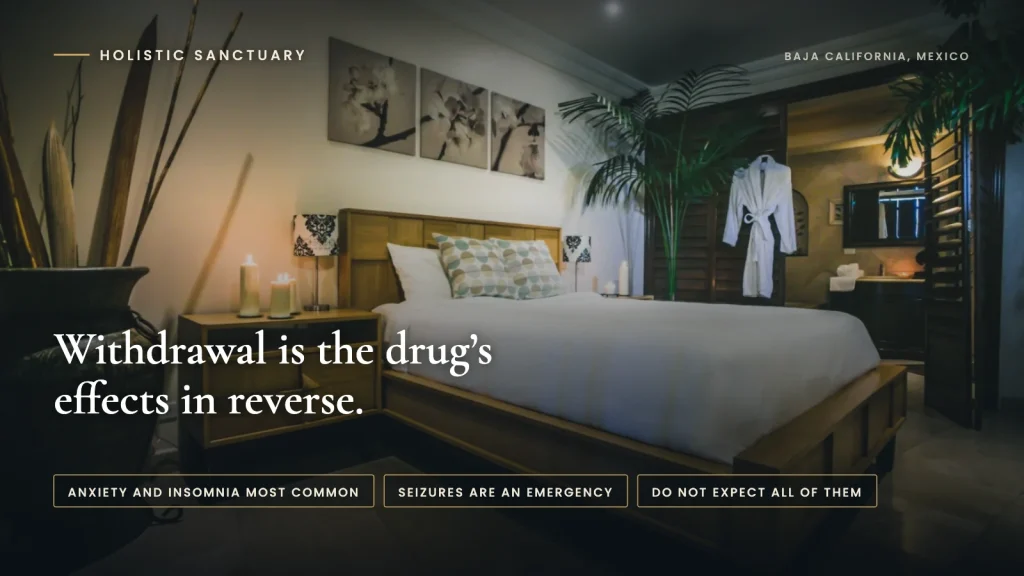
Ativan withdrawal is the mirror image of what the drug does. When GABA is no longer being amplified in a brain that has reduced its own GABA sensitivity, the result is a nervous system without enough brake: anxiety worse than the original, insomnia, tremor, sweating, a racing heart, muscle pain and stiffness, sensory hypersensitivity to light and sound, nausea, perceptual distortions, and, in the most serious cases, seizures and delirium. Pétursson’s 1994 review in Addiction sets out the syndrome in that order, from the common to the dangerous, and notes that the syndrome’s severity tracks the dose, the duration of use and the speed of discontinuation.
The twelve-hour half-life shapes the timing. Because lorazepam leaves the body within a day or two, Ativan withdrawal after an abrupt stop typically begins within a day, peaks over the first several days and is at its most dangerous in that first week, which is when withdrawal seizures cluster. It also produces something people on the long-acting drugs rarely describe: interdose withdrawal, the return of anxiety, dread and tremor between scheduled doses, when the previous dose has worn off and the next is hours away.
A person on Ativan three times a day is going through a small withdrawal three times a day, and a taper that ignores that rhythm is a taper that fails.
The FDA’s 2020 boxed warning is the authority for the seriousness of all of this. It states that continued use of benzodiazepines can lead to clinically significant physical dependence, that abrupt discontinuation or rapid dose reduction can precipitate acute withdrawal reactions which can be life-threatening, and that some patients experience a protracted withdrawal syndrome lasting weeks to more than twelve months. Ativan withdrawal is not a matter of willpower. It is a physiological event with a known and sometimes fatal course, and it is managed by a physician or it is gambled with.
The Ativan Withdrawal Timeline
No two timelines are the same, and I will not pretend otherwise. What the literature supports is a shape. In the first one to three days after a reduction or an abrupt stop, the acute phase begins: rebound anxiety, insomnia and agitation, and in the case of an abrupt stop from a substantial dose, the window in which seizures are most likely.
Over the first two to four weeks the acute symptoms typically peak and begin to ease, though with a dose reduction rather than a stop, each cut produces its own smaller version of this arc, which is why an Ativan withdrawal done properly is a series of small waves rather than one large one.
Then there is the long tail. The Ashton Manual, drawn from twelve years of running a benzodiazepine withdrawal clinic, estimates that perhaps ten to fifteen percent of people who withdraw from long-term benzodiazepines develop a protracted syndrome, with anxiety, insomnia, sensory and motor symptoms that wax and wane in windows and waves for months, and in a minority for a year or more. The FDA’s boxed warning uses similar language.
That tail is why the question “how long does Ativan withdrawal last” has no honest single answer, and why the speed of the taper matters so much: rapid withdrawals and repeated cycles of withdrawal and reinstatement are associated with worse and longer syndromes. For the full week-by-week picture, read the benzo withdrawal timeline; for the long tail, protracted benzodiazepine withdrawal.
How Ativan Is Tapered Safely
The 2025 joint clinical practice guideline on benzodiazepine tapering, developed by the American Society of Addiction Medicine with a coalition of other medical societies, recommends reductions of five to ten percent of the current dose every two to four weeks, states that the taper should typically not exceed twenty-five percent in any two weeks, advises slowing further as the dose gets low, and is explicit that benzodiazepines should not be discontinued abruptly in anyone likely to be dependent.
It acknowledges that a full taper may take months to years for people on high doses over long periods, and it discusses switching a patient from a short-acting benzodiazepine to a longer-acting one as an option to consider.
For lorazepam specifically, the Ashton Manual is emphatic. Heather Ashton favored gradual substitution of diazepam for shorter-acting benzodiazepines, lorazepam among them, because diazepam’s long half-life smooths the peaks and troughs that make an Ativan withdrawal so punishing, and because its small tablet sizes and liquid form allow the tiny reductions needed at the end, where a 0.5 mg lorazepam tablet is a 5 mg diazepam-equivalent step.
The substitution is done one dose at a time over weeks, under a physician, never as a single swap. Whether to substitute at all is a medical decision, and both sources agree on the principle that undoes most home tapers: the pace is set by the person’s response, not by the calendar.
Three practical rules hold for any Ativan withdrawal, whatever the schedule. A cut is never made while the previous one is still being felt. The end of the taper is the slowest part, because the last milligram is proportionally the largest cut. And a cut that goes wrong, meaning escalating panic, no sleep at all, tremor, confusion or a racing heart that will not settle, is reported to the physician the same day, whose usual answer is to hold or to return to the previous step and hold longer, not to reinstate at a high dose.
Seizure activity, confusion or hallucinations are an emergency room tonight. Do not add alcohol, and do not add a sleeping pill, most of which act on the same receptor under a different name.

How We Treat Ativan Dependence Here
I will describe how lorazepam dependence is treated here and then say where the claim stops. Programs at Holistic Sanctuary for benzodiazepine dependence are built around twelve to sixteen weeks in residence, one guest to one clinical team, with a physician managing the taper and licensed nurses present twenty-four hours a day. The taper follows the same principle as the guideline, gradual and individualized, but it is adjusted day by day rather than month by month, because the physician is here and so are you, and the decision about substituting a longer-acting drug is made by that physician against your history rather than by a forum.
What we do not do is as important as what we do. There is no group therapy here. There is no talk therapy, and no psychobabble in place of medicine. There is no strategy of replacing one dependence-forming medication with another as the treatment. Ativan withdrawal is treated as what the research says it is, a nervous system that has lost its own brake and needs time, safety and support to rebuild it, and the fifteen years we have spent doing this one thing, one guest at a time, are the reason people who have failed three home tapers come here for the fourth.
That support is the Brain Repair IV protocol, a proprietary intravenous protocol our founder developed for exactly this work, running side by side with red light therapy, infrared sauna, NAD, daily massage, reiki and morning yoga, the evidence for each of which is set out honestly, with its limits, on the timeline page. Every guest is screened before anything is administered: bloodwork, blood pressure, an EKG, a stress test and an echocardiogram reviewed by our medical director.
Every guest sleeps in a private oceanfront suite on organic sheets and eats organic food with no seed oils and no processed food, because a body rebuilding its GABA system should not be asked to do it on a cafeteria diet.
Where the claim stops on Ativan withdrawal: we do not claim to change anyone’s biology, we do not publish a success percentage, and we do not promise that your Ativan withdrawal will be finished in twelve weeks. What we can say is that the program is designed around that window, that we have run it for fifteen years, and that a slower, smoother, supervised taper in a place built for it is, in my experience, the version that holds.
For the structure of treatment, read how benzodiazepine treatment is built here; for the pillar, benzodiazepine withdrawal; and for the two drugs most often compared with lorazepam, the Xanax taper and the Klonopin taper. Admission is by medical clearance.
Frequently Asked Questions
How long does Ativan withdrawal last?
Because lorazepam’s half-life is about twelve hours, acute Ativan withdrawal typically begins within a day of a reduction or stop, peaks over the first several days and eases over two to four weeks. The Ashton Manual estimates that perhaps ten to fifteen percent of long-term users develop a protracted syndrome lasting months, and the FDA’s boxed warning describes protracted withdrawal lasting weeks to more than twelve months. A slow, supervised taper is associated with shorter and milder syndromes.
Is Ativan withdrawal dangerous?
Yes, Ativan withdrawal can be dangerous. The FDA’s boxed warning states that abrupt discontinuation or rapid dose reduction of a benzodiazepine can cause life-threatening withdrawal reactions including seizures, and the Ativan label instructs prescribers to use a gradual taper. Never stop Ativan abruptly; seizure activity, confusion or hallucinations during a taper mean an emergency room tonight.
What are the most common Ativan side effects?
Sedation, dizziness, weakness and unsteadiness are the most common, followed by memory impairment, especially difficulty forming new memories while the drug is active. With daily use, tolerance and physical dependence develop. Older adults are at higher risk of falls, fractures and confusion, which is why the 2023 Beers Criteria list benzodiazepines as drugs to avoid over sixty-five.
How much Ativan equals Valium?
For Ativan withdrawal planning, the Ashton Manual’s equivalence table puts 1 mg of lorazepam at approximately 10 mg of diazepam. That potency is why a 0.5 mg tablet is not a small step in a taper, and why physicians sometimes substitute diazepam gradually to allow smaller reductions at the end.
Does Ativan cause dementia?
A 2014 BMJ case-control study by Billioti de Gage and colleagues found roughly fifty percent higher odds of an Alzheimer’s diagnosis in people who had ever used a benzodiazepine, rising with cumulative dose. The authors stated that the study cannot prove causation and that benzodiazepine use may be an early marker of dementia. It is an association, not a proven cause, and a reason not to stay on lorazepam for years by default.
How does Holistic Sanctuary treat Ativan withdrawal?
A physician-managed, individualized taper adjusted daily within a twelve-to-sixteen-week residential program, one guest to one clinical team, nursing around the clock, medical screening before admission, and the Brain Repair IV protocol alongside red light therapy, infrared sauna, NAD, massage, reiki and yoga. No group therapy, no talk therapy, no outcome promised.
References
- Ativan (lorazepam) tablets. Prescribing information, Bausch Health US LLC. DailyMed, U.S. National Library of Medicine. dailymed.nlm.nih.gov
- U.S. Food and Drug Administration. FDA requiring Boxed Warning updated to improve safe use of benzodiazepine drug class. 2020. fda.gov
- Ashton H. Benzodiazepines: How They Work and How to Withdraw (the Ashton Manual), Chapters I–III. 2002. benzo.org.uk
- Brunner E, et al. Joint Clinical Practice Guideline on Benzodiazepine Tapering: Considerations When Risks Outweigh Benefits. J Gen Intern Med. 2025. link.springer.com
- American Society of Addiction Medicine. Benzodiazepine Tapering guideline page. asam.org
- Billioti de Gage S, et al. Benzodiazepine use and risk of Alzheimer’s disease: case-control study. BMJ. 2014;349:g5205. pmc.ncbi.nlm.nih.gov
- American Geriatrics Society 2023 updated AGS Beers Criteria for potentially inappropriate medication use in older adults. J Am Geriatr Soc. 2023. pubmed.ncbi.nlm.nih.gov
- Griffin CE, et al. Benzodiazepine pharmacology and central nervous system-mediated effects. Ochsner J. 2013. pmc.ncbi.nlm.nih.gov
- Vinkers CH, Olivier B. Mechanisms underlying tolerance after long-term benzodiazepine use. Adv Pharmacol Sci. 2012. pubmed.ncbi.nlm.nih.gov
- Pétursson H. The benzodiazepine withdrawal syndrome. Addiction. 1994;89(11):1455–1459. pubmed.ncbi.nlm.nih.gov
- Fluyau D, Revadigar N, Manobianco BE. Challenges of the pharmacological management of benzodiazepine withdrawal, dependence, and discontinuation. Ther Adv Psychopharmacol. 2018. pmc.ncbi.nlm.nih.gov
Medical disclaimer: this page is general information about lorazepam and is not medical advice or a taper schedule. Do not stop, reduce, or substitute a prescribed benzodiazepine without a physician; abrupt discontinuation can be life-threatening. Holistic Sanctuary does not diagnose, treat, or cure disease; individual results vary and no outcome is promised. In an emergency call 911. If you are thinking about suicide, call or text 988.